Rural Industrialization Schemes and MSME Employment Generation
Source:PIB ↗
Why It Matters
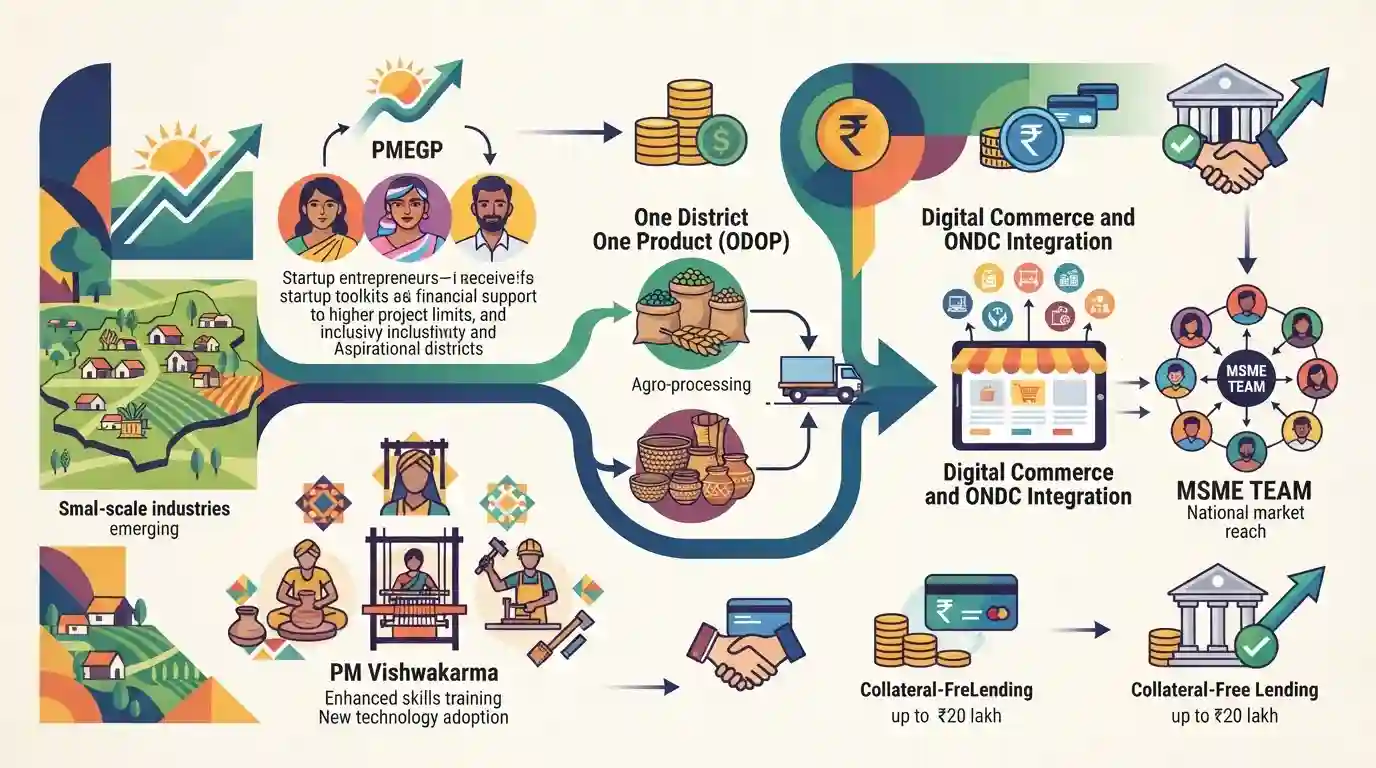
MSMEs are crucial for addressing regional imbalances and generating non-farm rural employment. The updates highlighted—particularly the inclusion of marginalized groups, enhanced project sizes under PMEGP, collateral-free credit mandates, and integration with digital infrastructure (ONDC)—reflect key policy shifts aimed at modernizing India's informal economy and promoting self-employment.
Summary
The Ministry of Micro, Small & Medium Enterprises (MoMSME) has outlined a multi-pronged strategy to drive rural industrialization, modernize traditional village industries, and check urban migration. Key initiatives include expanding the Prime Minister's Employment Generation Programme (PMEGP) with higher project limits and greater inclusivity (transgenders and Aspirational districts), scaling up PM Vishwakarma for traditional artisans, integrating MSMEs with ONDC via the MSME TEAM initiative, and utilizing the One District One Product (ODOP) framework under PMFME to boost regional agro-processing and handicrafts. Additionally, the Ministry has reiterated the RBI's collateral-free lending mandate for MSME loans up to ₹20 lakh to ease the credit flow.
Key Points
- The Ministry of MSME is enhancing the digital capabilities of local enterprises under the MSME TEAM (Trade Enablement and Marketing) initiative by onboarding micro and small enterprises (MSEs) onto the Open Network for Digital Commerce (ONDC) [1.1].
- The Procurement and Marketing Support (PMS) Scheme provides financial aid for trade fairs, National Workshops, barcode registration, and e-commerce platforms like MSME Global Mart to improve market access for regional handicrafts and agricultural products [1.1].
- PMEGP project cost limits have been significantly enhanced to support scaling up: from ₹25 lakh to ₹50 lakh for manufacturing, and from ₹10 lakh to ₹20 lakh for the services sector [1.1].
- To foster inclusive growth, PMEGP has expanded its 'Special Category' benefits (which offer higher subsidies) to include applicants from Aspirational districts and transgender individuals [1.1].
- In line with the RBI Master Directions, the Ministry re-emphasized that banks must not demand collateral security for PMEGP projects with credit requirements up to ₹20 lakh [1.1].
- The PM Vishwakarma Scheme provides holistic credit, skilling, and toolkit support targeting artisans and craftspeople across 18 traditional trades to promote local entrepreneurship and prevent youth migration [1.1].
- The PMFME Scheme utilizes the One District One Product (ODOP) approach to brand, package, and technologically upgrade micro food processing enterprises producing regional specialties like ginger, orthodox tea, and cardamom [1.1].
Prelims Trap
PM Vishwakarma is a Centrally Sponsored Scheme with shared funding between Center and States, implemented solely by the Ministry of MSME.
It is a 100% Central Sector Scheme fully funded by the Center, jointly implemented by MoMSME, MSDE, and the Department of Financial Services.
Static Concepts Connected
What distinguishes Central Sector Schemes from Centrally Sponsored Schemes?
- Funding source: Central Sector Schemes are 100% funded by the Union, whereas Centrally Sponsored Schemes have cost-sharing (e.g., 60:40) with States.
- Execution agency: Central Sector Schemes are executed by Union ministries directly, while Centrally Sponsored Schemes are implemented by State governments.
What is Priority Sector Lending and its MSME mandate?
- ANBC target: Commercial banks must allocate 40% of Adjusted Net Bank Credit to priority sectors, with 7.5% specifically reserved for Micro Enterprises.
- Collateral exemption: To ease credit flow, RBI mandates zero collateral requirement for Micro and Small Enterprises up to specified regulatory limits.
Cross-Topic Patterns
ONDC + Digital Public Infrastructure
Integrating MSMEs onto ONDC via the TEAM initiative shifts e-commerce from platform-centric monopolies to an open-network DPI, fostering inclusive retail growth.
Agglomeration economies + Rural industrialization
The ODOP framework under PMFME clusters micro-processors geographically, reducing supply-chain costs and linking local agricultural produce to global export markets.

Integration of ONDC (DPI) with MSME schemes and revised PMEGP/collateral-free credit limits will likely feature in 2026 Prelims.
Linked PYQs · 3
Linked PYQs · 3
- 2023MainsGS3
Faster economic growth requires increased share of the manufacturing sector in GDP, particularly of MSMEs. Comment on the present policies of the Government in this regard.
- 2023PrelimsGS1
Consider the following statements with reference to India: 1. According to the 'Micro, Small and Medium Enterprises Development (MSMED) Act, 2006', the 'medium enterprises' are those with investments in plant and machinery between ₹ 15 crore and ₹ 25 crore. 2. All bank loans to the Micro, Small and Medium Enterprises qualify under the priority sector. Which of the statements given above is/are correct?
- 2026PrelimsGS1
Which one of the following best describes the key objective of India's 'Open Network for Digital Commerce' (ONDC) initiative ?
