IndiaAI Mission and Digital Technology Adoption for MSME Productivity
Source:PIB ↗
Why It Matters
This intersects core GS3 themes of emerging technologies (AI) and economic development (MSME sector). Government interventions targeting MSMEs frequently feature in Mains exams (as seen in 2023). Understanding the pillars of the IndiaAI Mission is crucial for questions regarding India's digital public infrastructure and tech policy.
Summary
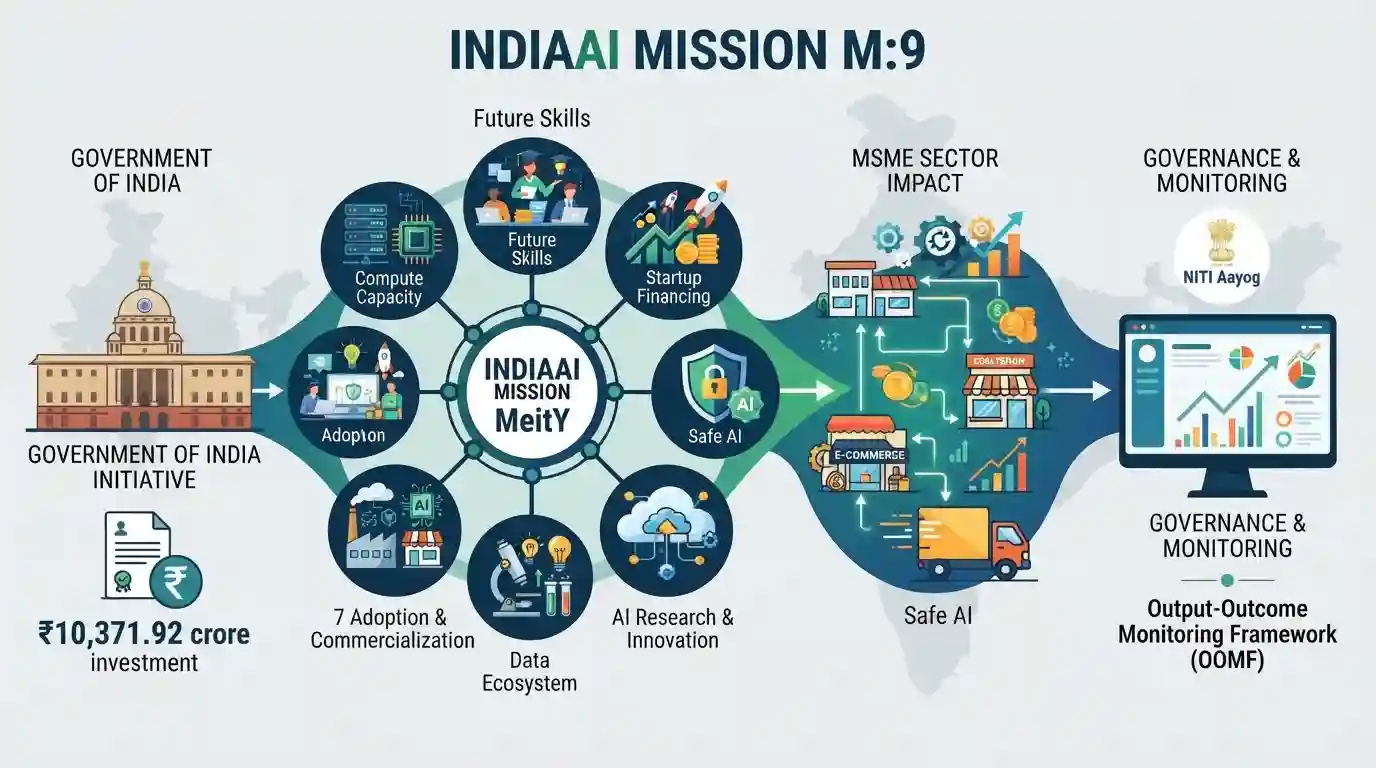
The Government of India is heavily promoting Artificial Intelligence (AI) and digital technology adoption to enhance productivity, specifically within the MSME sector, through the newly approved ₹10,371.92 crore IndiaAI Mission. Managed by the Ministry of Electronics and Information Technology (MeitY), the mission targets comprehensive growth across seven pillars—from compute capacity and future skills to startup financing and safe AI. Its overarching aim is to ensure responsible and inclusive AI growth while bolstering MSME competitiveness. To track the effectiveness of these interventions, outcomes are measured utilizing NITI Aayog's Output-Outcome Monitoring Framework (OOMF).
Key Points
- The IndiaAI Mission was approved in March 2024 with a budget of ₹10,371.92 crore to be implemented by MeitY.
- The mission is structured around seven pillars: Compute Capacity, Innovation Centre, Datasets Platform, Application Development Initiative, Future Skills, Startup Financing, and Safe & Trusted AI.
- A key goal of the mission is to democratize AI benefits, facilitating AI adoption in MSMEs to boost productivity, efficiency, and competitiveness.
- The government periodically evaluates digital technology adoption in the MSME sector in collaboration with industry and research institutions.
- Outcomes of government interventions are evaluated using NITI Aayog's Output-Outcome Monitoring Framework (OOMF).
Important Terms
IndiaAI Mission

An umbrella initiative under MeitY, approved in 2024 with a ₹10,371.92 crore outlay, designed to create a robust, democratic, and responsible artificial intelligence ecosystem in India across seven developmental pillars.
UPSC context
GS Paper 3 (Science and Technology); tests knowledge of national tech missions, AI governance, and digital infrastructure strategies.
Output-Outcome Monitoring Framework (OOMF)
A structured performance-monitoring tool coordinated by NITI Aayog's DMEO that maps the financial outlays of Central schemes to measurable, result-oriented physical outputs and socio-economic outcomes to ensure accountability.
UPSC context
GS Paper 2 (Governance) & GS Paper 3 (Budgeting); tests knowledge of output-outcome budgeting and executive monitoring.
NITI Aayog
The premier policy think tank of India, established in 2015 to replace the Planning Commission, facilitating cooperative federalism, long-term strategic policymaking, and rigorous program evaluation.
UPSC context
GS Paper 2 (Polity & Governance); tests understanding of decentralized planning, cooperative federalism, and advisory organs.
Ministry of Electronics and Information Technology (MeitY)
The nodal ministry of the Government of India responsible for formulating policies and implementing initiatives related to IT, electronics manufacturing, digital infrastructure, and the digital economy.
UPSC context
GS Paper 2 (Governance) & GS Paper 3 (Technology); tests awareness of executive organs driving national digitalization.
Ministry of Micro, Small and Medium Enterprises (MSME)
The apex executive body of the Government of India responsible for the administration, policy formulation, and promotion of micro, small, and medium enterprises.
UPSC context
GS Paper 3 (Indian Economy); tests comprehension of small-scale industrial policies and socio-economic development.
Prelims Trap
"The IndiaAI Mission is a flagship initiative implemented by NITI Aayog to democratize computing."
NITI Aayog drafted the initial National Strategy for AI, but the ₹10,371 crore IndiaAI Mission is implemented by MeitY (specifically, Digital India Corporation).
Static Concepts Connected
What is the Output-Outcome Monitoring Framework (OOMF)?
- Core Objective: Transitions scheme evaluation from tracking financial expenditure to measuring actual, tangible on-ground results.
- Nodal Agency: Managed by the Development Monitoring and Evaluation Office (DMEO), an attached office under NITI Aayog.
- Budget Mandate: Central schemes with over ₹500 crore annual allocation must present an Outcome Budget to Parliament alongside the Union Budget.
How are MSMEs currently classified in India?
- Composite Criteria: Since 2020, classification uses a composite criteria combining both Investment in Plant & Machinery/Equipment and Annual Turnover.
- Micro Enterprises: Investment up to ₹1 crore and annual turnover up to ₹5 crore.
- Small & Medium: Small: up to ₹10cr investment & ₹50cr turnover. Medium: up to ₹50cr investment & ₹250cr turnover.
Cross-Topic Patterns
Sovereign AI as Digital Public Infrastructure
Subsidizing 10,000 GPUs for startups mirrors India's Digital Public Infrastructure (DPI) strategy, aiming to build sovereign technological capacity rather than relying on global tech monopolies for compute power.
OOMF & Outcome Budgeting Governance Shift
Evaluating the IndiaAI Mission via OOMF reflects a broader governance shift toward outcome budgeting, a public finance reform frequently tested by UPSC.
Demographic Dividend via Tier 2/3 Skilling
Setting up 543 Data & AI labs in ITIs connects frontier tech policy directly with demographic dividend realization and grassroots vocational training in non-metros.

IndiaAI Mission's 7 pillars, MeitY's nodal role, and the >500 cr OOMF mandate are prime targets for a 2026 complex multi-statement MCQ.
Linked PYQs · 2
Linked PYQs · 2
- 2023MainsGS3
Faster economic growth requires increased share of the manufacturing sector in GDP, particularly of MSMEs. Comment on the present policies of the Government in this regard.
- 2023MainsGS3
What is the status of digitalization in the Indian economy? Examine the problems faced in this regard and suggest improvements.
