Sustainable Aviation Fuel and CORSIA Implementation in India
Source:PIB ↗
Why It Matters
Aviation is an historically hard-to-abate sector. Aligning India's domestic aviation infrastructure and feedstock supply chains with ICAO's mandatory CORSIA timeline starting in 2027 is a critical environmental and economic milestone. It closely links to previous UPSC prelims questions concerning SAF feedstocks and synthetic low-carbon fuel technologies.
Summary
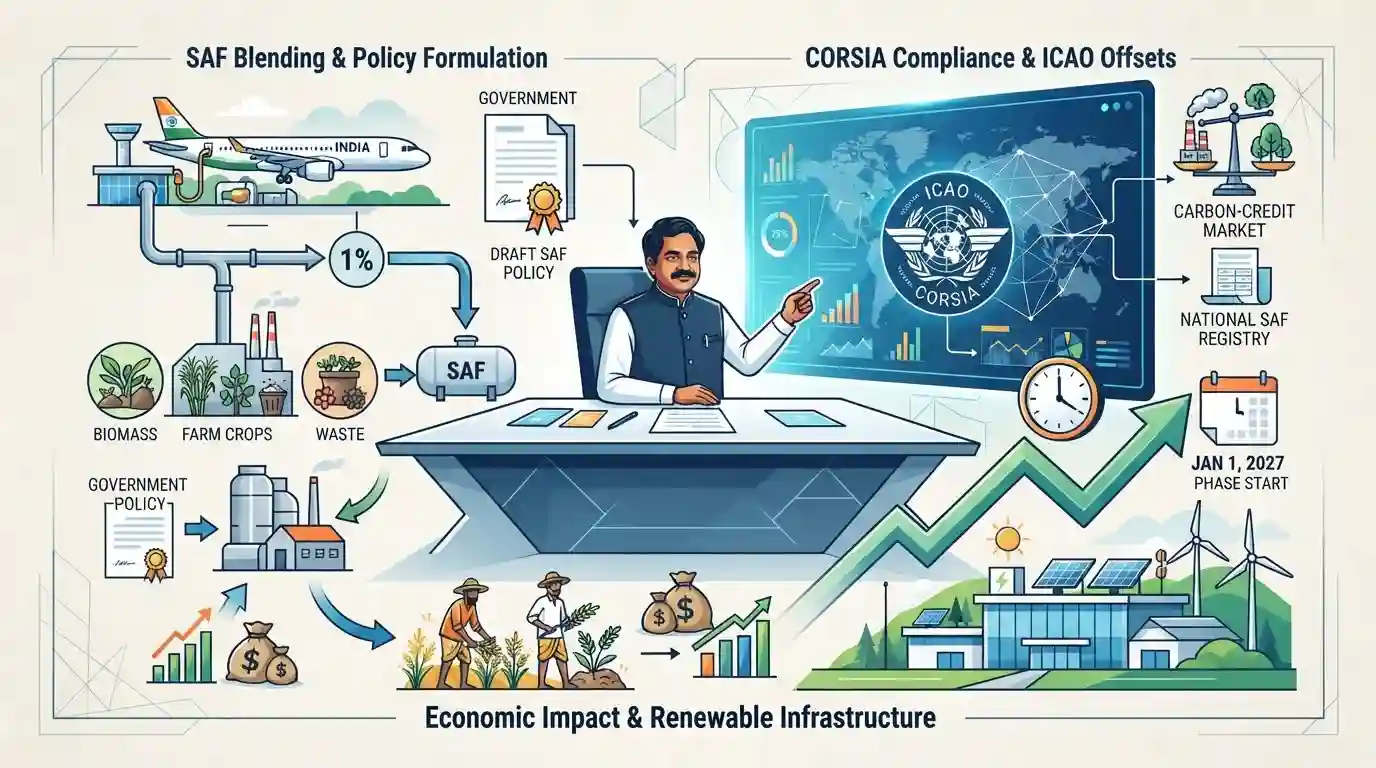
Union Minister Ram Mohan Naidu led a high-level review of India's readiness for Sustainable Aviation Fuel (SAF) blending and compliance with the International Civil Aviation Organization's (ICAO) Carbon Offsetting and Reduction Scheme for International Aviation (CORSIA). With the mandatory CORSIA phase starting on January 1, 2027, India is prioritizing a cost-effective 1% SAF blending target. The government is finalizing its draft SAF Policy, building a National SAF Registry for transparent carbon accounting, and promoting a carbon-credit market. This clean energy shift is projected to create economic opportunities for domestic farmers (as feedstock providers) and accelerate aviation-sector decarbonization.
Key Points
- Civil Aviation Minister Ram Mohan Naidu chaired a meeting to review India's preparedness for adopting Sustainable Aviation Fuel (SAF) and meeting Carbon Offsetting and Reduction Scheme for International Aviation (CORSIA) standards.
- India's immediate target is to achieve the 1% CORSIA blending requirement starting January 1, 2027, in a cost-effective manner.
- The government is finalizing the draft SAF Policy and creating a National SAF Registry to provide robust accounting, monitoring, reporting, and end-to-end traceability of aviation fuel emissions.
- A transition to 100% green energy usage has already been achieved at 104 airports in India since 2014, showing progress in aviation decarbonization.
- A coordinated, whole-of-government approach is being used to develop a domestic carbon-credit offset mechanism to facilitate CORSIA compliance.
Important Terms
Carbon Offsetting and Reduction Scheme for International Aviation (CORSIA)

A global market-based mechanism established by ICAO to offset greenhouse gas emissions from international aviation that exceed the established baseline levels.
UPSC context
GS Paper 3 (Environment and Climate Change); tests international environmental frameworks and market-based emission reduction schemes.
Sustainable Aviation Fuel (SAF) Blending Mandate
A regulatory target requiring airlines to blend a minimum percentage of renewable fuel with conventional aviation turbine fuel to lower civil aviation carbon emissions.
UPSC context
GS Paper 3 (Infrastructure and Energy); tests clean energy transitions, biofuels, and India's sector-specific decarbonization goals.
International Civil Aviation Organization (ICAO)
A specialized United Nations agency that coordinates international air navigation principles, planning, and standards to ensure safe, orderly, and sustainable global civil aviation.
UPSC context
GS Paper 2 (International Organizations); tests mandates of UN bodies and their regulatory impact on global sectors.
Directorate General of Civil Aviation (DGCA)
The statutory regulatory body in India responsible for governing safety standards, licensing, and environmental regulations within the civil aviation sector.
UPSC context
GS Paper 2 (Statutory Bodies); tests regulatory oversight, aviation infrastructure policies, and coordination of global emission standards domestically.
Bureau of Indian Standards (BIS)
The national standards body of India responsible for formulating and certifying product quality standards, including specifying safe guidelines for aviation fuels.
UPSC context
GS Paper 2 (Statutory Bodies); tests standardisation, quality control frameworks, and compliance mechanisms for national energy security.
Prelims Trap
CORSIA emission offsetting requirements apply to both domestic and international commercial aviation routes to meet Paris Agreement targets.
CORSIA only applies to international flights. Domestic aviation emissions are managed under individual country NDCs under the UNFCCC, not ICAO's CORSIA framework.
Static Concepts Connected
What is the ICAO's CORSIA framework and how does it operate?
- ICAO Origin: Established under the Chicago Convention (1944) as a UN specialized agency governing international civil aviation.
- CORSIA Objective: A global market-based measure designed to offset CO2 emissions from international aviation to achieve carbon-neutral growth.
- Phased Implementation: Features a voluntary phase (2021-2026) followed by a mandatory compliance phase starting on January 1, 2027.
What is Sustainable Aviation Fuel (SAF) and how does it function?
- Drop-in Fuel: A 'drop-in' fuel chemically identical to conventional jet fuel, requiring no modifications to aircraft engines, fueling systems, or distribution infrastructure.
- Feedstock Sources: Produced from non-fossil, renewable feedstocks such as municipal solid waste, agricultural residues, used cooking oil, and waste lipids.
- Carbon Performance: Can reduce lifecycle greenhouse gas emissions by up to 80% compared to conventional aviation turbine fuel.
Cross-Topic Patterns
SAF Feedstocks + Circular Economy
Utilizing agricultural residues and municipal waste for SAF creates a domestic value chain, offering farmers additional income while mitigating stubble burning.
CORSIA compliance + Domestic Carbon Markets
Aligning India’s Carbon Credit Trading Scheme (CCTS) with ICAO standards is essential to allow Indian airlines to purchase domestic offsets for compliance.

CORSIA's international-only scope versus domestic NDCs and the 'drop-in' nature of SAF will likely feature in a 2026 Environment MCQ.
Linked PYQs · 2
Linked PYQs · 2
- 2024PrelimsGS1
Consider the following materials: 1. Agricultural residues 2. Corn grain 3. Wastewater treatment sludge 4. Wood mill waste Which of the above can be used as feedstock for producing Sustainable Aviation Fuel?
- 2025PrelimsGS1
With reference to 'Direct Air Capture', an emerging technology, which of the following statements is/are correct? I. It can be used as a way of carbon sequestration. II. It can be a valuable approach for plastic production and in food processing. III. In aviation, it can be a source of carbon for combining with hydrogen to create synthetic low-carbon fuel. Select the correct answer using the code given below.
