DAANVEER Initiative for Gram Panchayat Digital Infrastructure
Source:PIB ↗
આ શા માટે મહત્વનું છે
Provides a contemporary example of using public-private partnership, CSR, and citizen participation to overcome resource constraints in local self-government (PRIs), directly addressing syllabus points on e-governance and devolution of funds/functionality.
સારાંશ
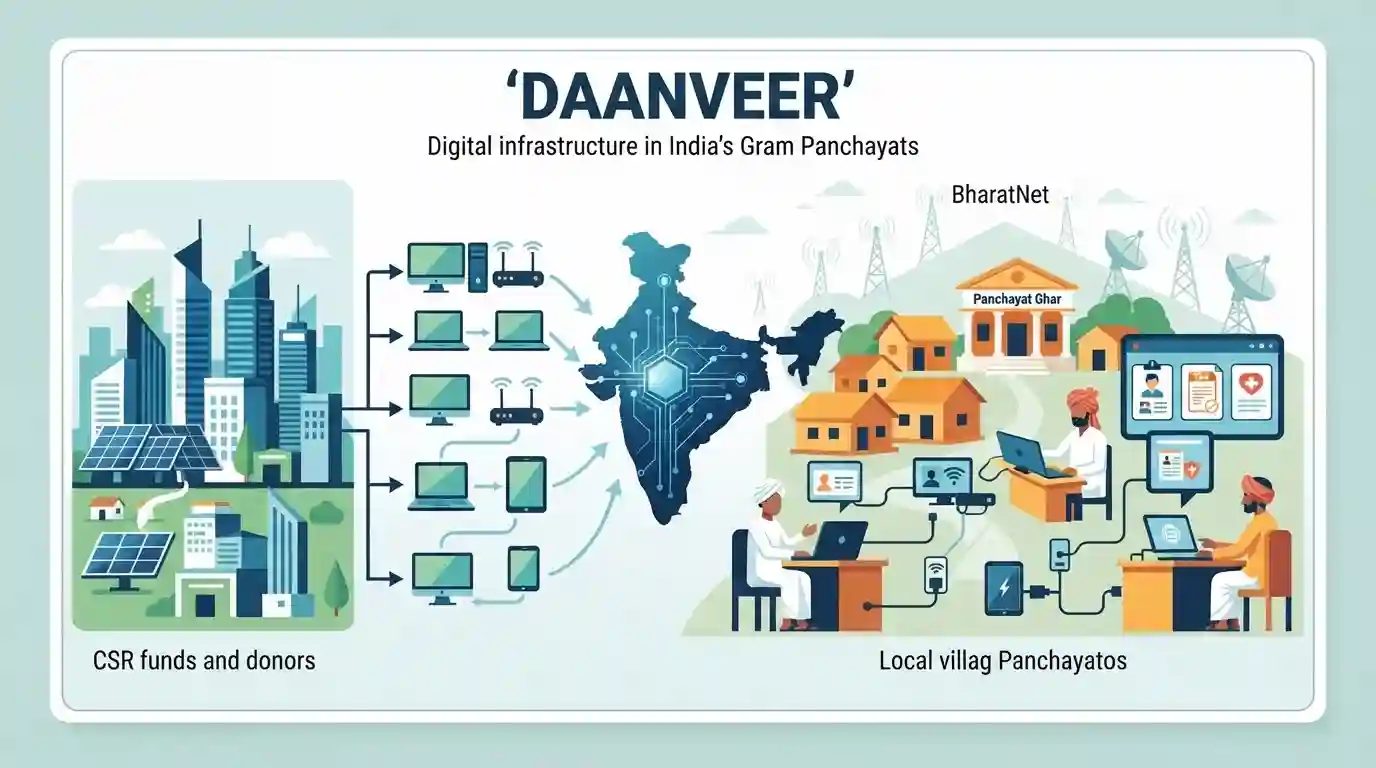
The 'DAANVEER' initiative has been launched to bolster digital infrastructure across India's Gram Panchayats by crowdsourcing support through CSR funds, philanthropists, and citizens. By facilitating the donation of critical IT equipment, the initiative aims to empower local self-governance, enhance the reach of e-governance services, and ensure that rural bodies have the necessary hardware to fully utilize connectivity projects like BharatNet. It represents a strategic shift towards participatory development in rural digitalization.
મુખ્ય મુદ્દા
- The DAANVEER initiative aims to bridge the rural digital divide by channeling Corporate Social Responsibility (CSR) funds, philanthropic donations, and citizen contributions toward equipping Gram Panchayats with digital infrastructure.
- It facilitates the provision of essential IT equipment—such as computers, smart screens, and internet routers—directly to rural local bodies.
- The initiative strengthens grassroots e-governance platforms (like e-Gram Swaraj), fostering greater transparency, accountability, and efficiency in Panchayati Raj Institutions (PRIs).
- By ensuring the availability of end-user hardware, it complements the broadband connectivity established under the BharatNet project.
- It promotes 'Jan Bhagidari' (public participation), shifting the burden of local infrastructure solely from state funds to a collaborative, society-driven model.
મહત્વપૂર્ણ શબ્દો
DAANVEER Initiative

A citizen-participation platform launched by the Ministry of Panchayati Raj to crowdsource IT equipment donations for Gram Panchayats, strengthening rural digital infrastructure.
UPSC context
GS Paper 2 (Governance, PRIs). Tests participatory governance, digital divide initiatives, and grassroots empowerment.
BharatNet
A Ministry of Communications project aiming to provide high-speed optical fiber and broadband connectivity to all Gram Panchayats and villages in India.
UPSC context
GS Paper 3 (Infrastructure, IT). Crucial for evaluating rural connectivity schemes, e-governance delivery, and Digital India targets.
e-Gram Swaraj
A comprehensive digital governance portal by the Ministry of Panchayati Raj for the planning, budgeting, accounting, and monitoring of Gram Panchayat development activities.
UPSC context
GS Paper 2 (E-Governance). Tests knowledge of digital tools that enhance financial transparency and decentralised planning in local self-government.
Gram Panchayats
The village-level, grassroots tier of India's Panchayati Raj Institutions (PRIs), functioning as the primary constitutional body for rural local self-governance.
UPSC context
GS Paper 2 (Polity). Core to the 73rd Amendment, testing democratic decentralisation and local administrative capabilities.
Corporate Social Responsibility (CSR)
A mandatory framework under the Companies Act requiring qualifying businesses to invest a portion of their profits in socially and environmentally beneficial projects.
UPSC context
GS Paper 2 & 4 (Governance, Ethics). Tests corporate accountability and non-state funding mechanisms for rural development initiatives like DAANVEER.
પ્રિલિમ્સ ટ્રેપ
DAANVEER is a mandatory digital infrastructure cess managed by the Ministry of Electronics and IT to fund rural broadband.
It is a voluntary donation and CSR initiative under the Ministry of Panchayati Raj, utilizing ONDC/DigiHaat, not a mandatory cess or a MeitY project.
સંલગ્ન સ્થિર ખ્યાલો
What is the constitutional mandate for Panchayati Raj Institutions (PRIs) under Article 243?
- 73rd Amendment Act: Inserted Part IX and the Eleventh Schedule, detailing 29 functional subjects for rural local bodies to manage.
- Article 243G: Empowers state legislatures to devolve powers, authority, and responsibilities to Panchayats for economic development and social justice.
- Article 243H: Authorizes Panchayats to levy, collect, and appropriate taxes, duties, tolls, and fees to strengthen financial autonomy.
What are the key statutory rules governing Corporate Social Responsibility (CSR) in India?
- Companies Act 2013: Section 135 mandates companies with specific financial thresholds to spend 2% of their average net profits on CSR.
- Schedule VII: Prescribes eligible activities, including rural development projects and ecological balance, where CSR funds can legally be deployed.
આંતર-વિષય પેટર્ન
DPI integration with ONDC ecosystem
Using the ONDC-linked DigiHaat for Panchayat procurement showcases how open-network e-commerce can streamline state-led asset distribution and bypass traditional bureaucratic procurement delays.
CSR integration with local self-government
Directing corporate social responsibility (CSR) funds toward rural IT hardware assets represents a functional bridge between private corporate wealth and constitutional grassroots empowerment.

DAANVEER's integration of CSR, ONDC, and local governance is highly likely to be tested under digital public infrastructure in 2026.
સંલગ્ન PYQ · 5
સંલગ્ન PYQ · 5
- 2024MainsGS2
e-governance is not just about the routine application of digital technology in service delivery process. It is as much about multifarious interactions for ensuring transparency and accountability. In this context evaluate the role of the 'Interactive Service Model' of e-governance.
- 2020MainsGS2
The strength and sustenance of local institutions in India has shifted from their formative phase of 'Functions, Functionaries and Funds' to the contemporary stage of 'Functionality'. Highlight the critical challenges faced by local institutions in terms of their functionality in recent times.
- 2024MainsGS2
Public charitable trusts have the potential to make India's development more inclusive as they relate to certain vital public issues. Comment.
- 2022MainsGS4
In contemporary world, corporate sector's contribution in generating wealth and employment is increasing. In doing so, they are bringing in unprecedented onslaught on the climate, environmental sustainability and living conditions of human beings. In this background, do you find that Corporate Social Responsibility (CSR) is efficient and sufficient enough to fulfill the social roles and responsibilities needed in the corporate world for which the CSR is mandated? Critically examine.
- 2017PrelimsGS1
What is the aim of the programme 'Unnat Bharat Abhiyan'?
