NIPUN Bharat Mission and Foundational Literacy Objectives
Source:PIB ↗
આ શા માટે મહત્વનું છે
Foundational Literacy and Numeracy is the bedrock of future learning and human capital development. NIPUN Bharat directly addresses this, aligning with SDG-4 (Quality Education) and the NEP 2020. It is a highly relevant topic for UPSC GS2 (Education/Social Sector) and Essay papers, emphasizing early childhood care and primary education reforms.
સારાંશ
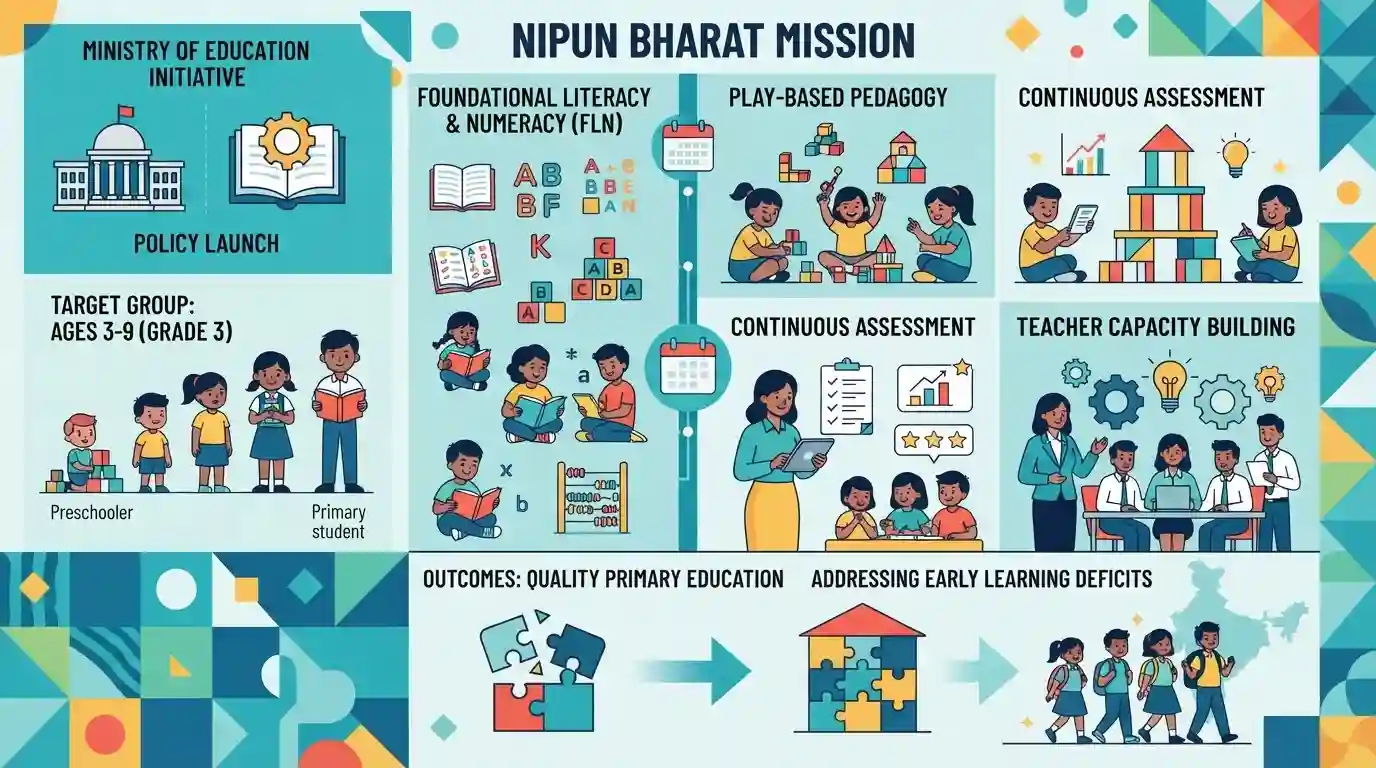
The article outlines the NIPUN Bharat Mission (National Initiative for Proficiency in Reading with Understanding and Numeracy), an initiative by the Ministry of Education aimed at achieving Foundational Literacy and Numeracy (FLN) for all children aged 3 to 9 years (by Grade 3) by 2026-27. Launched under the Samagra Shiksha scheme in alignment with the National Education Policy (NEP) 2020, the mission emphasizes play-based pedagogy, continuous assessment, and teacher capacity-building. It represents a critical intervention to ensure quality primary education and address early learning deficits in India.
મુખ્ય મુદ્દા
- The NIPUN Bharat Mission aims to ensure that every child achieves desired learning competencies in reading, writing, and numeracy by the end of Grade 3.
- The mission targets children in the 3 to 9 years age group, aiming to achieve universal foundational literacy and numeracy (FLN) by 2026-27.
- It is implemented under the centrally sponsored Samagra Shiksha scheme as a core component of realizing the National Education Policy (NEP) 2020.
- Key focus areas include play-based pedagogy, capacity building of teachers (like NISHTHA), and continuous tracking of student progress to reduce early learning deficits.
મહત્વપૂર્ણ શબ્દો
NIPUN Bharat Mission

A national mission launched in 2021 under Samagra Shiksha to ensure every child in India achieves basic foundational literacy and numeracy (FLN) by the end of Grade 3 (2026-27).
UPSC context
GS Paper II (Social Sector/Education), testing knowledge of targeted interventions to correct learning deficits in primary education.
National Education Policy (NEP) 2020
A comprehensive policy framework launched in 2020 that restructures Indian school education into a 5+3+3+4 pedagogical model, emphasizing early childhood care, foundational learning, and holistic assessment.
UPSC context
GS Paper II (Government Policies), testing awareness of structural reforms aimed at modernizing India’s human capital development framework.
Samagra Shiksha
An integrated, centrally sponsored scheme for school education spanning from pre-school to class 12, uniting Sarva Shiksha Abhiyan, Rashtriya Madhyamik Shiksha Abhiyan, and Teacher Education.
UPSC context
GS Paper II (Social Sector/Education), testing knowledge of national-level funding and infrastructure schemes promoting educational equity.
Right to Education (RTE) Act
A landmark 2009 legislation enforcing free and compulsory elementary education for children aged 6 to 14 years under Article 21A of the Indian Constitution.
UPSC context
GS Paper II (Indian Constitution), testing understanding of fundamental rights and statutory provisions that secure universal basic education.
Department of School Education and Literacy
A department under the Ministry of Education that administers primary, secondary, and adult education, executing schemes like Samagra Shiksha and implementing the NEP 2020.
UPSC context
GS Paper II (Governance/Social Sector), testing familiarity with the administrative bodies implementing grassroot-level literacy programs.
Ministry of Education
The apex Union Ministry of India responsible for formulating and implementing national education policies, managing school systems, literacy, and higher education.
UPSC context
GS Paper II (Governance/Policies), testing knowledge of ministerial jurisdiction over academic policy formulation and administrative execution.
પ્રિલિમ્સ ટ્રેપ
NIPUN Bharat targets only school-going children within the 6 to 14 age bracket of the Right to Education (RTE) Act.
NIPUN Bharat focuses on early development (ages 3 to 9, up to Grade 3) to prevent cumulative learning deficits before formal upper-primary education.
સંલગ્ન સ્થિર ખ્યાલો
What is the structural scope of the Samagra Shiksha Scheme?
- Subsumed Schemes: Subsumes three erstwhile schemes: Sarva Shiksha Abhiyan (SSA), Rashtriya Madhyamik Shiksha Abhiyan (RMSA), and Teacher Education (TE).
- Continuum Approach: Spans from preschool to senior secondary levels (Class 12), moving away from fragmented, stage-wise schooling interventions.
- Outcome Focus: Shifts policy focus from mere school enrollment and infrastructure provisioning to measurable student learning outcomes.
How does the Indian Constitution address early childhood and primary education?
- Article 21A: Mandates free and compulsory education as a Fundamental Right for children aged 6 to 14 years.
- Article 45 (DPSP): Directs the State to endeavor to provide early childhood care and education (ECCE) for children under six years.
- Article 51A(k): Duties parents or guardians to provide educational opportunities to their child or ward between the ages of 6 and 14.
આંતર-વિષય પેટર્ન
FLN & India's Future Labor Productivity
Severe early learning deficits permanently stunt future cognitive development, directly undermining India's transition to a high-income knowledge economy and reducing long-term labor productivity.
Pedagogical Governance & Digital Public Infrastructure
FLN execution relies heavily on structured digital content via DIKSHA, linking pedagogical policy with India's wider Digital Public Infrastructure (DPI) framework.

UPSC may contrast NIPUN targets (Grade 3, ages 3-9) with the structural mandates of the RTE Act (ages 6-14) in a multi-statement question.
સંલગ્ન PYQ · 4
સંલગ્ન PYQ · 4
- 2020MainsGS2
National Education Policy 2020 is in conformity with the Sustainable Development Goal-4 (2030). It intends to restructure and reorient education system in India. Critically examine the statement.
- 2016MainsGS2
Professor Amartya Sen has advocated important reforms in the realms of primary education and primary health care. What are your suggestions to improve their status and performance?
- 2018PrelimsGS1
Consider the following statements: 1. As per the Right to Education (RTE) Act, to be eligible for appointment as a teacher in a State, a person would be required to possess the minimum qualification laid down by the concerned State Council of Teacher Education. 2. As per the RTE Act, for teaching primary classes, a candidate is required to pass a Teacher Eligibility Test conducted in accordance with the National Council of Teacher Education guidelines. 3. In India, more than 90% of teacher education institutions are directly under the State Governments. Which of the statements given above is/are correct?
- 2017PrelimsGS1
What is the aim of the programme 'Unnat Bharat Abhiyan'?
