Mother Tongue Based Education and NEP 2020 Implementation
Source:PIB ↗
Why It Matters
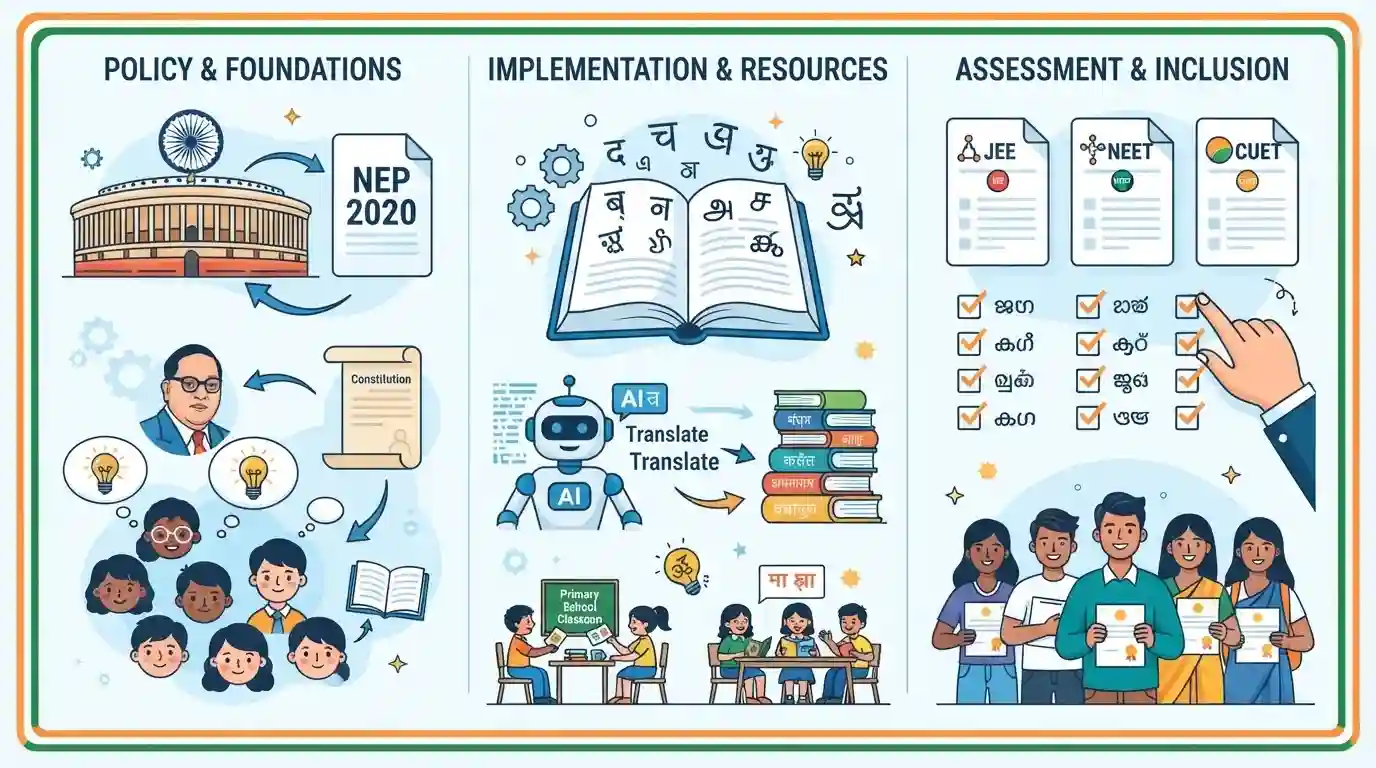
Mother tongue-based education is a cornerstone of NEP 2020 and represents a major shift in India's education policy. It bridges the gap between constitutional provisions (like Article 350-A and the 8th Schedule) and practical governance, addressing educational inequality and poor learning outcomes linked to language barriers.
Summary
The Government is actively promoting mother tongue-based education to improve learning outcomes and make education more inclusive, in alignment with the National Education Policy (NEP) 2020. NEP 2020 recommends using the mother tongue or regional language as the medium of instruction up to at least Grade 5. To support this transition, the Ministry of Education has initiated the translation of textbooks across school and higher education into multiple Indian languages using AI tools. Furthermore, major competitive exams like JEE, NEET, and CUET are now conducted in over a dozen regional languages. This promotion of regional languages not only enhances cognitive development and foundational literacy but also fulfills the constitutional mandate under Article 350-A to protect the educational rights of linguistic minorities.
Key Points
- The National Education Policy (NEP) 2020 strongly advocates using the mother tongue, local language, or regional language as the medium of instruction until at least Grade 5, and preferably till Grade 8 and beyond.
- The policy aligns with Article 350-A of the Constitution, which directs states to provide adequate facilities for instruction in the mother tongue at the primary education stage.
- The Ministry of Education has expanded access by conducting major entrance examinations like JEE, NEET, and CUET in multiple Indian languages.
- Technology and AI-based translation tools (such as the Anuvadini app) are being leveraged to translate school textbooks, higher education materials, and engineering books into regional languages.
- Learning in the mother tongue is recognized to significantly improve foundational literacy, cognitive development, and classroom participation among children.
Important Terms
National Education Policy (NEP) 2020

The comprehensive framework guiding India's educational reforms. It emphasizes holistic, inclusive learning and strongly advocates using a student's mother tongue, home language, or regional language as the medium of instruction until at least Grade 5.
UPSC context
Crucial for GS Paper 2 (Education). Tests knowledge of modern educational policies, foundational learning strategies, and linguistic inclusivity.
Article 350-A
A constitutional provision (inserted by the 7th Amendment) directing every state and local authority to endeavor to provide adequate facilities for instruction in the mother tongue at the primary educational stage for linguistic minorities.
UPSC context
Highly relevant for GS Paper 2 (Indian Constitution). Tests understanding of linguistic minority safeguards, fundamental rights, and center-state directives.
Ministry of Education
The nodal central ministry responsible for national educational planning. It is spearheading the mandate to provide higher and school education study materials in all 22 scheduled Indian languages to bridge linguistic divides.
UPSC context
Relevant for GS Paper 2 (Government Policies). Evaluates understanding of administrative roles in executing national human resource and educational development.
NCERT
The National Council of Educational Research and Training is the apex advisory body for school curricula. It is currently translating textbooks into 22 regional languages using AI tools to fulfill NEP 2020 mandates.
UPSC context
Important for GS Paper 2 (Education). Tests knowledge of key institutional frameworks and their role in standardizing public school education.
Anuvadini
An AI-powered translation tool developed by the AICTE. It is utilized by the government to efficiently translate engineering, medical, law, and school textbooks into 22 regional Indian languages.
UPSC context
Relevant for GS Paper 3 (Science & Technology) and GS 2 (Education), illustrating the application of artificial intelligence in governance.
Prelims Trap
Article 350-A was part of the original Constitution and mandates mother-tongue primary instruction universally for all children.
It was added by the 7th Amendment (1956) and specifically targets children of linguistic minority groups, though NEP 2020 aims to implement mother-tongue education universally.
Static Concepts Connected
What are the constitutional safeguards for linguistic minorities in India?
- Article 29: Protects the right of any section of citizens to conserve their distinct language, script, or culture.
- Article 30: Grants minorities (linguistic and religious) the right to establish and administer educational institutions of their choice.
- Article 350-A: Directs states to provide adequate primary-stage instruction facilities in the mother tongue to linguistic minority children.
- Article 350-B: Mandates a Special Officer for Linguistic Minorities, appointed by the President, to investigate all safeguard-related matters.
Cross-Topic Patterns
Language policy & asymmetric federalism
The shift from Hindi-English exams to regional-language exams reflects federal accommodations balancing regional identity and developmental equity with national integration.
AI translation & digital inclusion
Tools like Anuvadini and Bhashini showcase how national AI initiatives serve as digital public infrastructure, actively bridging the educational and digital divide.

Expect a 2026 prelims question linking the 7th Amendment, Article 350-A, and the distinction between linguistic minority rights and NEP targets.
Linked PYQs · 2
Linked PYQs · 2
- 2020MainsGS2
National Education Policy 2020 is in conformity with the Sustainable Development Goal-4 (2030). It intends to restructure and reorient education system in India. Critically examine the statement.
- 2001PrelimsGS1
Which Article of the Constitution provides that it shall be the endeavour of every State to provide adequate facility for instruction in the mother tongue at the primary stage of education?
