India First Telecom Manufacturing Zone in Madhya Pradesh
Source:PIB ↗
ఇది ఎందుకు ముఖ్యం
Establishing India's first dedicated Telecom Manufacturing Zone is a significant step toward self-reliance in critical networking equipment. It is highly relevant for UPSC GS3 as it bridges economic development (boosting manufacturing and reducing import bills) with internal security (minimizing vulnerabilities tied to foreign telecom hardware). Furthermore, it exemplifies collaborative federalism in driving industrial growth.
సారాంశం
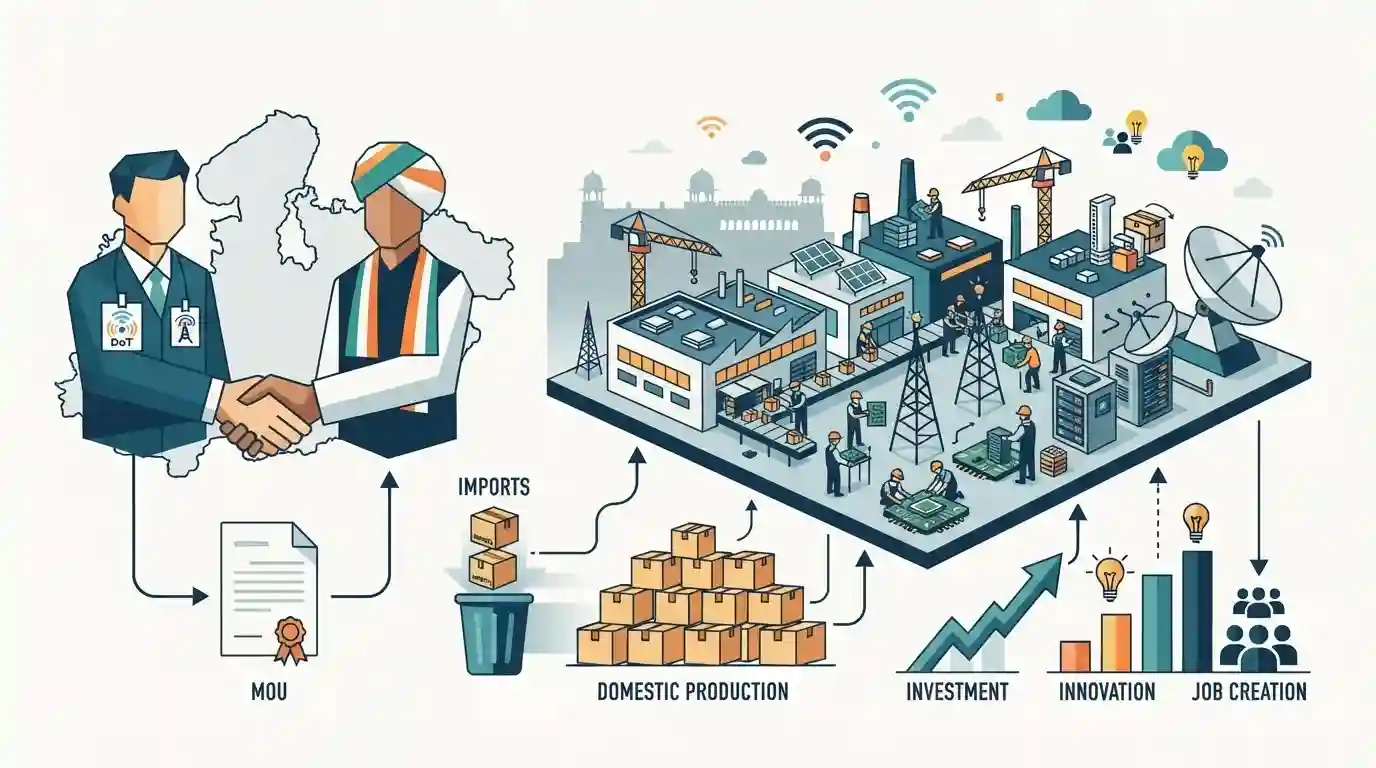
The Department of Telecommunications (DoT) has partnered with the Madhya Pradesh government by signing a Memorandum of Understanding (MoU) to set up India’s first Telecom Manufacturing Zone (TMZ) in Gwalior. The initiative focuses on scaling up domestic production of telecom and networking equipment to reduce import dependency and strengthen national security. By creating a dedicated industrial cluster, the TMZ aligns with the 'Atmanirbhar Bharat' and 'Make in India' initiatives, promising to attract investment, spur innovation, and generate employment in the telecom hardware manufacturing sector.
ముఖ్య అంశాలు
- The Department of Telecommunications (DoT) and the Government of Madhya Pradesh signed an MoU to establish India's first Telecom Manufacturing Zone (TMZ) in Gwalior.
- The TMZ aims to create a robust indigenous ecosystem for manufacturing telecom and networking equipment, reducing the country's reliance on imported hardware.
- This initiative is a strategic push to align the telecom sector with the broader 'Make in India' and 'Atmanirbhar Bharat' missions.
- The dedicated manufacturing zone is expected to attract significant domestic and foreign investments, foster innovation, and generate employment opportunities in the region.
ముఖ్యమైన పదాలు
Telecom Manufacturing Zone (TMZ)

India's first dedicated industrial cluster for the telecom sector, offering plug-and-play infrastructure for manufacturing equipment, data centers, and semiconductors. The inaugural zone is being established in Gwalior.
UPSC context
GS-3 Infrastructure & Indigenization. Tests knowledge of specialized industrial clusters and strategies to reduce electronic import dependency.
Production Linked Incentive (PLI) Scheme
A government initiative offering financial incentives based on incremental sales of domestically manufactured goods. In telecom, it aims to boost local hardware production and offset manufacturing disabilities.
UPSC context
Core GS-3 Industrial Policy topic. Evaluates understanding of fiscal incentives to promote 'Make in India' and global supply chain integration.
Atmanirbhar Bharat
The 'Self-Reliant India' vision aimed at making the country a crucial, resilient node in global supply chains, while significantly reducing strategic reliance on imported critical technologies and equipment.
UPSC context
GS-3 Economy & Technology. Serves as a foundational concept for questions regarding economic self-sufficiency and import substitution.
Department of Telecommunications (DoT)
A department under the Ministry of Communications responsible for formulating telecom policies, licensing services, building digital infrastructure, and executing initiatives like the Telecom PLI and TMZ.
UPSC context
Relevant for Prelims (Governance). Tests awareness of nodal ministries and administrative bodies driving India's digital and telecom frameworks.
Make in India
A flagship national initiative launched to facilitate domestic and foreign investment, foster innovation, and build state-of-the-art manufacturing infrastructure to position India as a global design and manufacturing hub.
UPSC context
GS-3 Economic Development. Vital for analyzing government strategies aimed at increasing the manufacturing sector's share in national GDP and job creation.
ప్రిలిమ్స్ ఉచ్చు
The Gwalior Telecom Manufacturing Zone (TMZ) is an export-oriented cluster modeled on Special Economic Zones (SEZs).
Aspirants often assume tech zones are export-focused. However, the TMZ primarily targets import substitution, domestic capacity building, and mitigating national security risks from foreign hardware.
అనుసంధానమైన స్థిర భావనలు
How do National Investment and Manufacturing Zones (NIMZs) differ from SEZs?
- Primary Objective: SEZs focus predominantly on export promotion, whereas NIMZs prioritize broad industrial growth, increasing manufacturing's share in GDP, and domestic production.
- Size and Scale: NIMZs are massive integrated industrial townships requiring at least 5,000 hectares, while SEZs are generally much smaller, localized enclaves.
- Regulatory Framework: NIMZs are governed by the National Manufacturing Policy framework, while SEZs operate under the dedicated SEZ Act of 2005.
What cybersecurity threats are posed by imported telecom hardware?
- Hardware Backdoors: Foreign manufacturers may embed hidden vulnerabilities or malicious code that allow stealthy, unauthorized access to India's core communication networks.
- Supply Chain Risks: High reliance on foreign networking gear creates critical vulnerabilities during geopolitical standoffs, risking sudden service disruptions or maintenance blackouts.
- Data Exfiltration: Compromised network routing equipment can be programmed to secretly intercept, mirror, and transfer sensitive domestic data to hostile foreign servers.
అంతర-అంశ నమూనాలు
Internal Security meets Industrial Policy
Reducing telecom imports is not just about the current account deficit; it is a strategic move to secure critical information infrastructure against cyber espionage and state-sponsored hardware backdoors.
Spatial shift in tech manufacturing hubs
Establishing the TMZ in Gwalior signals a deliberate decentralization of high-tech manufacturing away from traditional southern tech clusters, aiding balanced regional development and inclusive growth.

Telecom PLI + TMZ import substitution + critical infrastructure cybersecurity is highly likely as a fused GS-3 or Prelims multi-statement Q.
అనుసంధాన PYQలు · 4
అనుసంధాన PYQలు · 4
- 2025MainsGS3
Discuss the rationale of the Production Linked Incentive (PLI) scheme. What are its achievements? In what way can the functioning and outcomes of the scheme be improved?
- 2015MainsGS3
There is a clear acknowledgement that Special Economic Zones (SEZs) are a tool of industrial development, manufacturing and exports. Recognizing this potential, the whole instrumentality of SEZs requires augmentation. Discuss the issues plaguing the success of SEZs with respect to taxation, governing laws and administration.
- 2023PrelimsGS1
Consider the following statements: Statement-I: India accounts for 3.2% of global export of goods. Statement-II: Many local companies and some foreign companies operating in India have taken advantage of India's 'Production-linked Incentive' scheme. Which one of the following is correct in respect of the above statements?
- 2023MainsGS3
Faster economic growth requires increased share of the manufacturing sector in GDP, particularly of MSMEs. Comment on the present policies of the Government in this regard.
