PLI Scheme for Advanced Chemistry Cell Manufacturing
Source:PIB ↗
Why It Matters
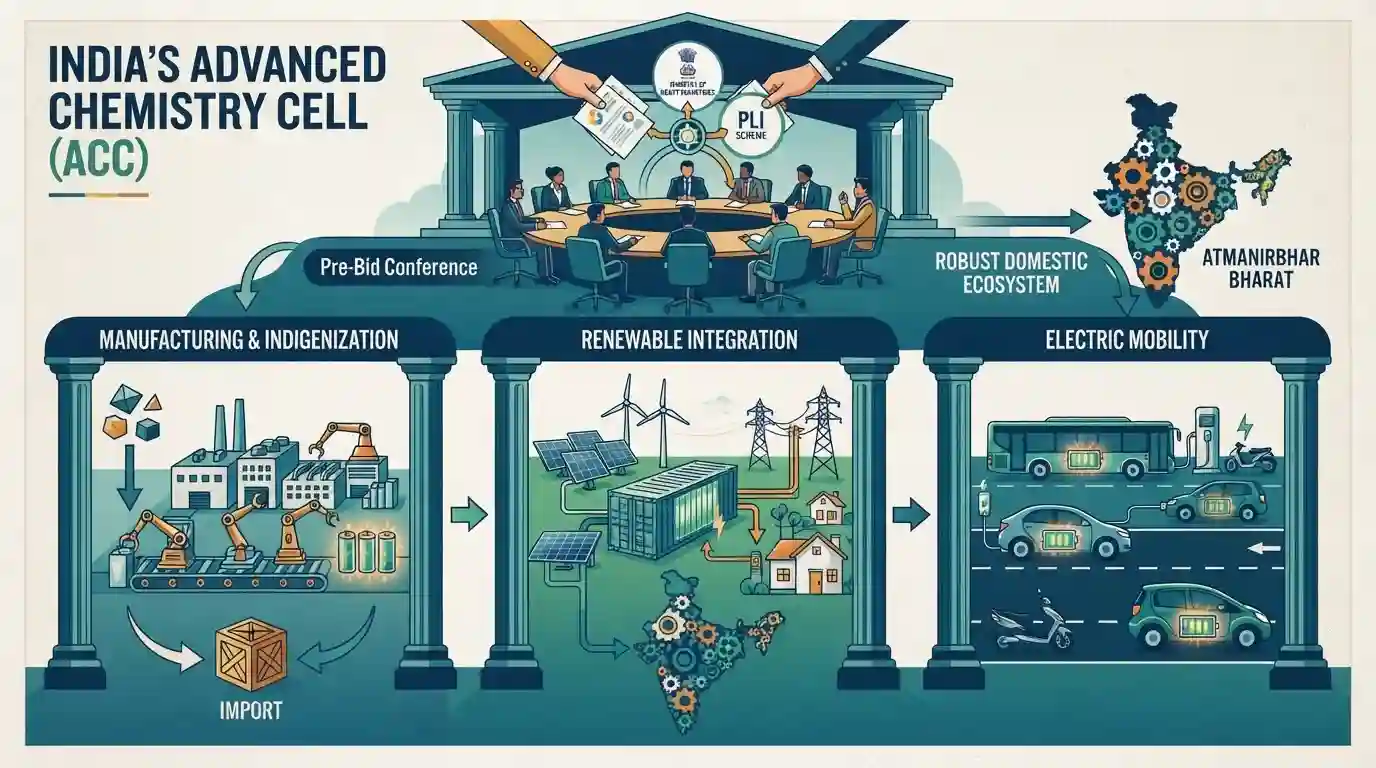
Energy storage is the lynchpin of India's green energy transition. The PLI Scheme for ACC batteries is highly relevant for GS3 as it bridges manufacturing (Atmanirbhar Bharat) with environmental sustainability (EV adoption and renewable grid balancing), reducing strategic dependence on foreign nations for critical technologies.
Summary
The Ministry of Heavy Industries (MHI) organized a pre-bid conference for selecting firms under the Production Linked Incentive (PLI) Scheme for Advanced Chemistry Cell (ACC) manufacturing. The initiative aims to build a robust domestic ecosystem for advanced battery storage systems, thereby reducing import reliance and fostering 'Atmanirbhar Bharat'. Scaling up ACC production is crucial for supporting India's transition to electric mobility and integrating renewable energy into the grid.
Key Points
- The Ministry of Heavy Industries (MHI) held a pre-bid conference for selecting beneficiary firms under the PLI scheme for Advanced Chemistry Cell (ACC) manufacturing.
- The PLI ACC scheme is designed to boost domestic manufacturing capacity, specifically targeting Giga-scale facilities for battery production.
- It aims to reduce India's import dependence for advanced energy storage systems, supporting the principles of Atmanirbhar Bharat (self-reliant India).
- Enhanced domestic production of ACCs will accelerate the adoption of electric vehicles (EVs) and aid the integration of renewable energy grids, contributing to India's climate goals.
Important Terms
Production Linked Incentive (PLI) Scheme

A flagship industrial policy offering direct financial incentives based on incremental sales of domestically manufactured goods, aiming to boost local production, reduce import dependence, and build global manufacturing champions.
UPSC context
Crucial for GS-3 (Economy/Industrial Growth). Tests understanding of manufacturing sector reforms, import substitution, and Atmanirbhar Bharat.
Advanced Chemistry Cell (ACC)
Next-generation technologies that store electric energy in electrochemical or chemical forms and reconvert it to electricity, forming the core components of electric vehicles and renewable energy grids.
UPSC context
Important for GS-3 (Science & Tech/Environment). Tests awareness of clean energy transition, EV ecosystem requirements, and modern energy storage.
National Programme on Advanced Chemistry Cell (ACC) Battery Storage
An ₹18,100 crore PLI scheme launched in 2021 to establish 50 GWh of domestic ACC manufacturing capacity. It aims to build a competitive battery ecosystem and ensure supply chain resilience.
UPSC context
Relevant for GS-3 (Infrastructure/Energy). Questions focus on India's import dependence for critical technologies and government strategies for indigenous capacity building.
Ministry of Heavy Industries (MHI)
The nodal central ministry responsible for promoting the growth of India's engineering and heavy machinery sectors. It administers key schemes like PLI-ACC and FAME to advance electric mobility and manufacturing.
UPSC context
Vital for Prelims (scheme-ministry mapping) and GS-2/3 (Governance). Tests awareness of institutional mechanisms driving India's industrial and e-mobility policies.
Prelims Trap
The PLI ACC scheme exclusively subsidizes Lithium-ion battery manufacturing to achieve immediate domestic economies of scale.
The PLI-ACC scheme is explicitly technology-agnostic. It does not mandate any single chemistry (such as Lithium-ion) and instead links incentives to performance metrics like energy density and cycle life.
Static Concepts Connected
What is Advanced Chemistry Cell (ACC) technology and its significance?
- Definition: New-generation advanced storage technologies storing electric energy as chemical energy, convertible back to electricity on demand.
- Performance Metrics: Characterized by significantly higher energy density, faster charging rates, and longer cycle life compared to traditional lead-acid batteries.
What is the Minimum Efficient Scale (MES) in battery manufacturing?
- Economies of Scale: Large-scale battery cell manufacturing requires reaching a high Minimum Efficient Scale to compete with global, low-cost producers.
- Technology Neutrality: Incentives target performance outputs rather than prescribing specific chemistries, allowing market forces to determine the winning battery technology.
Cross-Topic Patterns
Mineral Diplomacy and Battery Manufacturing
India's ACC ambitions depend on secure supply chains for lithium and cobalt, connecting domestic manufacturing to foreign policy initiatives like Khanij Bidesh India Limited.
Fiscal Policy vs Capital Subsidies
The PLI's performance-linked framework represents a strategic shift from traditional, upfront capital subsidies to output-tied fiscal support, minimizing state-backed inefficiencies.

PLI-ACC's technology-agnostic criteria and coordination with F/E mobility schemes likely to feature in a 2026 multi-statement question.
Linked PYQs · 2
Linked PYQs · 2
- 2025MainsGS3
Discuss the rationale of the Production Linked Incentive (PLI) scheme. What are its achievements? In what way can the functioning and outcomes of the scheme be improved?
- 2023MainsGS3
The adoption of electric vehicles is rapidly growing worldwide. How do electric vehicles contribute to reducing carbon emissions and what are the key benefits they offer compared to traditional combustion engine vehicles?
