Panchayati Raj Institutions in Nasha Mukt Bharat Abhiyan
Source:PIB ↗
কেন এটি গুরুত্বপূর্ণ
Provides a direct example of using decentralized governance (PRIs) to tackle complex social issues (drug abuse). Useful for GS2 answers on local self-government functionality and social justice, as well as GS3 answers on drug demand reduction as a counter to drug trafficking.
সারসংক্ষেপ
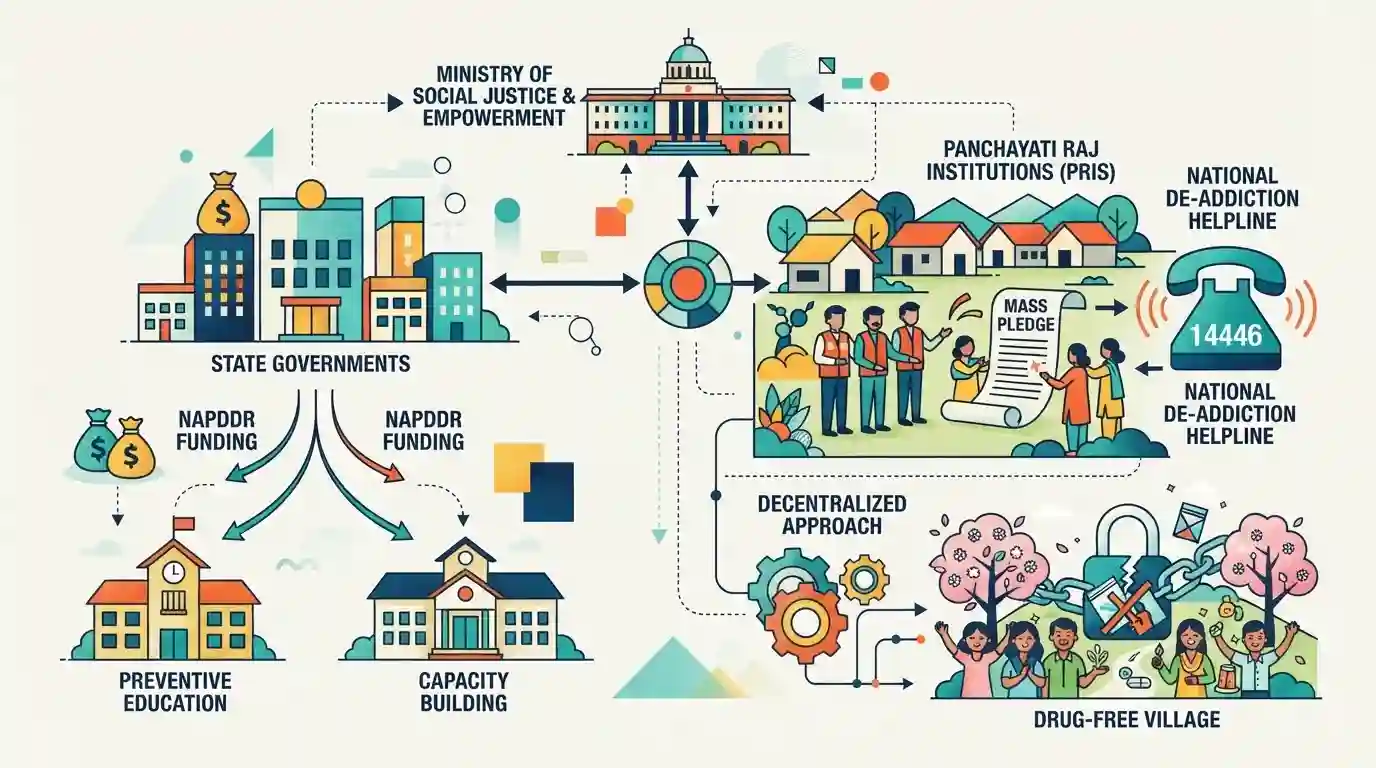
The Ministry of Social Justice & Empowerment is strengthening grassroots drug prevention under the Nasha Mukt Bharat Abhiyan (NMBA) by actively involving Panchayati Raj Institutions (PRIs). Local communities are being engaged through 'Nasha Mukti Mitras', who are Panchayat Resource Persons tasked with promoting the NMBA Mass Pledge and raising awareness about the National De-addiction Helpline (14446). Furthermore, the National Action Plan for Drug Demand Reduction (NAPDDR) provides financial backing to states for preventive education and capacity building, promoting a decentralized and people-led approach to drug-free villages.
মূল বিষয়
- The government is leveraging Panchayati Raj Institutions to combat drug abuse at the village level under the Nasha Mukt Bharat Abhiyan (NMBA).
- Panchayat Resource Persons are being engaged as 'Nasha Mukti Mitras' to promote the NMBA Mass Pledge and create grassroots awareness.
- The initiative integrates the National De-addiction Helpline (14446) into rural awareness campaigns to build a people-led movement against substance abuse.
- Financial assistance is provided to states under the State Action Plan component of the National Action Plan for Drug Demand Reduction (NAPDDR).
গুরুত্বপূর্ণ শব্দ
Nasha Mukt Bharat Abhiyan (NMBA)

A flagship nationwide campaign launched in 2020 to eradicate substance abuse across India, utilizing community mobilization, youth outreach, and awareness in vulnerable districts.
UPSC context
GS Paper II (Social Justice); tests strategies, flagship campaigns, and civil society-led public health initiatives.
National Action Plan for Drug Demand Reduction (NAPDDR)
An umbrella central sector scheme providing financial support for preventive education, capacity building, identification, counselling, and rehabilitation of individuals affected by substance abuse.
UPSC context
GS Paper II (Welfare Schemes); tests government institutional frameworks and funding mechanisms for tackling substance abuse.
Panchayati Raj Institutions
A three-tier system of local self-government in rural India constitutionally recognized by the 73rd Amendment Act, 1992, promoting democratic decentralization and grassroots development.
UPSC context
GS Paper II (Polity/Governance); tests the constitutional framework, devolution of powers, and role of local bodies.
Ministry of Social Justice & Empowerment
The nodal ministry of the Government of India responsible for welfare, social justice, and the empowerment of disadvantaged, marginalized, and vulnerable sections.
UPSC context
GS Paper II (Polity/Governance); tests knowledge of administrative machinery and central schemes for vulnerable groups.
প্রিলিমস ফাঁদ
The Nasha Mukt Bharat Abhiyan and the NAPDDR are primarily run by the Ministry of Health and Family Welfare.
These social reintegration and demand-reduction initiatives are under the Ministry of Social Justice & Empowerment, not Health or Home Affairs.
সংযুক্ত স্থির ধারণা
What are the constitutional and statutory provisions governing drug control in India?
- Article 47 DPSP: Directs the State to endeavor to bring about prohibition of the consumption of intoxicating drinks and drugs injurious to health.
- NDPS Act 1985: Provides the primary statutory framework to curb drug abuse and trafficking while regulating medical and scientific use.
- Institutional Division: Enforcement lies with Ministry of Home Affairs (NCB), while demand reduction and rehabilitation are handled by Ministry of Social Justice.
আন্তঃবিষয় প্যাটার্ন
DPSP execution through PRIs
Links Article 47 (public health) with the 73rd Amendment, showing how socio-economic DPSP objectives are realized through decentralized local self-government institutions rather than top-down administration.
Narco-terrorism and domestic demand
Connects internal security challenges of cross-border drug smuggling to domestic demand-reduction, which weakens the financial networks funding regional narco-terrorism.

Integrating Article 47 with 73rd Amendment (PRIs) for social schemes likely to feature as a GS-2 mains question on local governance.
সংযুক্ত PYQ · 3
সংযুক্ত PYQ · 3
- 2024MainsGS2
Analyse the role of local bodies in providing good governance at local level and bring out the pros and cons merging the rural local bodies with the urban local bodies.
- 2020MainsGS2
The strength and sustenance of local institutions in India has shifted from their formative phase of 'Functions, Functionaries and Funds' to the contemporary stage of 'Functionality'. Highlight the critical challenges faced by local institutions in terms of their functionality in recent times.
- 2018MainsGS3
India's proximity to two of the world's biggest illicit opium-growing states has enhanced her internal security concerns. Explain the linkages between drug trafficking and other illicit activities such as gunrunning, money laundering and human trafficking. What counter-measures should be taken to prevent the same?
