Safety Preparedness For Indian Seafarers In Conflict Zones
Source:PIB ↗
কেন এটি গুরুত্বপূর্ণ
With a high percentage of the global merchant navy crew coming from India, their physical and psychological safety in conflict-ridden bottlenecks directly impacts India's maritime trade, energy security, and international diaspora standing. This highlights the intersection of national security, regulatory welfare, and diplomatic rescue missions.
সারসংক্ষেপ
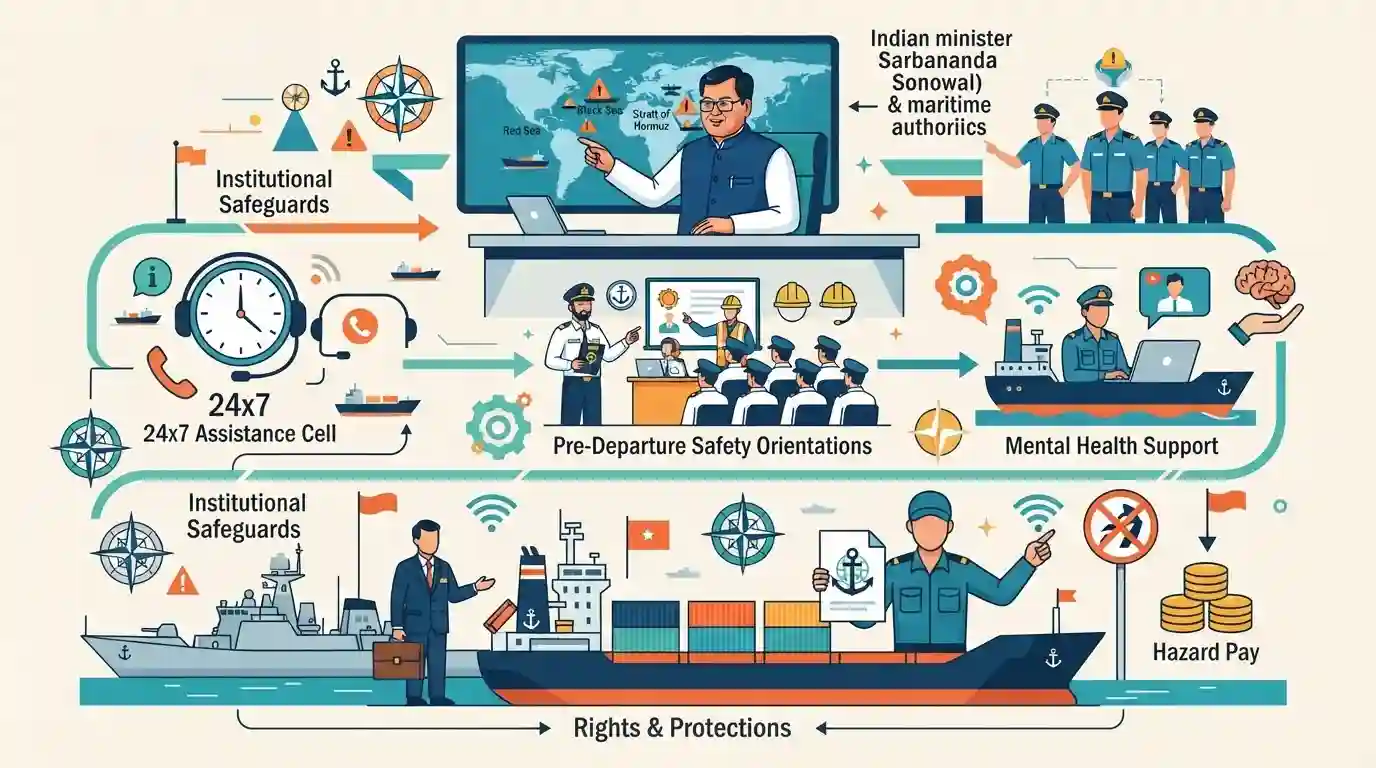
Union Minister of Ports, Shipping and Waterways Sarbananda Sonowal reviewed the safety preparedness and welfare measures for Indian seafarers navigating conflict-prone maritime zones, such as the Red Sea, Strait of Hormuz, and the Black Sea. Since India provides a substantial portion of the global maritime workforce, the government is strengthening institutional safeguards. Key interventions include the Directorate General of Shipping's (DGS) 24x7 assistance cell, pre-departure safety orientations by recruiters, mental health support, and strict compliance with the 'Right of Refusal' and hazard pay under the Maritime Labour Convention (MLC, 2006), backed by Indian Navy and diplomatic coordination.
মূল বিষয়
- High-level safety review chaired by Union Minister Sarbananda Sonowal in response to evolving geopolitical conflicts affecting global sea lanes (such as Red Sea, Gulf of Aden, Strait of Hormuz, and Black Sea).
- Indian seafarers represent approximately 10% of the global seafaring workforce, making their protection crucial for India's maritime economy and diaspora security.
- The Directorate General of Shipping (DGS) operates a 24x7 Seafarer Grievance and Assistance Cell to monitor the movement of vessels carrying Indian crews and handle emergency distress situations.
- Recruitment and Placement Service Licensees (RPSLs) are mandated to conduct structured, safety-focused pre-departure orientation training for Indian seafarers entering conflict-sensitive areas.
- Upholding international standards (e.g., MLC, 2006), the government emphasizes seafarers' 'Right of Refusal' to sail in designated high-risk zones without facing career repercussions, alongside double wages and hazard benefits for those who do.
- Robust institutional coordination is maintained with the Ministry of External Affairs (MEA), Indian Missions abroad, and the Indian Navy to facilitate emergency rescue and safe passage operations.
- Integration of psychological and mental health counseling support within the welfare framework for seafarers working under severe geopolitical stress.
গুরুত্বপূর্ণ শব্দ
Maritime Labour Convention (MLC, 2006)

An International Labour Organization (ILO) treaty, known as the "Seafarers' Bill of Rights," establishing global standards for seafarers' working conditions, welfare, health, and repatriation.
UPSC context
GS Paper II: International Treaties & Diaspora. Tests global labor frameworks, maritime rights, and welfare policies.
Directorate General of Shipping (DGS)
The statutory regulator under the Ministry of Ports, Shipping and Waterways, responsible for maritime safety, seafarer welfare, vessel certification, and implementing shipping laws.
UPSC context
GS Paper II: Statutory Bodies & Governance. Tests administrative mechanisms regulating international shipping and crew protections.
Ministry of Ports, Shipping and Waterways (MoPSW)
The Union ministry responsible for formulating and administering laws, policies, and development programs for ports, inland waterways, and the maritime shipping sector.
UPSC context
GS Paper III: Infrastructure & Blue Economy. Tests policy-making for maritime logistics, Sagarmala, and trade security.
Recruitment and Placement Service Licensees (RPSLs)
Seafarer recruitment agencies in India registered under DGS, mandated to safely place Indian crews on vessels and guarantee repatriation in emergencies.
UPSC context
GS Paper II: Welfare of Diaspora. Tests institutional protection of transnational workers and oversight of labor recruitment.
Indian Navy
The naval branch of India’s military, crucial for safeguarding Sea Lines of Communication, conducting anti-piracy patrols, and protecting commercial shipping (e.g., Operation Sankalp).
UPSC context
GS Paper III: Security challenges & management. Tests maritime security, IOR net security provision, and rescue missions.
International Maritime Organization (IMO)
A specialized United Nations agency that serves as the global standard-setting authority for the safety, security, and environmental performance of international shipping.
UPSC context
GS Paper II: International Institutions. Tests global maritime governance, multilateral treaties (SOLAS, MARPOL), and India's interests.
প্রিলিমস ফাঁদ
"The Maritime Labour Convention (MLC, 2006) is a binding treaty adopted by the International Maritime Organization (IMO)."
MLC 2006 was adopted by the International Labour Organization (ILO), not the IMO. It is known as the "Seafarers' Bill of Rights" and is often confused with IMO treaties.
সংযুক্ত স্থির ধারণা
What is the Maritime Labour Convention (MLC), 2006?
- ILO Origin: Adopted by the International Labour Organization (ILO), it sets minimum working and living standards for seafarers globally.
- Fourth Pillar: Considered the "fourth pillar" of international maritime law, complementing key IMO conventions like SOLAS, MARPOL, and STCW.
- Right of Refusal: Grants seafarers the right to refuse sailing into designated high-risk conflict zones without career penalty, alongside hazard pay guarantees.
What are the key West Asian maritime chokepoints and India's security response?
- Strait of Hormuz: Connects the Persian Gulf to the Gulf of Oman. It is a critical artery for global oil transit.
- Bab el-Mandeb: Connects the Red Sea to the Gulf of Aden. Recently vulnerable to Houthi militia attacks disrupting global supply chains.
- Operation Sankalp: An Indian Navy operation launched in 2019 to ensure the safe transit of Indian-flagged commercial vessels through the Gulf region.
আন্তঃবিষয় প্যাটার্ন
Diaspora welfare in conflict zones
The protection of Indian seafarers bridges maritime geography and diaspora welfare, testing similar themes to India's overseas rescue operations (e.g., Operation Ganga, Operation Kaveri) during geopolitical crises.
Naval diplomacy and economic security
Securing trade chokepoints connects India's economic supply-chain security with its strategic role as a 'Net Security Provider' in the Indian Ocean Region (IOR) under SAGAR.

Expect a 2026 prelims question pairing map chokepoints (Bab el-Mandeb, Hormuz) with the ILO's Maritime Labour Convention (MLC) features.
সংযুক্ত PYQ · 3
সংযুক্ত PYQ · 3
- 2025MainsGS3
Why is maritime security vital to protect India's sea trade? Discuss maritime and coastal security challenges and the way forward.
- 2022MainsGS3
What are the maritime security challenges in India ? Discuss the organisational, technical and procedural initiatives taken to improve the maritime security.
- 2023MainsGS2
‘Sea is an important Component of the Cosmos’ Discuss in the light of the above statement the role of the IMO (International Maritime Organisation) in protecting environment and enhancing maritime safety and security.
