CAQM Reviews Legacy Dust Removal Campaign In Delhi
Source:PIB ↗
ఇది ఎందుకు ముఖ్యం
Air pollution in Delhi-NCR is a recurring, severe environmental crisis. Understanding the micro-level governance challenges (like road dust, mechanical sweeping limitations, and inter-agency coordination) and the role of statutory bodies like CAQM provides excellent fodder for GS3 environment and GS2 governance answers.
సారాంశం
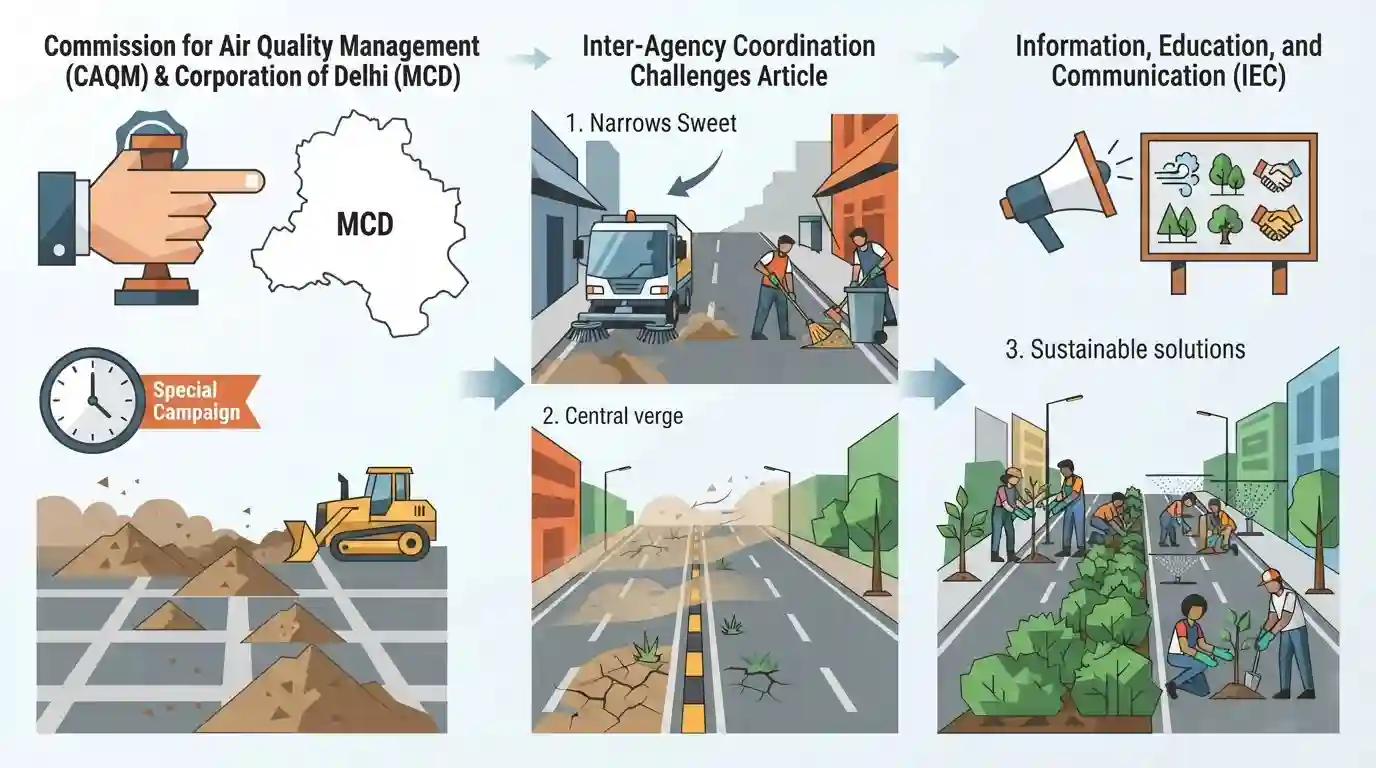
The Commission for Air Quality Management (CAQM) has directed the Municipal Corporation of Delhi (MCD) to intensify its Special Campaign for the removal of legacy dust, aiming to curb air pollution in the region. Emphasizing inter-agency coordination, CAQM highlighted practical challenges such as the limited efficacy of mechanical sweepers on narrow roads and recurring dust from poorly managed central verges. To ensure sustainable dust mitigation, the Commission recommended prioritizing the greening of roads with soil-trapping plants over excessive concretisation and bolstering citizen participation through IEC initiatives.
ముఖ్య అంశాలు
- The CAQM reviewed a Special Campaign for the removal of legacy dust across 12 MCD zones in Delhi, directing agencies to sustain dust mitigation efforts.
- Dust Control and Management Cells (DCMCs) have been tasked with the identification, removal, and scientific disposal of legacy dust from roadsides, footpaths, and medians.
- Key operational challenges identified include the limited utility of Mechanical Road Sweeping Machines (MRSMs) on narrow roads (under 9 meters) due to parked vehicles, and repeated dust deposition caused by overflowing irrigation water from central verges.
- CAQM recommended shifting away from excessive concretisation in favor of 'greening' roads using soil-trapping plant species to minimise soil erosion and dust resuspension.
- Inter-agency coordination, capacity-building for sanitation workers, and Information, Education and Communication (IEC) initiatives for citizen participation were heavily emphasized.
ముఖ్యమైన పదాలు
Commission for Air Quality Management (CAQM)

A statutory body established under a 2021 Act to coordinate, research, identify, and resolve air quality issues in India's National Capital Region (NCR) and adjoining areas.
UPSC context
GS Paper III (Environment); tests knowledge of statutory environmental bodies, pollution governance, and regional coordination frameworks.
Dust Control and Management Cells (DCMCs)
Specialised units established by road-owning and construction agencies across NCR to monitor, implement, and report on localized road dust mitigation and control measures.
UPSC context
GS Paper III (Environment); tests understanding of decentralized pollution management and urban dust mitigation strategies.
Municipal Corporation of Delhi (MCD)
A major municipal body governing Delhi, reunited in 2022 to provide civic services, infrastructure, and public health management to over 20 million residents across 12 zones.
UPSC context
GS Paper II (Polity & Governance); tests concepts of local self-government, urban decentralization, and municipal coordination.
National Clean Air Programme (NCAP)
A time-bound national initiative launched in 2019 to reduce particulate matter (PM10 and PM2.5) concentrations by 40% by 2026 across non-attainment cities.
UPSC context
GS Paper III (Environment); tests awareness of central pollution control targets and collaborative city-specific air quality policies.
ప్రిలిమ్స్ ఉచ్చు
CAQM's jurisdiction is strictly confined to the National Capital Region (NCR) and it functions under the Central Pollution Control Board (CPCB).
CAQM is a statutory body with overriding powers over the CPCB. Its jurisdiction legally extends beyond the NCR to adjoining areas in Punjab, Haryana, Rajasthan, and UP.
అనుసంధానమైన స్థిర భావనలు
How does the CAQM differ from the previous EPCA and CPCB?
- Statutory Backing: CAQM is established by a 2021 Act of Parliament, whereas the now-dissolved EPCA was formed via Supreme Court directions under the EPA 1986.
- Overriding Powers: CAQM directives supersede the orders of state pollution control boards and the CPCB regarding air pollution within its territorial remit.
- Broad Jurisdiction: It covers the NCR as well as 'adjoining areas' across four neighboring states whose pollution sources impact Delhi's air quality.
What drives PM10 and PM2.5 pollution differently in urban areas?
- Dominant Sources: PM10 is heavily driven by mechanical processes like road dust and construction, while PM2.5 largely stems from combustion such as vehicle exhaust and biomass burning.
- Health Impact: PM2.5 poses severe systemic risks as its fine size (<2.5 micrometers) allows it to bypass lung barriers and enter the bloodstream, unlike coarser PM10.
అంతర-అంశ నమూనాలు
Concretisation: Dust, Floods & Heat
CAQM's push against excessive road concretisation to curb dust links directly to mitigating urban flooding (by preserving groundwater recharge zones) and the Urban Heat Island effect (GS1/GS3).
CAQM vs NCAP Mandates
While the National Clean Air Programme targets 'non-attainment cities' across India, CAQM exercises overriding statutory powers specifically targeting the NCR and its broader airshed.

Expect a 2026 prelims question contrasting CAQM's statutory overriding powers with CPCB, or linking concretisation to PM10 & urban floods.
అనుసంధాన PYQలు · 3
అనుసంధాన PYQలు · 3
- 2021MainsGS3
Describe the key points of the revised Global Air Quality Guidelines (AQGs) recently released by the World Health Organisation (WHO). How are these different from its last update in 2005? What changes in India's National Clean Air Programme are required to achieve these revised standards?
- 2022PrelimsGS1
In the context of WHO Air Quality Guidelines, consider the following statements: 1. The 24-hour mean of PM2.5 should not exceed 15 µg/m³ and annual mean of PM2.5 should not exceed 5 µg/m³. 2. In a year, the highest levels of ozone pollution occur during the periods of inclement weather. 3. PM10 can penetrate the lung barrier and enter the bloodstream. 4. Excessive ozone in the air can trigger asthma. Which of the statements given above are correct?
- 2020MainsGS3
What are the key features of the National Clean Air Programme (NCAP) initiated by the Government of India?
