Prime Minister Chairs High Level Meeting With Secretaries
Source:PIB ↗
ఇది ఎందుకు ముఖ్యం
The meeting highlights top-level administrative directives aimed at civil service reforms, improving administrative efficiency by tackling inter-ministerial silos, and aligning policy outcomes directly with citizen benefits. It links core administrative reforms directly with national security priorities like cybersecurity and energy independence, which are frequent themes in UPSC GS2 and GS3 syllabus.
సారాంశం
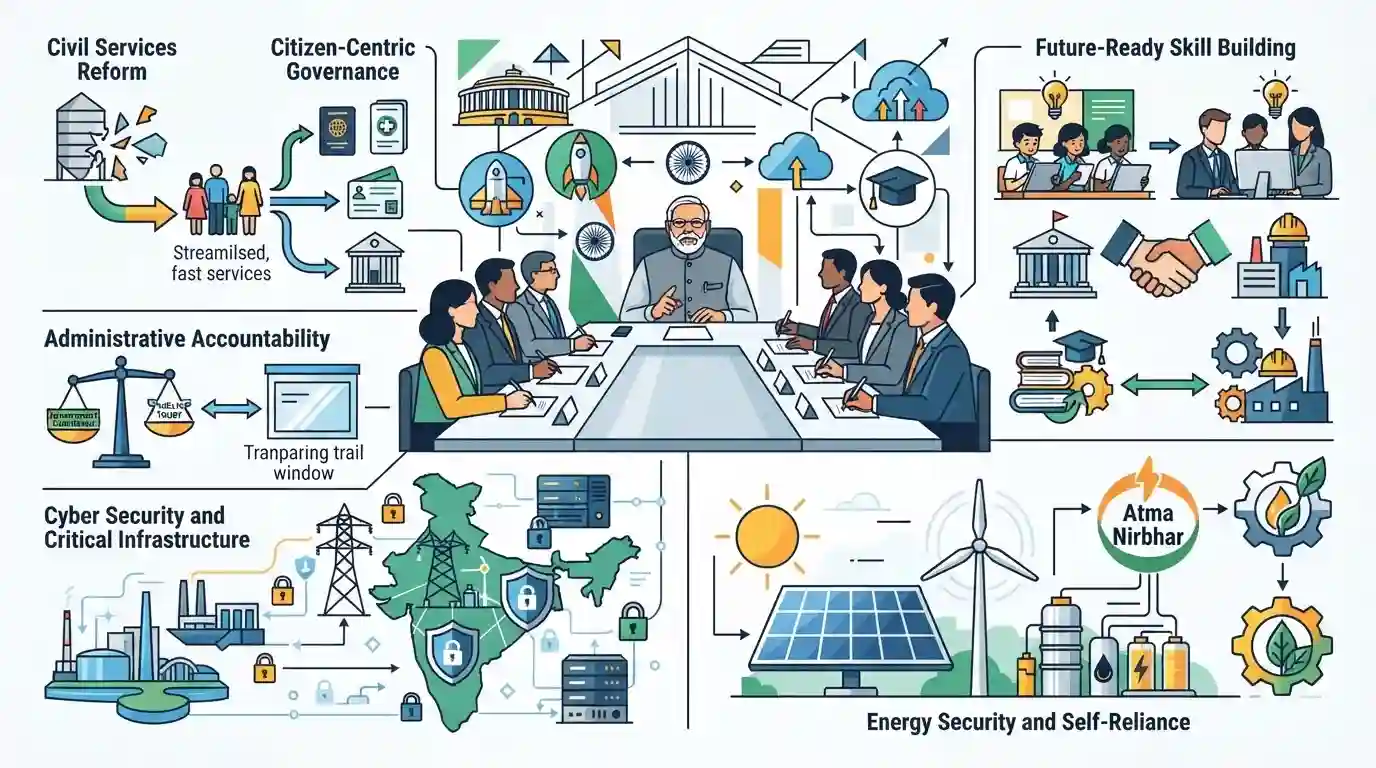
Prime Minister Narendra Modi chaired the second high-level coordination meeting with Secretaries of the Government of India. The discussions centered on institutionalizing a 'whole-of-government' approach by breaking down administrative silos, prioritizing citizen-centric outcomes over mere departmental outputs, driving technological self-reliance, and elevating cybersecurity into a nationwide movement. The Prime Minister also linked energy security with national stability and called for future-ready skill building via industry-academia collaborations.
ముఖ్య అంశాలు
- Prime Minister Narendra Modi chaired the second high-level meeting with Secretaries to the Government of India, emphasizing a 'Whole-of-Government' administrative approach.
- Urged secretaries to dismantle both horizontal (inter-departmental) and vertical (hierarchical) silos to ensure unified, swift, and coordinated action across ministries.
- Stressed a shift from output-based tracking to citizen-centric outcome delivery, focusing on the actual societal impact and quality of life improvements.
- Highlighted technological self-reliance, noting the necessity of promoting indigenous technologies, young innovators, and strengthening local capabilities in crucial economic and tech sectors.
- Identified energy security as a core pillar of national security and economic stability, urging accelerated capacity creation and innovation.
- Called for transforming cybersecurity into a nationwide movement to counter emerging cyber threats and protect digital infrastructure.
- Emphasized restructuring educational and training curricula through industry-academia partnerships to equip the youth with future-ready skills.
ముఖ్యమైన పదాలు
Whole-of-Government Approach

A collaborative governance model where multiple government departments and ministries coordinate across horizontal and vertical levels to deliver integrated solutions, breaking traditional administrative silos.
UPSC context
GS Paper II: Governance and Administrative Reforms. Tests knowledge of policy coordination and institutional synergy.
Viksit Bharat
The Government of India’s long-term vision to transform the country into a fully developed, prosperous, and self-reliant nation by 2047, the centenary year of its independence.
UPSC context
GS Paper III: Indian Economy. Tests understanding of long-term economic planning and national development goals.
Cabinet Secretariat
The premier administrative office under the Prime Minister that facilitates the transaction of government business and ensures inter-ministerial coordination to implement major executive decisions.
UPSC context
GS Paper II: Polity and Governance. Tests administrative machinery, cabinet committees, and roles of senior civil servants.
Citizen-Centric Governance
An administrative approach that places citizen welfare and needs at the center of public service delivery, ensuring transparency, robust grievance redressal, accountability, and active public participation.
UPSC context
GS Paper II: Governance. Tests recommendations from the Second Administrative Reforms Commission (2nd ARC) reports.
Administrative Silos
The isolation of governmental departments or ministries working independently, which causes duplication of efforts, resource wastage, and fragmented policy execution.
UPSC context
GS Paper II: Civil Services Reforms. Tests structural bottlenecks and inter-departmental coordination strategies.
ప్రిలిమ్స్ ఉచ్చు
The Cabinet Secretariat functions under the administrative control of the Ministry of Personnel, Public Grievances and Pensions.
The Cabinet Secretariat is placed directly under the Prime Minister of India, not under the Ministry of Personnel, ensuring its independent horizontal coordination power.
అనుసంధానమైన స్థిర భావనలు
What is the difference between Output and Outcome Budgeting in India?
- Output Budgeting: Measures physical, immediate, and quantifiable deliverables of a scheme, such as total funds spent or kilometers of national highways constructed.
- Outcome Budgeting: Evaluates the qualitative, long-term developmental impact on the target population, such as reduced travel time or lowered transport logistics costs.
- Indian Evolution: First introduced in India in 2005-06 to shift the bureaucratic focus from purely absorbing monetary allocations to actual service performance.
What is the institutional role of the Cabinet Secretariat in Indian governance?
- Direct Jurisdiction: Functions directly under the Prime Minister and acts as the apex administrative coordinating body for the entire Government of India.
- Business Rules: Responsible for administering the Government of India (Allocation of Business) Rules, 1961, ensuring seamless inter-ministerial operation.
- Administrative Head: Headed by the Cabinet Secretary, who is the administrative head of the civil services and chairs the critical Committee of Secretaries.
అంతర-అంశ నమూనాలు
Cybersecurity + Digital Public Infrastructure
Direct integration of national cybersecurity systems with digital civic portals is crucial to safeguarding massive public-service databases from sophisticated, state-sponsored cyber threat actors.
Administrative Reforms + Energy Transition
Adopting a 'whole-of-government' approach resolves inter-ministerial coordination bottlenecks, allowing concurrent clearance of green energy corridors, land acquisition, and financial subsidies.

GS-2 is highly likely to test the structural barriers of administrative silos vs. the 'Whole-of-Government' model in 2026.
అనుసంధాన PYQలు · 4
అనుసంధాన PYQలు · 4
- 2020MainsGS2
Institutional quality is a crucial driver of economic performance". In this context suggest reforms in Civil Service for strengthening democracy.
- 2022MainsGS3
What are the different elements of cyber security ? Keeping in view the challenges in cyber security, examine the extent to which India has successfully developed a comprehensive National Cyber Security Strategy.
- 2018MainsGS3
“Access to affordable, reliable, sustainable and modern energy is the sine qua non to achieve Sustainable Development Goals (SDGs).” Comment on the progress made in India in this regard.
- 2025MainsGS2
e-governance projects have a built-in bias towards technology and back-end integration than user-centric designs. Examine.
