Bharat 6G Alliance Progress And 5G Lab Awards
Source:PIB ↗
Why It Matters
It highlights India's strategic roadmap for transitioning from 5G deployment to 6G innovation, a key topic for GS3 Science & Technology and Infrastructure. It underscores the importance of generating indigenous intellectual property (Standard Essential Patents) and fostering an 'Atmanirbhar' telecom manufacturing ecosystem.
Summary
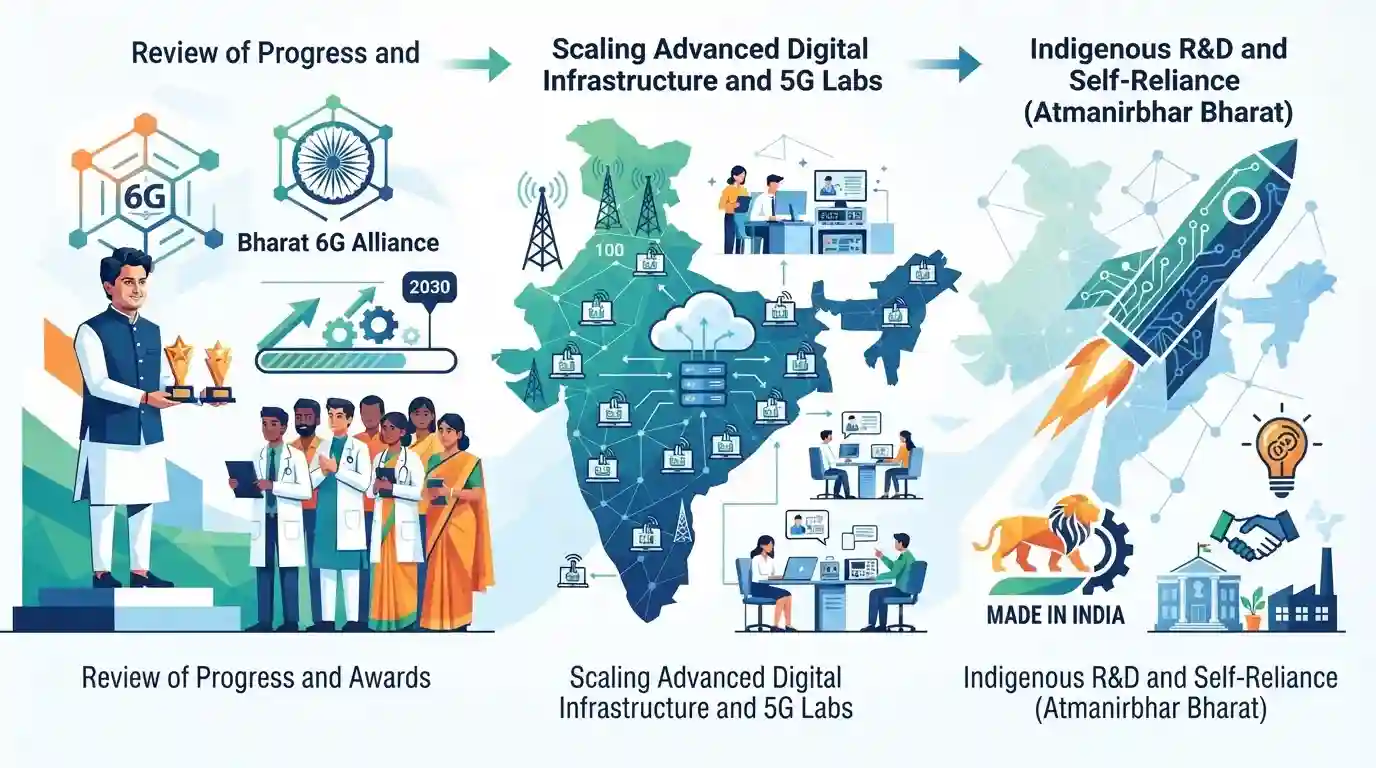
Union Minister for Communications Shri Jyotiraditya M. Scindia reviewed the progress of the Bharat 6G Alliance and presented the 5G Lab Excellence Awards. The event highlighted India's rapid strides in establishing a robust domestic telecom ecosystem and scaling advanced digital infrastructure. With the Bharat 6G Vision aiming to position India as a leading contributor in 6G standard-setting and technology creation by 2030, the establishment of 100 5G labs across academic institutions plays a critical role in fostering indigenous R&D, intellectual property generation, and industry-academia collaborations. The development emphasizes a shift toward self-reliance (Atmanirbhar Bharat) in high-tech telecommunications.
Key Points
- The Union Minister reviewed the progress of the Bharat 6G Alliance (B6GA), a collaborative platform driving India's efforts to become a global leader in 6G standard-setting and innovation by 2030.
- 5G Lab Excellence Awards were distributed to recognize outstanding use cases and indigenous intellectual property (IP) generated across 100 5G labs established in academic institutions nationwide.
- The initiative underscores India's push towards 'Atmanirbhar Bharat' in telecommunications by fostering industry-academia partnerships, developing domestic telecom equipment, and reducing import reliance.
- The transition from 5G application deployment to 6G foundational research is crucial for advancing India's digital economy, smart infrastructure, and global technological competitiveness.
Important Terms
Bharat 6G Vision

A national strategic roadmap launched in March 2023 aiming to position India as a leading global contributor in the design, development, and deployment of advanced, affordable, and secure 6G telecom technology by 2030.
UPSC context
GS Paper III (Science and Technology); tests knowledge of next-gen telecom policies, digital infrastructure, and domestic R&D.
Bharat 6G Alliance
An industry-led, government-facilitated collaborative platform launched in July 2023 to foster domestic research, design, intellectual property creation, and standard-setting for next-generation 6G telecommunications.
UPSC context
GS Paper III (Science & Technology); tests awareness of industry-academia collaboration, technological self-reliance, and standards-setting in telecom.
Department of Telecommunications (DoT)
A department under the Ministry of Communications responsible for formulating developmental policies, licensing, and frequency spectrum management to accelerate the growth of telecommunication services across India.
UPSC context
GS Paper II (Government Policies & Interventions); tests understanding of regulatory bodies, administrative frameworks, and policy implementation in the digital sector.
Digital India
A flagship umbrella programme launched in July 2015 to transform India into a digitally empowered society and knowledge economy by improving online infrastructure and internet connectivity.
UPSC context
GS Paper III (Information Technology/Digital Infrastructure); tests knowledge of e-governance, digital inclusion, and technology-driven development schemes.
Atmanirbhar Bharat
A national campaign launched in May 2020 promoting self-reliance across critical sectors, emphasizing domestic manufacturing, local supply chains, and high-tech innovation to reduce import dependence.
UPSC context
GS Paper III (Indian Economy/Industrial Policy); tests understanding of manufacturing reforms, high-tech indigenization, and national economic strategies.
Prelims Trap
6G networks operate primarily on the same millimeter-wave (mmWave) spectrum bands as 5G, utilizing higher tower density.
5G relies on millimeter-wave bands. 6G represents a foundational shift to ultra-high frequency Terahertz (THz) bands (100 GHz to 3 THz), enabling vastly higher speeds.
Static Concepts Connected
What is the Universal Service Obligation Fund (USOF) / Digital Bharat Nidhi?
- Statutory basis: Established under the Indian Telegraph Act, it is funded by a Universal Access Levy (UAL) charged as a percentage of telecom operators' revenue.
- New nomenclature: Renamed 'Digital Bharat Nidhi' under the Telecommunications Act 2023, its legal mandate was expanded beyond providing basic rural connectivity.
- R&D funding: It now explicitly funds indigenous R&D, such as the Telecom Technology Development Fund (TTDF) which is financing India's 6G testbeds.
What are the core technological differences between 5G and 6G?
- Frequency spectrum: 5G utilizes Sub-6 GHz and millimeter waves. 6G shifts to sub-terahertz (THz) and terahertz bands for vastly wider channels.
- Speed and latency: 5G peaks at 20 Gbps with 1-millisecond latency. 6G targets 1 Terabit per second (Tbps) with microsecond (~100µs) latency.
- Terrestrial integration: 6G aims for seamless convergence of terrestrial (cell towers) and non-terrestrial (satellite) networks to provide ubiquitous global coverage.
Cross-Topic Patterns
Digital Bharat Nidhi & R&D
The transition of USOF to Digital Bharat Nidhi provides legal backing to fund high-tech initiatives like the Bharat 6G Alliance, shifting policy focus from basic rural connectivity to indigenous IP generation.
Terahertz Spectrum & Satcom
6G's reliance on Terahertz bands requires deep integration of terrestrial mobile networks with non-terrestrial satellite communication, linking telecom policy directly to India's recent space sector privatization and satcom reforms.

Expect a comparative science question in 2026 contrasting 5G (mmWave, Gbps) with 6G (Terahertz, Tbps, microsecond latency) + USOF funding.
Linked PYQs · 4
Linked PYQs · 4
- 2023MainsGS3
What is the status of digitalization in the Indian economy? Examine the problems faced in this regard and suggest improvements.
- 2019PrelimsGS1
With reference to communication technologies, what is/are the difference/differences between LTE (Long-Term Evolution) and VoLTE (Voice over Long-Term Evolution)? 1. LTE is commonly marketed as 3G and VoLTE is commonly marketed as advanced 3G. 2. LTE is data-only technology and VoLTE is voice-only technology. Select the correct answer using the code given below.
- 2026PrelimsGS1
Which of the following statements with regard to drone swarms is/are correct ? 1. They use Terahertz band of frequency to communicate with the command centre. 2. Individual drones in the swarm can communicate with other drones in the swarm. 3. GPS Spoofing is a commonly used technique to counter drone swarm attack. Select the answer using the code given below :
- 2022PrelimsGS1
Consider the following communication technologies: 1. Closed-circuit Television 2. Radio Frequency Identification 3. Wireless Local Area Network Which of the above are considered Short-Range devices/technologies?
