Continuation Of PM AJAY Welfare Scheme For Scheduled Castes
Source:PIB ↗
কেন এটি গুরুত্বপূর্ণ
This article highlights the shift towards evidence-based governance, where independent evaluations by bodies like NITI Aayog\'s DMEO dictate the continuation and funding of major welfare schemes. For UPSC aspirants, PM-AJAY serves as a prime case study of consolidating multiple central schemes to maximize grassroots impact on marginalized groups (Scheduled Castes) through targeted interventions like livelihood grants, student hostels, and model villages.
সারসংক্ষেপ
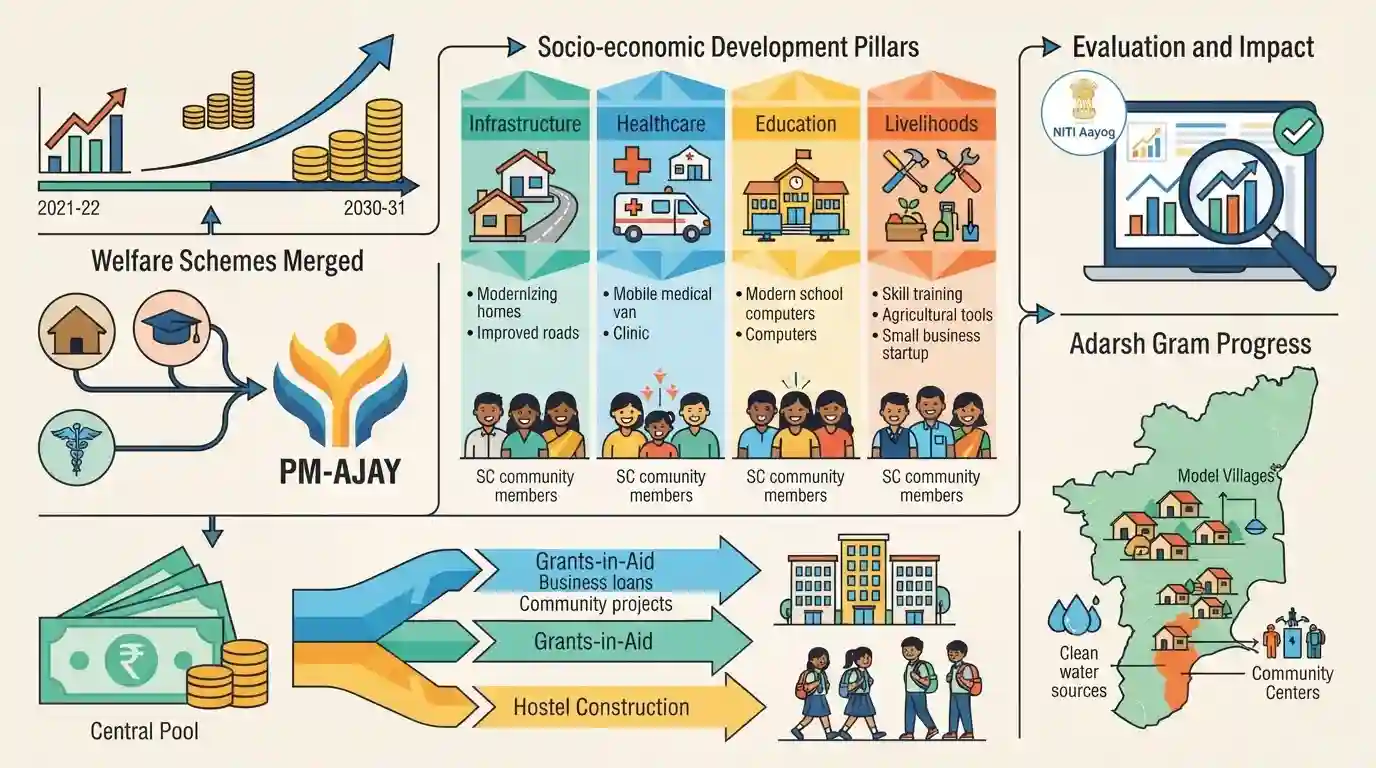
The Central Government has proposed extending the Pradhan Mantri Anusuchit Jaati Abhyuday Yojana (PM-AJAY) from 2026-27 to 2030-31 with an increased financial outlay. PM-AJAY, launched in 2021-22 to merge earlier welfare schemes, supports the socio-economic development of Scheduled Caste (SC) communities through Adarsh Gram, Grants-in-Aid, and Hostel construction. An independent evaluation by NITI Aayog\'s DMEO verified the positive impact of the scheme in enhancing infrastructure, healthcare, education, and livelihoods in SC-dominated areas. Over ₹4,276.62 crores has been released since the scheme\'s inception, with notable progress under the Adarsh Gram component, especially in Tamil Nadu.
মূল বিষয়
- The Ministry of Social Justice and Empowerment has proposed the continuation of the Pradhan Mantri Anusuchit Jaati Abhyuday Yojana (PM-AJAY) for the cycle 2026-27 to 2030-31 with an enhanced financial outlay.
- An independent evaluation by NITI Aayog\'s Development Monitoring and Evaluation Office (DMEO) concluded that PM-AJAY has successfully improved access to basic infrastructure, electricity, banking facilities, institutional healthcare, education, and livelihood opportunities for SC communities.
- PM-AJAY was launched in FY 2021-22 and is implemented through three components: Adarsh Gram (development of SC-majority model villages), Grants-in-Aid (for district/state level socio-economic projects), and Hostels (construction and maintenance for SC students).
- Since its launch, the Central Government has released ₹4,276.62 crores under the scheme across 30 states and UTs, with states reporting a utilization of ₹3,185.072 crores. In FY 2025-26 alone, ₹1,100.09 crores was released.
- Under the Adarsh Gram component, 3,112 villages have been identified since 2018-19, of which 3,111 villages located in Tamil Nadu have been officially declared Adarsh Grams.
গুরুত্বপূর্ণ শব্দ
Pradhan Mantri Anusuchit Jaati Abhyuday Yojana (PM-AJAY)

A 100% centrally funded scheme launched in FY 2021-22 merging earlier schemes to uplift Scheduled Castes through Adarsh Gram development, livelihood grants, and student hostel construction.
UPSC context
GS Paper II: Welfare schemes for vulnerable sections. Tests knowledge of social justice initiatives and inclusive growth.
Development Monitoring and Evaluation Office (DMEO)
An attached office of NITI Aayog established in 2015 to actively monitor, evaluate, and provide data-driven feedback on the implementation of Government of India schemes.
UPSC context
GS Paper II: Governance. Tests mechanisms of evidence-based policymaking, programmatic accountability, and administrative reforms.
Ministry of Social Justice and Empowerment
The nodal Union ministry responsible for the welfare, social justice, and empowerment of marginalized groups, including Scheduled Castes, OBCs, senior citizens, and persons with disabilities.
UPSC context
GS Paper II: Welfare and institutional mechanisms. Tests understanding of governmental structures supporting vulnerable demographics.
NITI Aayog
The premier public policy think tank of the Government of India, established in 2015 to replace the Planning Commission and foster cooperative and competitive federalism.
UPSC context
GS Paper II & III: Planning and federalism. Tests knowledge of decentralized governance and cooperative federal structures.
Lok Sabha
The lower house of India's bicameral Parliament, comprising representatives directly elected by the public, holding primary authority over financial bills and executive accountability.
UPSC context
GS Paper II: Parliament and State Legislatures. Tests knowledge of constitutional provisions, legislative procedures, and democratic accountability.
প্রিলিমস ফাঁদ
PM-AJAY is a Central Sector Scheme that extends model village benefits to any rural area with an SC population exceeding 25%.
PM-AJAY is a Centrally Sponsored Scheme (not Central Sector), and its Adarsh Gram component specifically targets villages with an SC population of 50% or more (not 25%).
সংযুক্ত স্থির ধারণা
What is the structural difference between Central Sector and Centrally Sponsored Schemes (CSS)?
- Funding Split: Central Sector schemes are 100% funded by the Union, whereas CSS are co-funded by Centre and States based on fixed splits (e.g., 60:40 or 90:10).
- Implementation Machinery: Central Sector schemes are executed directly by Central Ministries, while CSS are implemented by State/UT administrative machinery.
- Constitutional Alignment: CSS align closely with subjects under the State or Concurrent Lists, fostering cooperative federalism through shared execution responsibilities.
What is the mandate and role of NITI Aayog's DMEO?
- Institutional Mandate: Established as an attached office under NITI Aayog to fulfill monitoring and evaluation mandates for central government schemes.
- Role in Budgeting: Evaluates Centrally Sponsored Schemes (CSS) to determine their efficiency, impact, and whether they should be continued, restructured, or discontinued.
আন্তঃবিষয় প্যাটার্ন
Scheme Mergers and Administrative Rationalization
Merging PMAGY, SCA to SCSP, and BJRCY into PM-AJAY reflects a policy shift towards consolidated, multi-sectoral interventions rather than fragmented, single-objective schematic silos.
Fiscal Devolution and Evidence-Based Policy
Linking the extension of CSS to independent evaluations by NITI Aayog's DMEO aligns with the Finance Commission's push for performance-linked fiscal transfers and outcome-based budgeting.

PM-AJAY's structural criteria (50% SC threshold) and DMEO evaluation linkages likely to feature in 2026 Prelims social sector questions.
সংযুক্ত PYQ · 1
সংযুক্ত PYQ · 1
- 2019MainsGS2
Performance of welfare schemes that are implemented for vulnerable sections is not so effective due to absence of their awareness and active involvement at all stages of policy process. Discuss.
