PM E DRIVE Scheme For Electric Mobility Promotion
Source:PIB ↗
Why It Matters
Electric mobility is a recurrent theme in both Prelims (battery chemistry, powertrain technologies) and Mains (climate change mitigation, urban transport policy, energy transition). Understanding the shift from FAME to PM E-DRIVE is essential for GS3 questions on infrastructure, subsidies, and environmental conservation.
Summary
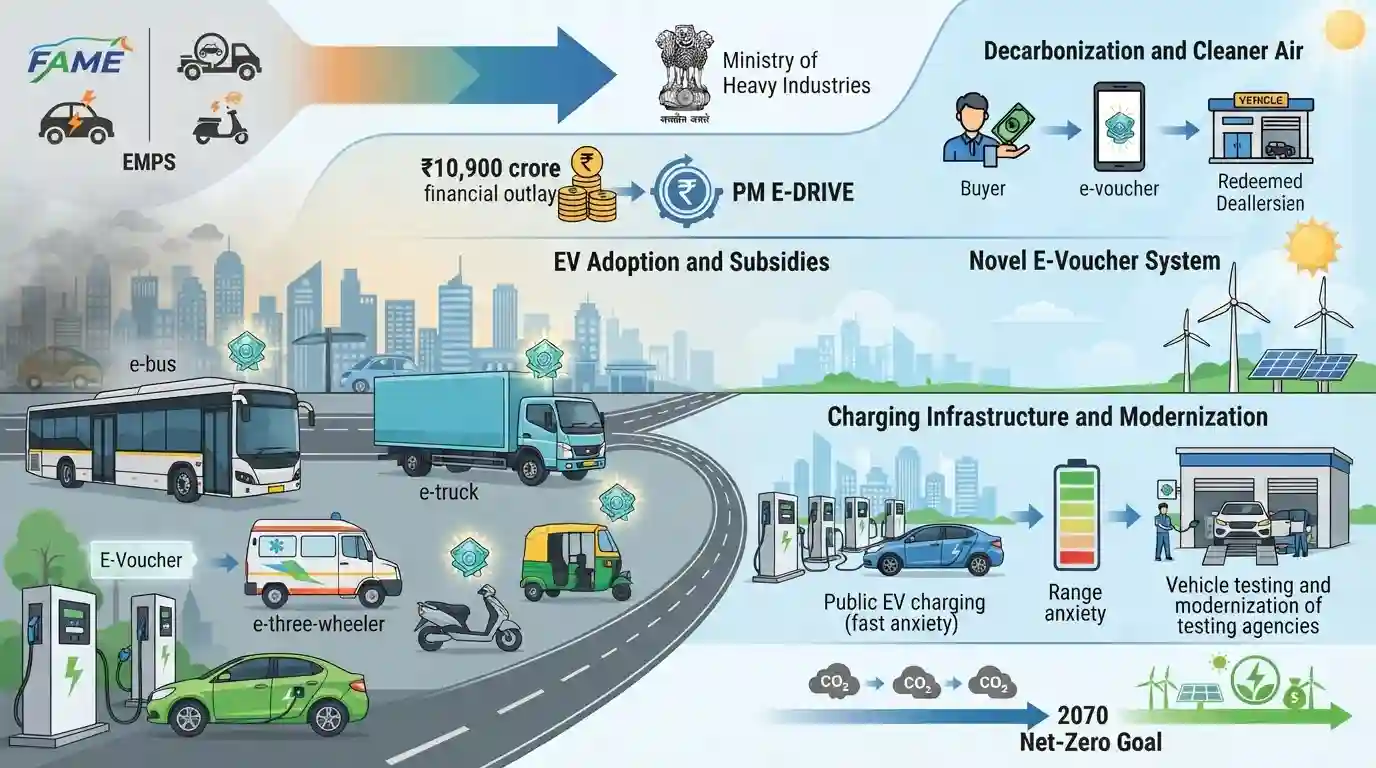
The PM E-DRIVE (PM Electric Drive Revolution in Innovative Vehicle Enhancement) scheme is the Government of India's flagship initiative launched by the Ministry of Heavy Industries to accelerate EV adoption. With an outlay of ₹10,900 crore over two years, it succeeds the FAME and EMPS schemes. The scheme pivots toward public and commercial transportation, heavily subsidizing e-buses, e-trucks, e-ambulances, as well as electric two and three-wheelers via a novel e-voucher system. Crucially, it allocates ₹2,000 crore to build robust public charging infrastructure to alleviate range anxiety, and funds the modernization of vehicle testing agencies. The initiative is a cornerstone of India's strategy to decarbonize the transport sector, improve urban air quality, and achieve net-zero emissions by 2070.
Key Points
- Replaces earlier FAME iterations with a ₹10,900 crore outlay over two years to accelerate India's transition to electric mobility.
- Focuses heavily on electrifying public transport and commercial fleets by allocating substantial funds for e-buses (₹4,391 crore), e-trucks (₹500 crore), and e-ambulances (₹500 crore).
- Introduces an Aadhaar-authenticated e-voucher mechanism on the PM E-DRIVE portal to ensure transparent, targeted delivery of demand incentives to EV buyers.
- Directly tackles 'range anxiety' by earmarking ₹2,000 crore for a massive rollout of Public Charging Stations (PCS) across high-penetration cities and key highways.
- Dedicates ₹780 crore to upgrade the infrastructure of domestic test agencies to ensure rigorous safety and performance standards for emerging EV and battery technologies.
Important Terms
PM E-DRIVE Scheme

A flagship central sector scheme (outlay ₹10,900 crore, 2024–2026) by the Ministry of Heavy Industries to accelerate electric vehicle adoption, subsidize green transit, and establish robust public charging infrastructure.
UPSC context
GS Paper III (Infrastructure/Environment); tests clean mobility policies, decarbonization schemes, and India's net-zero 2070 goals.
FAME (Faster Adoption and Manufacturing of Electric Vehicles)
A flagship subsidy initiative under the National Electric Mobility Mission Plan, run in two phases (2015–2024), aimed at boosting early electric and hybrid vehicle adoption through upfront purchase incentives.
UPSC context
GS Paper III (Infrastructure/Energy); tests evolution of green transport policies and effectiveness of demand-side subsidies.
Electric Mobility Promotion Scheme (EMPS)
A transitional, fund-limited scheme with an outlay of ₹500 crore (April-July 2024) launched by the Ministry of Heavy Industries to maintain momentum in commercial electric two- and three-wheeler adoption.
UPSC context
GS Paper III (Economic Development); tests transitional policy mechanisms and targeted commercial transport incentives in green energy.
Production Linked Incentive (PLI) Scheme for Advanced Chemistry Cell (ACC)
A ₹18,100 crore financial incentive program to establish 50 GWh of domestic giga-scale manufacturing capacity for high-performance battery cells, reducing import reliance and strengthening the local EV supply chain.
UPSC context
GS Paper III (Science & Tech/Industry); tests high-tech industrial indigenization, critical supply chains, and battery manufacturing self-reliance.
Convergence Energy Services Limited (CESL)
A green-energy enterprise under the Ministry of Power that aggregates clean energy demand, drives state-level e-bus procurement, and designs business models to scale up countrywide electric mobility.
UPSC context
GS Paper III (Infrastructure); tests public-sector business models, renewable-energy integration, and public transit electrification strategies.
Automotive Research Association of India (ARAI)
An autonomous cooperative industrial research association established in 1966, affiliated with the Ministry of Heavy Industries, providing crucial testing, certification, and homologation services to India's automotive sector.
UPSC context
GS Paper III (Science & Tech); tests knowledge of institutional bodies setting vehicular safety, emission standards, and R&D indigenization.
International Centre for Automotive Technology (ICAT)
A leading automotive testing, certification, and R&D service provider under the aegis of the Ministry of Heavy Industries, assisting the industry in regulatory homologation and technical validations.
UPSC context
GS Paper III (Science & Tech); tests infrastructure for automotive standards, safety compliance, and technological incubation ecosystems.
Prelims Trap
The PM E-DRIVE scheme provides direct purchase subsidies to buyers of all categories of electric vehicles, including private electric passenger cars.
PM E-DRIVE explicitly excludes private/personal electric passenger cars (e-4Ws) from demand subsidies, prioritizing public transport, commercial fleets, and 2W/3Ws.
Static Concepts Connected
How does PM E-DRIVE differ from the PLI for Advanced Chemistry Cells (ACC)?
- Demand vs Supply: PM E-DRIVE provides demand-side incentives (subsidies to EV buyers), whereas PLI ACC is a supply-side scheme incentivizing domestic battery manufacturing.
- Nodal Ministry: Both schemes are administered by the Ministry of Heavy Industries (MHI) to build a comprehensive EV ecosystem.
How does the Vehicle Scrapping Policy intersect with the PM E-DRIVE scheme?
- Scrappage Mandate: Vehicles failing fitness tests (after 15 years for commercial, 20 for private) must be scrapped at a Registered Vehicle Scrapping Facility (RVSF).
- E-Truck Subsidy Linkage: Under PM E-DRIVE, demand incentives for purchasing e-trucks are strictly contingent upon the buyer presenting a valid scrapping certificate.
Cross-Topic Patterns
EV Subsidies + Digital Public Infrastructure
The Aadhaar-authenticated e-voucher mechanism mirrors e-RUPI, leveraging India's DPI to ensure targeted, leak-proof delivery of vehicle subsidies directly at the point of sale.
Green Transition + Circular Economy
By mandating scrapping certificates for e-truck subsidies, the scheme forces a dual outcome: retiring high-polluting older ICE fleets while simultaneously stimulating commercial EV adoption.

Prelims 2026 will likely test the exclusions of PM E-DRIVE (private e-cars) and its mandatory linkage to the Vehicle Scrapping Policy.
Linked PYQs · 5
Linked PYQs · 5
- 2023MainsGS3
The adoption of electric vehicles is rapidly growing worldwide. How do electric vehicles contribute to reducing carbon emissions and what are the key benefits they offer compared to traditional combustion engine vehicles?
- 2025PrelimsGS1
Consider the following types of vehicles : I. Full battery electric vehicles II. Hydrogen fuel cell vehicles III. Fuel cell-electric hybrid vehicles How many of the above are considered as alternative powertrain vehicles?
- 2025PrelimsGS1
In the context of electric vehicle batteries, consider the following elements : I. Cobalt II. Graphite III. Lithium IV. Nickel How many of the above usually make up battery cathodes?
- 2014MainsGS3
National Urban Transport Policy emphasises on 'moving people' instead of 'moving vehicles'. Discuss critically the success of the various strategies of the Government in this regard.
- 2024PrelimsGS1
Which one of the following is the exhaust pipe emission from Fuel Cell Electric Vehicles, powered by hydrogen ?
