Electric Vehicle Ecosystem And FAME Scheme Transition
Source:PIB ↗
Why It Matters
The transition to electric mobility is crucial for India to achieve its COP26 net-zero commitments and reduce crude oil import dependency. Understanding the shift from blanket subsidy schemes (FAME) to targeted domestic manufacturing (PLI) and infrastructure support (PM EDRIVE) is vital for GS3 questions on industrial growth, infrastructure, and environmental conservation.
Summary
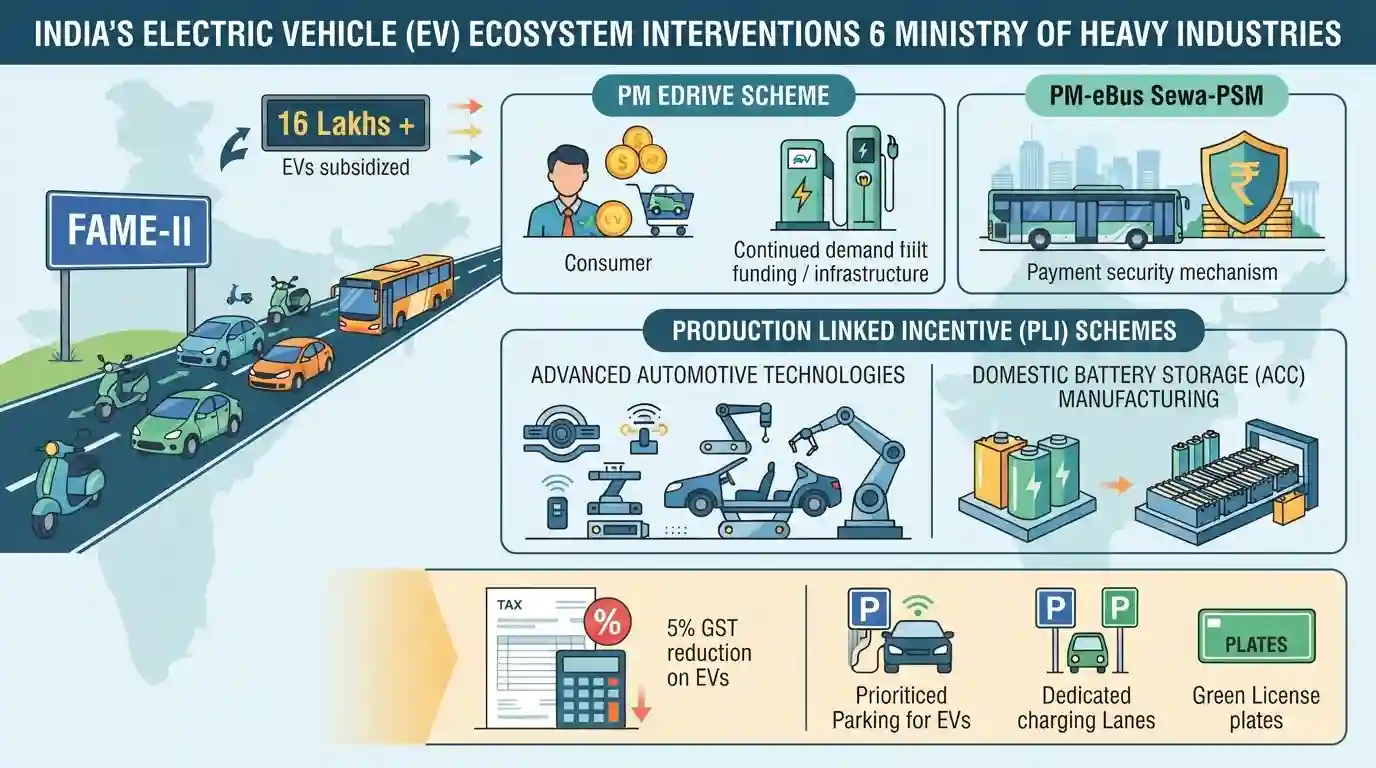
The Ministry of Heavy Industries detailed various government interventions promoting the electric vehicle (EV) ecosystem in India. Following the completion of the Faster Adoption and Manufacturing of (Hybrid & Electric) Vehicles (FAME-II) scheme, which subsidized over 16 lakh EVs, the government has transitioned to targeted initiatives. The PM EDRIVE scheme will continue demand incentives and fund public charging stations, while the PM-eBus Sewa-PSM guarantees payment security for electric public transport. Supply-side support is driven by two major Production Linked Incentive (PLI) schemes focused on advanced automotive technologies and domestic battery storage (ACC) manufacturing. Additionally, the government has reduced GST on EVs to 5% and provided non-fiscal incentives. However, there is no plan to introduce a standalone National Electric Vehicle Policy.
Key Points
- FAME-II (2019-2024) supported 16.72 lakh electric vehicles and 5,197 e-buses with an outlay of Rs 11,500 crore.
- The government is pushing domestic manufacturing through the PLI-Auto (Rs. 25,938 crore) and PLI for Advanced Chemistry Cell Battery Storage (Rs. 18,100 crore) schemes.
- The newly notified PM EDRIVE Scheme (Rs. 10,900 crore) subsidizes electric two-wheelers, three-wheelers, e-buses, e-trucks, and public charging infrastructure.
- The PM-eBus Sewa-Payment Security Mechanism (Rs. 3,435 crore) supports procurement and operation of electric buses by public transport authorities.
- Taxes on EVs and charging stations have been reduced to 5%, alongside non-fiscal incentives like green license plates and road tax waivers.
- The Ministry clarified that no overarching 'National Electric Vehicle Policy' is currently under consideration.
Important Terms
PM EDRIVE Scheme

A ₹10,900 crore central scheme launched in 2024 providing demand incentives for electric vehicles (two-wheelers, three-wheelers, ambulances, trucks, and buses) and funding public EV charging infrastructure.
UPSC context
GS Paper III (Infrastructure/Environment); tests understanding of fiscal interventions for clean energy transitions and national pollution reduction goals.
FAME India Scheme Phase-II
An ₹11,500 crore flagship scheme (2019–2024) that catalyzed India’s initial transition to electric mobility by subsidizing EV purchases and supporting public charging infrastructure development.
UPSC context
GS Paper III (Infrastructure); tests understanding of policy instruments used to kickstart domestic manufacturing and adoption of green vehicles.
PLI Scheme for National Programme on Advanced Chemistry Cell (ACC) Battery Storage
An ₹18,100 crore performance-linked manufacturing incentive program targeting the establishment of 50 GWh of domestic giga-scale battery manufacturing capacity to secure self-reliance in the clean energy supply chain.
UPSC context
GS Paper III (Industrial Policy); tests understanding of clean technology localization, supply chain resilience, and battery storage ecosystems.
PLI Scheme for Automobile and Auto Component Industry
A performance-linked scheme designed to address cost disabilities and encourage investments in domestic manufacturing of Advanced Automotive Technology (AAT) products, including electric and hydrogen vehicles.
UPSC context
GS Paper III (Industrial Policy); tests comprehension of measures to upgrade manufacturing capabilities toward high-value green automotive technologies.
PM-eBus Sewa-Payment Security Mechanism (PSM) Scheme
A ₹3,435 crore scheme providing payment security to electric bus operators in case of municipal defaults, aimed at boosting private sector participation in green public transport.
UPSC context
GS Paper III (Infrastructure/PPP); tests knowledge of de-risking mechanisms to attract private investments into sustainable public urban transport.
Scheme to Promote Manufacturing of Electric Passenger Cars in India (SPMEPCI)
A 2024 framework offering a concessional 15% customs duty on imported premium electric cars to global companies committing to invest ₹4,150 crore in domestic manufacturing.
UPSC context
GS Paper III (Industrial Growth/FDI); tests comprehension of tariff-linked industrial policies designed to attract global EV manufacturing investments.
Prelims Trap
The PM E-DRIVE scheme extends demand incentives across all categories of electric transport, including private electric passenger cars.
Under PM E-DRIVE, private electric passenger cars (four-wheelers) are explicitly excluded from demand subsidies, prioritizing public/commercial transport, e-2Ws, and e-3Ws.
Static Concepts Connected
What is the Gross Cost Contract (GCC) model used in public transport PPPs?
- Core Mechanism: Private operators procure, operate, and maintain buses, while the transport authority pays them on a per-kilometer basis.
- Risk Sharing: Private operator bears operational risks, whereas the public authority bears the commercial market (fare-collection) risk.
- PSM Linkage: The Payment Security Mechanism protects operators against defaults by cash-strapped State Transport Undertakings (STUs).
What constitutes an Advanced Chemistry Cell (ACC) and why is its PLI technology-agnostic?
- Definition: ACCs are next-generation energy storage cells that convert chemical energy to electricity with high density and efficiency.
- Tech-Agnostic: The PLI does not mandate Lithium-ion; any chemistry (Sodium-ion, Solid-state) meeting minimum performance criteria qualifies.
- DVA Target: Beneficiary firms must scale Domestic Value Addition from 25% within 2 years to 60% within 5 years.
Cross-Topic Patterns
Critical Minerals and EV Geopolitics
India's battery localization (PLI ACC) interacts directly with mineral diplomacy (Minerals Security Partnership) to secure upstream access to lithium, cobalt, and nickel.
Fiscal Federalism in Transit Decarbonization
Central schemes like PM-eBus Sewa require municipal/state cooperation, exposing structural financial distress in State Transport Undertakings (STUs) managing operational contracts.

PM E-DRIVE vehicle exclusions combined with PLI ACC value-addition mandates will likely feature in a 2026 multi-statement question.
Linked PYQs · 3
Linked PYQs · 3
- 2023MainsGS3
The adoption of electric vehicles is rapidly growing worldwide. How do electric vehicles contribute to reducing carbon emissions and what are the key benefits they offer compared to traditional combustion engine vehicles?
- 2025MainsGS3
Discuss the rationale of the Production Linked Incentive (PLI) scheme. What are its achievements? In what way can the functioning and outcomes of the scheme be improved?
- 2025PrelimsGS1
Consider the following types of vehicles : I. Full battery electric vehicles II. Hydrogen fuel cell vehicles III. Fuel cell-electric hybrid vehicles How many of the above are considered as alternative powertrain vehicles?
