Production Linked Incentive Schemes For Manufacturing Sector
Source:PIB ↗
কেন এটি গুরুত্বপূর্ণ
This comprehensive policy approach is highly relevant for GS-3, covering topics like changes in industrial policy, infrastructure (energy), and indigenization of technology. It provides concrete examples for mains answers regarding government interventions to promote EVs (carbon emission reduction), secure critical supply chains (rare earth magnets, advanced chemistry cells), and modernize manufacturing (Industry 4.0).
সারসংক্ষেপ
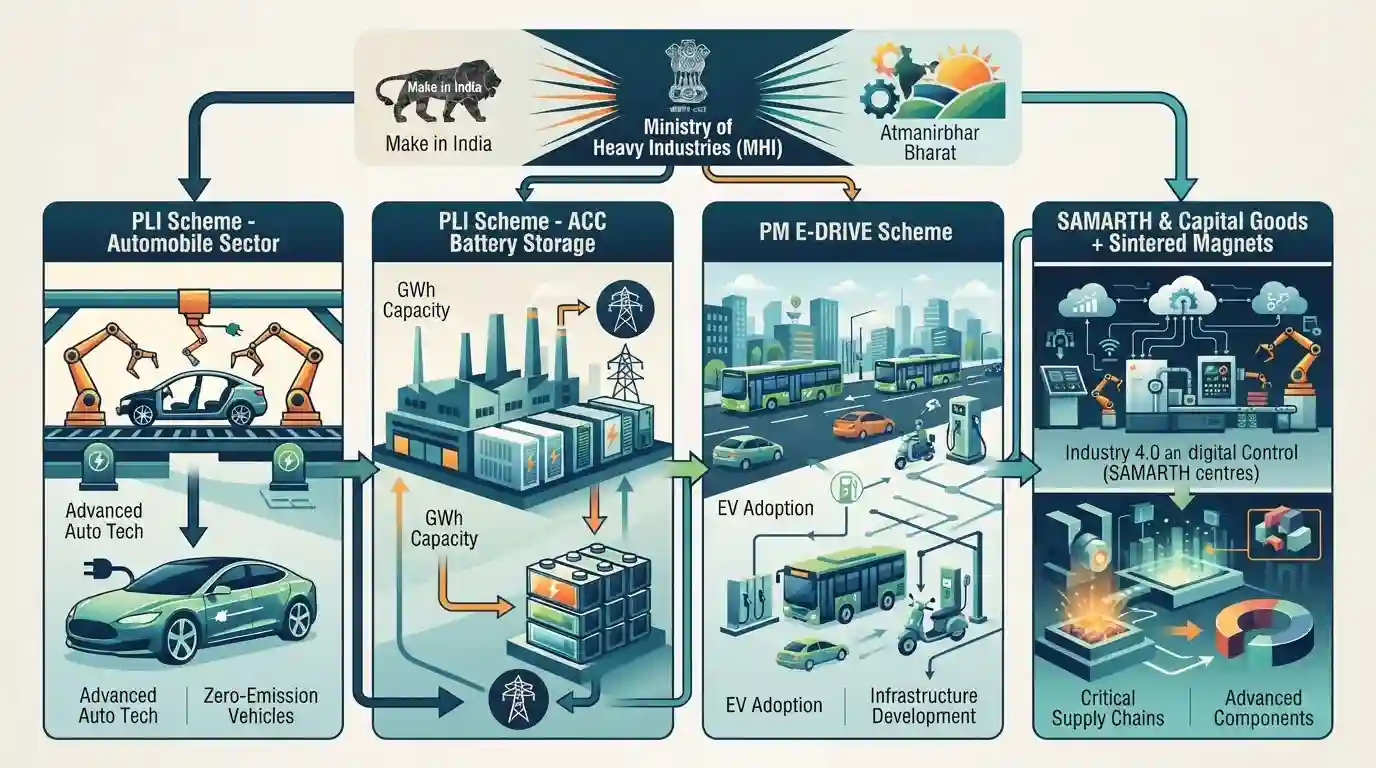
The Ministry of Heavy Industries (MHI) has detailed a suite of schemes aimed at bolstering India's domestic manufacturing, technological capabilities, and self-reliance, aligning with the 'Make in India' and 'Atmanirbhar Bharat' visions. Central to this are the Production Linked Incentive (PLI) schemes for the Auto Sector (focusing on advanced automotive tech and zero-emission vehicles) and Advanced Chemistry Cell (ACC) battery storage. Furthermore, the PM E-DRIVE scheme drives EV adoption and infrastructure development. The MHI is also advancing the Capital Goods sector through SAMARTH centres for Industry 4.0 and securing critical supply chains with a scheme for manufacturing Sintered Rare Earth Permanent Magnets.
মূল বিষয়
- The PLI-Auto scheme aims to boost domestic manufacturing of Advanced Automotive Technology (AAT) products, particularly focusing on zero-emission vehicles.
- The PLI-ACC scheme is designed to establish gigascale domestic manufacturing capacity for Advanced Chemistry Cell batteries, reducing reliance on imports for energy storage.
- The PM E-DRIVE Scheme accelerates the transition to electric mobility by providing subsidies for EV adoption and heavily investing in public charging infrastructure.
- Phase-II of the Capital Goods scheme establishes SAMARTH centres to facilitate the adoption of Industry 4.0 and smart manufacturing technologies across Indian industries.
- A targeted scheme promotes the indigenous manufacturing of Sintered Rare Earth Permanent Magnets, which are critical for motors in EVs and other advanced technologies.
গুরুত্বপূর্ণ শব্দ
PLI Scheme for Automobile and Auto Component Industry (PLI-Auto)

A ₹25,938 crore production-linked incentive scheme boosting domestic manufacturing of Advanced Automotive Technology (AAT) products, including EVs and hydrogen fuel cell vehicles, mandating minimum domestic value addition.
UPSC context
GS-3 Economy. Tests knowledge of industrial policy, import substitution, and India's transition toward green mobility manufacturing.
Advanced Chemistry Cell (ACC) Battery Storage PLI Scheme
An ₹18,100 crore incentive scheme to establish a 50 GWh competitive domestic ecosystem for advanced high-density battery manufacturing, crucial for EVs and renewable energy integration.
UPSC context
GS-3 Infrastructure & Energy. Relevant for energy transition targets, EV supply chains, and reducing critical mineral import dependencies.
PM Electric Drive Revolution in Innovative Vehicle Enhancement (PM E-DRIVE) Scheme
Replacing FAME-II, this ₹10,900 crore central scheme uses Aadhaar-linked e-vouchers to subsidize EV purchases (2W, 3W, buses, trucks) while expanding nationwide electric public charging infrastructure through 2028.
UPSC context
GS-3 Environment & Infrastructure. Crucial for assessing government interventions in green mobility and achieving Net Zero 2070 targets.
SAMARTH Centres (Industry 4.0)
Smart Advanced Manufacturing and Rapid Transformation Hubs established under the Phase-II Capital Goods scheme to raise awareness, train workforces, and help MSMEs adopt Industry 4.0 automation and data-driven technologies.
UPSC context
GS-3 Technology & Economy. Highlights efforts to upgrade manufacturing competitiveness and bridge skill gaps for the Fourth Industrial Revolution.
Scheme to Promote Manufacturing of Sintered Rare Earth Permanent Magnet
A ₹7,280 crore initiative targeting 6,000 MTPA capacity to build an end-to-end domestic value chain for critical NdFeB magnets, heavily utilized in wind turbines, EVs, aerospace, and defence systems.
UPSC context
GS-3 Economy & Security. Tests strategic independence policies concerning critical minerals and minimizing reliance on China for defence/tech components.
প্রিলিমস ফাঁদ
The PM E-DRIVE scheme provides subsidies and demand incentives for all electric vehicles, including electric passenger cars and hybrid passenger cars.
PM E-DRIVE explicitly excludes electric passenger cars (under the SPMEPCI scheme) and hybrid cars, focusing only on e-2Ws, e-3Ws, e-buses, e-trucks, and e-ambulances.
সংযুক্ত স্থির ধারণা
What are Rare Earth Elements (REEs) and their strategic utility?
- Definition: A group of 17 chemical elements (15 lanthanides plus scandium and yttrium) prized for unique magnetic and luminescent properties.
- Clean Tech Link: Critical for manufacturing high-strength NdFeB permanent magnets used in EV motors, wind turbines, and defense guidance systems.
- Geopolitical Chokepoint: China controls over 90% of global permanent magnet manufacturing, making the midstream processing sector a major geopolitical vulnerability.
What is Domestic Value Addition (DVA) in manufacturing policy?
- Definition: The portion of a product's final value created within the importing/manufacturing country, net of imported parts.
- Policy Purpose: Prevents simple 'screwdriver assembly' of imported completely knocked-down (CKD) kits, forcing deep localization and tech transfer.
আন্তঃবিষয় প্যাটার্ন
Critical Minerals + Midstream Geopolitics
Securing critical minerals via international alliances like MSP is incomplete without midstream value-addition. The REPM scheme translates mineral diplomacy into domestic industrial capacity.
Industrial Policy + Decarbonization Goals
India is transitioning from consumer-centric subsidies to supply-side mandates (DVA thresholds in PLI), leveraging state-directed capital to achieve long-term Net-Zero emission targets.

2026 Prelims will likely test PM E-DRIVE vehicle exclusions (no e-cars/hybrids) paired with REPM scheme's focus on midstream processing.
সংযুক্ত PYQ · 4
সংযুক্ত PYQ · 4
- 2025MainsGS3
Discuss the rationale of the Production Linked Incentive (PLI) scheme. What are its achievements? In what way can the functioning and outcomes of the scheme be improved?
- 2023MainsGS3
The adoption of electric vehicles is rapidly growing worldwide. How do electric vehicles contribute to reducing carbon emissions and what are the key benefits they offer compared to traditional combustion engine vehicles?
- 2025PrelimsGS1
In the context of electric vehicle batteries, consider the following elements : I. Cobalt II. Graphite III. Lithium IV. Nickel How many of the above usually make up battery cathodes?
- 2025PrelimsGS1
Consider the following statements : Statement I: Some rare earth elements are used in the manufacture of flat television screens and computer monitors. Statement II : Some rare earth elements have phosphorescent properties. Which one of the following is correct in respect of the above statements?
