Government Task Force Targets Five Percent Global Toy Market Share
Source:PIB ↗
কেন এটি গুরুত্বপূর্ণ
Provides a concrete case study for Mains GS3 on how the government is actively promoting specific manufacturing sectors (like toys) to increase MSME participation, integrate into global value chains, and boost exports. It highlights the role of quality standards (BIS) and cluster development in making Indian industries globally competitive.
সারসংক্ষেপ
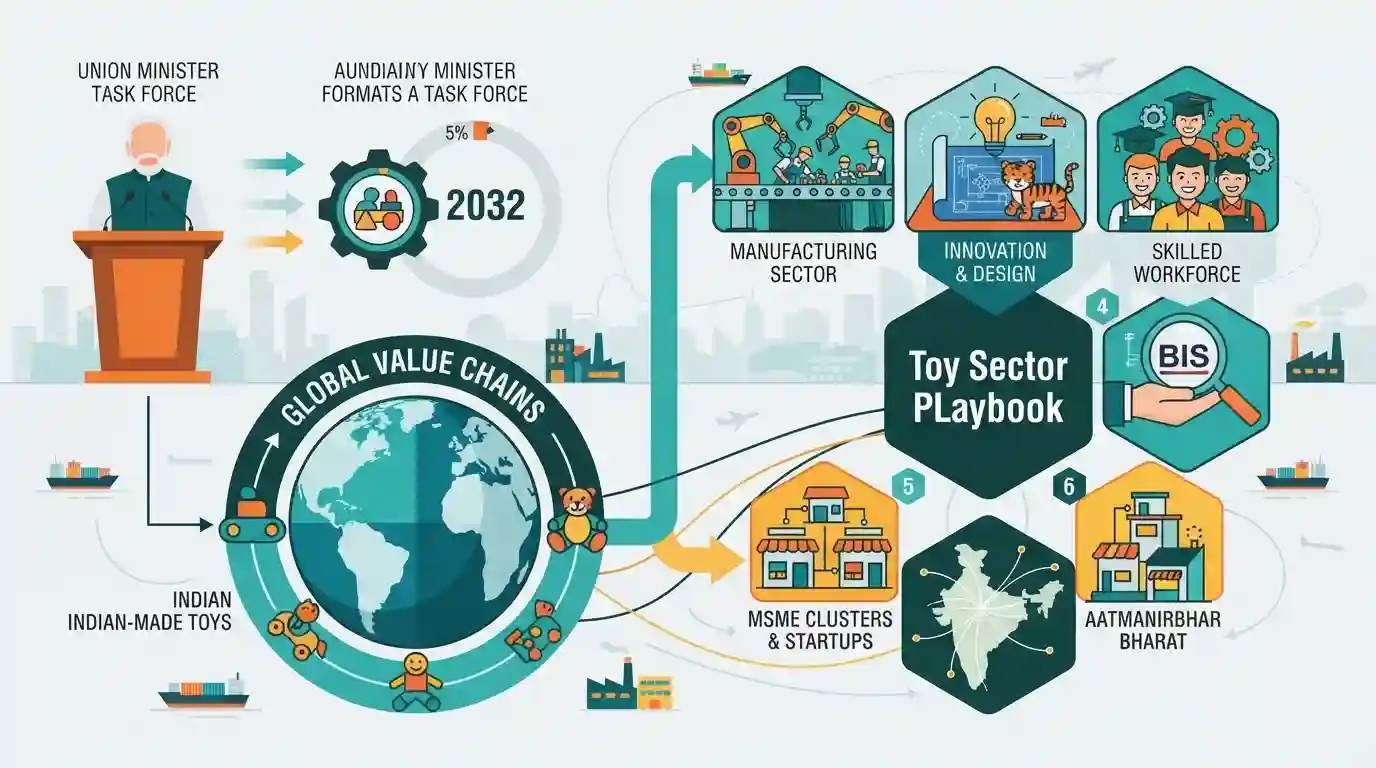
Union Minister Piyush Goyal has announced the formation of a dedicated task force to boost India's toy sector, setting an ambitious target to capture a 5% share of the global market by 2032. Coordinated by the Department for Promotion of Industry and Internal Trade (DPIIT), the initiative includes the launch of a 'Toy Sector Playbook' with six core objectives, including integration with global value chains, enhancing design and innovation, and fostering a skilled workforce. The strategy emphasizes quality through mandatory Bureau of Indian Standards (BIS) certification and relies heavily on developing MSME clusters and supporting startups to scale local manufacturing capabilities, aligning with the broader vision of Aatmanirbhar Bharat.
মূল বিষয়
- The government announced a task force to support the toy sector, setting a target to achieve a 5% global market share by 2032.
- DPIIT launched the 'Toy Sector Playbook', outlining six core objectives: global value chain integration, strengthening manufacturing, resolving bottlenecks, skilling, innovation, and ease of doing business.
- The strategy emphasizes ensuring product safety and quality through mandatory Bureau of Indian Standards (BIS) certification.
- The initiative focuses on MSME cluster development and supporting startups to build scale and enhance local manufacturing capabilities.
গুরুত্বপূর্ণ শব্দ
Steering Committee for Advancing Local Value Add and Employment (SCALE)

A committee under the Ministry of Commerce & Industry that identifies priority manufacturing sectors (like toys and footwear) to boost domestic manufacturing, export competitiveness, and employment.
UPSC context
GS Paper III: Industrial Policy. Tests understanding of manufacturing growth strategies, import substitution, and Aatmanirbhar Bharat initiatives.
Department for Promotion of Industry and Internal Trade (DPIIT)
The nodal government department responsible for formulating industrial policies, promoting foreign direct investment (FDI), and facilitating startup ecosystems and internal trade in India.
UPSC context
GS Paper III: Indian Economy. Relevant for administrative bodies driving ease of doing business, manufacturing, and sectoral growth.
Bureau of Indian Standards (BIS)
The national standards body of India established under the BIS Act 2016, responsible for standardization, product marking, and quality certification of goods.
UPSC context
GS Paper III: Indian Economy. Crucial for understanding regulatory frameworks, consumer safety, and product standard compliance.
Toys (Quality Control) Order, 2020
A regulation notified by the DPIIT that mandates compulsory BIS certification and ISI standard marking for all domestic and imported toys sold in India.
UPSC context
GS Paper III: Industrial Growth and Trade Policy. Evaluates knowledge of non-tariff barriers, import regulations, and standardization.
প্রিলিমস ফাঁদ
The mandatory Bureau of Indian Standards (BIS) certification for toys applies exclusively to domestic manufacturers, while foreign imports are exempt.
The Toys (Quality Control) Order, 2020, mandates that both domestic manufacturers and foreign exporters must obtain a BIS license and use the ISI mark to sell toys in India.
সংযুক্ত স্থির ধারণা
What is SFURTI and its role in MSME cluster development?
- Nodal Ministry: Administered by the Ministry of MSME to preserve and regenerate traditional Indian industries.
- Cluster Approach: Organizes traditional artisans into collaborative clusters to enhance competitiveness, infrastructure, and skill development.
- Interventions: Funds modern machinery, Common Facility Centres (CFCs), and strategic market linkages for artisans.
What is the difference between Tariff and Non-Tariff Barriers?
- Tariff Barriers: Direct financial levies like Basic Customs Duty (BCD) imposed on imports to make domestic alternatives more price-competitive.
- Non-Tariff Barriers: Administrative regulations, such as mandatory quality control orders (QCOs), acting as Technical Barriers to Trade (TBT) without direct taxation.
আন্তঃবিষয় প্যাটার্ন
Trade protectionism vs. WTO obligations
Rising customs duties (up to 70%) on toys test India's bound rate commitments under GATT, demonstrating the balance between defensive trade policy and multilateral rules.
GI tags and rural livelihood recovery
Integrating GI-protected traditional crafts (e.g., Channapatna toys) into modern supply chains under NAPT links cultural preservation with export-led MSME growth.

Mandatory QCOs and BCD hikes as combined trade-policy tools for manufacturing turnaround will likely be tested under WTO & MSME mains themes.
সংযুক্ত PYQ · 3
সংযুক্ত PYQ · 3
- 2023MainsGS3
Faster economic growth requires increased share of the manufacturing sector in GDP, particularly of MSMEs. Comment on the present policies of the Government in this regard.
- 2025MainsGS3
What are the challenges before the Indian economy when the world is moving away from free trade and multilateralism to protectionism and bilateralism? How can these challenges be met?
- 2017PrelimsGS1
Consider the following statements: 1. The Standard Mark of Bureau of Indian Standards (BIS) is mandatory for automotive tyres and tubes. 2. AGMARK is a quality Certification Mark issued by the Food and Agriculture Organisation (FAO). Which of the statements given above is/are correct?
