Public Examinations Amendment Bill Introduces Stricter Penalties
Source:PIB ↗
Why It Matters
Public examination leaks disrupt the careers of millions of aspirants and corrode trust in public institutions. This amendment, building on the 2024 Act (which was directly asked in the 2024 UPSC Mains), is a major current affairs theme under governance, judicial reforms (Special Fast Track Courts), and administrative probity.
Summary
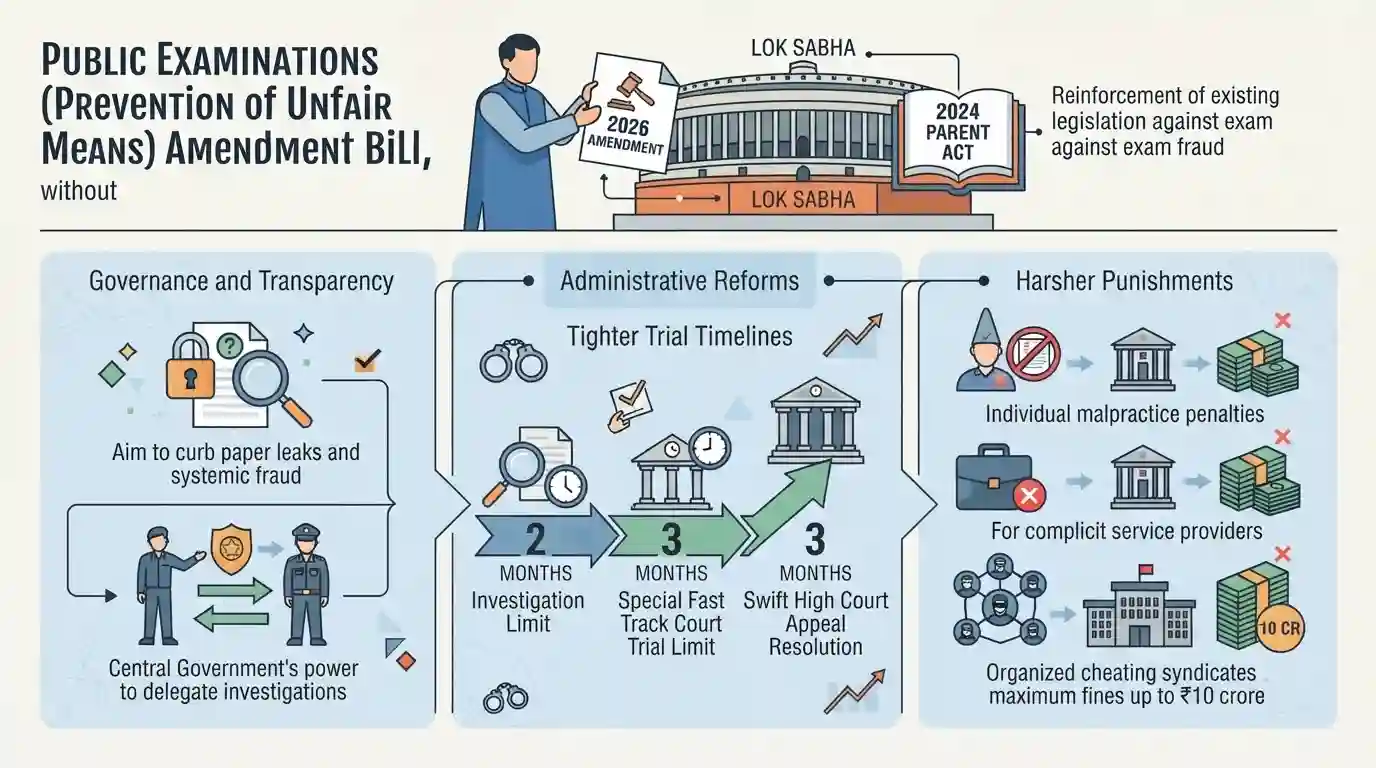
Union Minister Dr. Jitendra Singh introduced the Public Examinations (Prevention of Unfair Means) Amendment Bill, 2026, in the Lok Sabha. Aimed at reinforcing the 2024 parent Act to curb paper leaks and systemic exam fraud, the Bill proposes tighter trial timelines and harsher punishments. It introduces Special Fast Track Courts with a 3-month trial limit, a 2-month investigation limit, and swift 3-month appeal resolutions in High Courts. Penalties for individual malpractice, complicit service providers, and organized cheating syndicates have been significantly increased, including up to 10 years of imprisonment and fines up to ₹10 crore. It also permits the Central Government to delegate investigations to a Special Task Force.
Key Points
- Union Minister Dr. Jitendra Singh introduced the Public Examinations (Prevention of Unfair Means) Amendment Bill, 2026 in the Lok Sabha to address question paper leaks and organized exam malpractices.
- The Bill introduces Section 12A, prescribing a 2-month limit for investigation, day-to-day trials through Special Fast Track Courts (to be completed in 3 months from charge sheet), and appointment of Special Public Prosecutors.
- The Bill introduces Section 12B, requiring appeals to the High Court against Special Fast Track Court rulings to be preferred within 30 days and resolved, as far as possible, within 3 months.
- For individuals using unfair means, the punishment is increased to 5-10 years imprisonment (up from 3-5 years) and a maximum fine of ₹50 lakh (up from ₹10 lakh).
- For organized examination-related crimes, the minimum jail term increases from 5 to 7 years (extendable to 10 years), with the maximum fine raised to ₹10 crore (up from ₹1 crore).
- Service providers involved in malpractice face fines up to ₹5 crore (up from ₹1 crore) and an extended debarment from 4 years to 8 years, while their managerial personnel face 5-10 years of imprisonment.
- The Central Government is empowered to refer investigation of these offenses to a designated Special Task Force.
- The parent 2024 Act applies to central recruiting bodies like UPSC, SSC, RRBs, IBPS, and NTA; all offenses are cognizable, non-bailable, and non-compoundable.
Important Terms
Public Examinations (Prevention of Unfair Means) Amendment Bill, 2026

A legislative proposal to amend the 2024 parent Act by introducing Special Fast Track Courts, a Special Task Force, and significantly harsher penalties to curb systemic paper leaks and organized exam fraud.
UPSC context
GS Paper II: Governance & Polity. Tests understanding of legislative measures to reform administrative systems and ensure transparency in public recruitments.
Public Examinations (Prevention of Unfair Means) Act, 2024
India's landmark central law enacted to prevent unfair practices—such as paper leaks, impersonation, and tampering—in national examinations, establishing strict penalties for individuals, service providers, and organized syndicates.
UPSC context
GS Paper II: Government Policies. Tests knowledge of legal mechanisms created to preserve academic integrity and reform public recruitment systems.
National Testing Agency (NTA)
An autonomous, self-sustained premier testing organization registered as a society under the Ministry of Education, established to conduct efficient, standardized, and transparent entrance examinations for higher education institutions.
UPSC context
GS Paper II: Governance & Statutory Bodies. Tests understanding of national agencies responsible for institutional reforms in education and testing.
Union Public Service Commission (UPSC)
A constitutional body established under Article 315 of the Indian Constitution, responsible for conducting standardized examinations and recruiting officers for India’s All India Services and Group A/B Central Civil Services.
UPSC context
GS Paper II: Constitutional Bodies. Tests knowledge of constitutional provisions governing civil service recruitments, public administration, and executive appointments.
Staff Selection Commission (SSC)
An attached office of the Ministry of Personnel, Public Grievances and Pensions that recruits non-gazetted Group 'B' and non-technical Group 'C' personnel across various central ministries and departments.
UPSC context
GS Paper II: Governance & Statutory Bodies. Tests understanding of central recruitment agencies that manage administrative and executive support staff.
Prelims Trap
The 2026 central amendment automatically applies to state PSCs and high school board examinations across all Indian states.
The parent Act and amendment apply only to designated central public examination authorities like UPSC, SSC, and NTA. States must pass their own laws for state exams.
Static Concepts Connected
What are the distinctions between cognizable, non-bailable, and non-compoundable offenses under Indian law?
- Cognizable: Offenses where police can arrest without a warrant and initiate an investigation without prior judicial permission.
- Non-Bailable: Offenses where bail is not an absolute right; the court exercises judicial discretion to grant or deny bail.
- Non-Compoundable: Severe public offenses that cannot be settled or compromised between the parties, requiring a full trial.
How does the Constitution distribute legislative powers regarding public examinations and criminal administration?
- Concurrent List: Criminal law and procedure fall under List III, permitting both Parliament and State Legislatures to enact penal statutes.
- Union/State Services: Under Article 315, UPSC and State PSCs are created; however, central laws require adaptation to govern state-level examinations.
Cross-Topic Patterns
Statutory timelines vs judicial pendency
Investigating the trade-offs of mandatory statutory trial timelines against systemic judicial pendency and the accused's right to a fair trial.
Central penal codes vs federal autonomy
Analyzing how uniform central penal codes for examinations intersect with state-level executive autonomy in conducting local recruitment drives.

Statutory trial timelines and federal jurisdiction of the 2026 Bill will likely be tested against Article 21 fair trial norms in GS-2.
Linked PYQs · 1
Linked PYQs · 1
- 2024MainsGS2
What are the aims and objects of recently passed and enforced, The Public Examination (Prevention of Unfair Means) Act, 2024? Whether University/State Education Board examinations, too, are covered under the Act ?
