PM Vidyalaxmi Portal Enhances Higher Education Loan Accessibility
Source:PIB ↗
কেন এটি গুরুত্বপূর্ণ
This scheme serves as a model for utilizing digital public infrastructure (DPI) and direct benefit transfer (DBT) in governance to resolve social justice challenges. For UPSC, it represents a concrete case study on interventions targeting inclusivity and human resource capacity-building in the higher education sector.
সারসংক্ষেপ
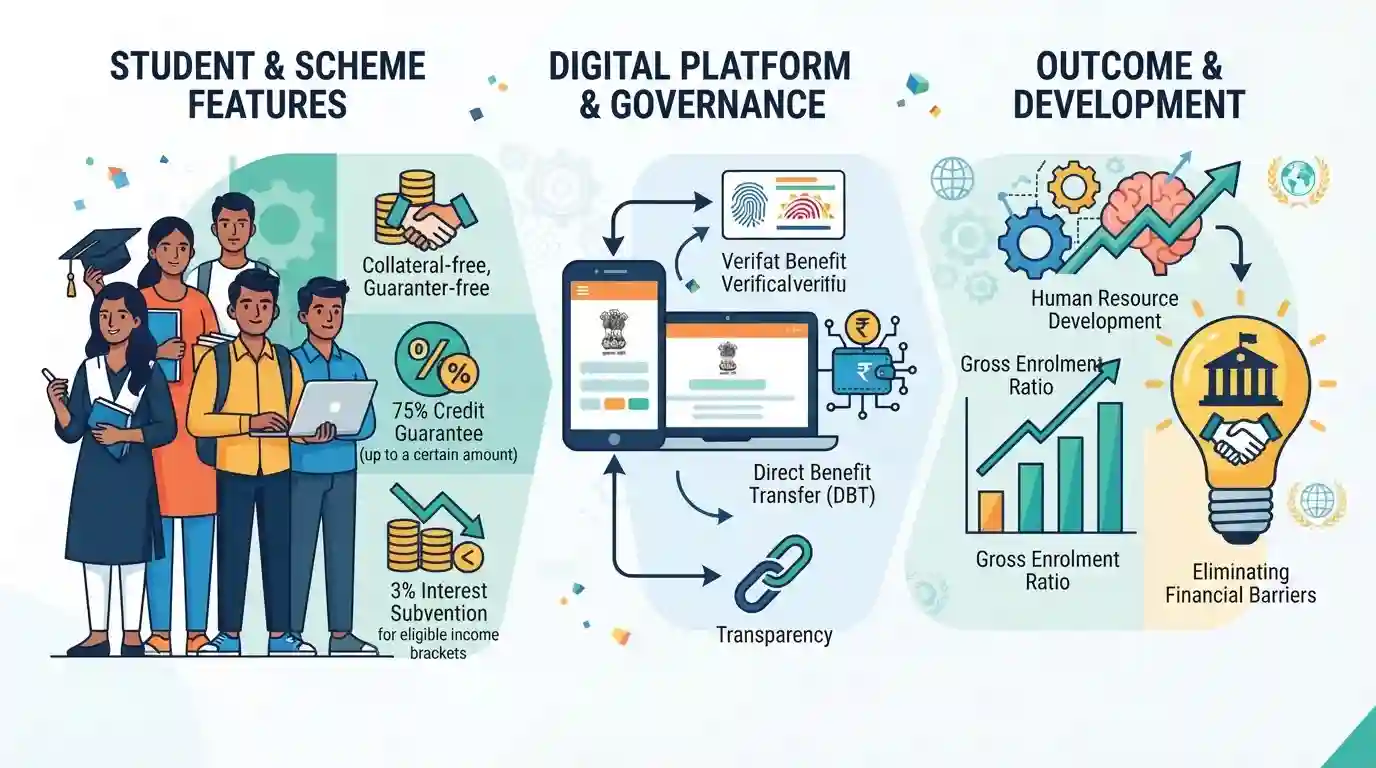
The PM-Vidyalaxmi portal serves as an integrated digital platform under a central sector scheme designed to provide collateral-free, guarantor-free higher education loans to meritorious students. The scheme features a 75% credit guarantee for loans up to ₹7.5 lakhs and a 3% interest subvention on loans up to ₹10 lakhs for families with annual incomes below ₹8 lakhs. By utilizing an e-governance framework involving a dedicated portal, Aadhaar-based checks, and a digital rupee app for Direct Benefit Transfers (DBT), the initiative enhances transparency and user convenience. Ultimately, it aims to eliminate financial barriers to higher education, increasing India's Gross Enrolment Ratio (GER) and strengthening human resource development.
মূল বিষয়
- PM-Vidyalaxmi ensures financial constraints do not impede access to higher education by offering collateral-free, guarantor-free education loans to meritorious students securing admission to Quality Higher Education Institutions (QHEIs).
- The scheme provides a 3% interest subvention for students with an annual family income up to ₹8 lakhs on loans up to ₹10 lakhs, targeting 1 lakh fresh students annually.
- For loans up to ₹7.5 lakhs, the government extends a 75% credit guarantee default cover under the PM-USP CGFSEL.
- PM-Vidyalaxmi functions through e-governance solutions, utilizing a dedicated portal, Aadhaar-based deduplication, and a digital rupee app for transferring Direct Benefit Transfers (DBT) directly to the loan account.
- The initiative seeks to lower dropout rates, improve the Gross Enrolment Ratio (GER) in higher education, and maximize India's demographic dividend through targeted human resource development.
গুরুত্বপূর্ণ শব্দ
PM-Vidyalaxmi

A central sector scheme launched in 2024 to provide collateral-free and guarantor-free education loans and interest subventions to meritorious students pursuing higher education in top-tier Quality Higher Educational Institutions.
UPSC context
GS Paper II (Social Sector); tests public policies addressing financial barriers to human capital development and educational equity.
PM-USP CGFSEL
A credit guarantee scheme providing a 75% default cover on collateral-free higher education loans up to ₹7.5 lakhs, thereby mitigating risk for commercial banks and facilitating easier institutional credit.
UPSC context
GS Paper III (Inclusive Growth); tests risk-sharing financial mechanisms and institutional credit delivery models in social sectors.
Department of Higher Education
A department under the Ministry of Education overseeing tertiary education, responsible for execution of scholarship schemes, regulatory frameworks, and increasing India's Gross Enrolment Ratio.
UPSC context
GS Paper II (Governance); tests institutional machinery and administrative implementation of central sector educational schemes.
Ministry of Education
The central ministry responsible for formulating the National Education Policy and implementing programs across primary, secondary, and tertiary sectors to foster equitable human resource development.
UPSC context
GS Paper II (Executive Ministries); tests central educational policies, development initiatives, and state-centre cooperative federalism in education.
প্রিলিমস ফাঁদ
DBT interest subvention under PM-Vidyalaxmi is credited as normal cash into the student's savings account.
The subvention is disbursed specifically as CBDC (Central Bank Digital Currency) tokens via the PM-Vidyalaxmi Digital Rupee App, marking a shift from traditional cash bank-account transfers.
সংযুক্ত স্থির ধারণা
What is Gross Enrolment Ratio (GER) in higher education and its NEP 2020 targets?
- Definition: Measures the percentage of the student population in the eligible age group (typically 18-23 years) enrolled in higher education.
- Target: NEP 2020 targets raising the GER in higher education to 50% by 2035 from around 27.3% in recent years.
- Key Bottlenecks: Financial barriers, high dropout rates, and geographical inequalities are the primary bottlenecks in achieving this target.
What is Central Bank Digital Currency (CBDC) and how does it differ from traditional digital payments?
- Nature: A digital form of fiat currency issued by the Reserve Bank of India (RBI), representing a direct sovereign liability.
- Difference: Unlike commercial bank electronic transfers, CBDC transactions settle instantly on the central bank's ledger without clearinghouse intermediaries.
- Programmability: CBDC enables programmable welfare delivery, ensuring funds (such as interest subventions) are utilized strictly for their intended purposes.
আন্তঃবিষয় প্যাটার্ন
Programmable CBDC in social welfare
Using Central Bank Digital Currency for interest subventions showcases a transition from direct cash transfers to programmable, purpose-bound digital currency, reducing leakages and ensuring end-use.
Higher education and demographic dividend
Access to credit for QHEIs prevents meritorious dropouts, shifting India's workforce from low-skill employment to high-skill, knowledge-based economy roles vital for Viksit Bharat goals.

Multi-statement questions will likely test PM-Vidyalaxmi's unique CBDC-based DBT delivery mechanism and the NIRF eligibility criteria.
সংযুক্ত PYQ · 4
সংযুক্ত PYQ · 4
- 2025MainsGS2
e-governance projects have a built-in bias towards technology and back-end integration than user-centric designs. Examine.
- 2023MainsGS2
The crucial aspect of development process has been the inadequate attention paid to Human Resource Development in India. Suggest measures that can address this inadequacy.
- 2023MainsGS2
Skill development programmes have succeeded in increasing human resources supply to various sectors. In the context of the statement analyse the linkages between education, skill and employment.
- 2016MainsGS2
Demographic Dividend in India will remain only theoretical unless our manpower becomes more educated, aware, skilled and creative." What measures have been taken by the government to enhance the capacity of our population to be more productive and employable?
