Bhashini AI Initiative Promotes Multilingual Legislative Governance
Source:PIB ↗
Why It Matters
It illustrates the practical application of Artificial Intelligence in governance, specifically how indigenous platforms like BHASHINI are being used to remove language barriers, enhance legislative transparency, and promote digital inclusion in Indian democracy.
Summary
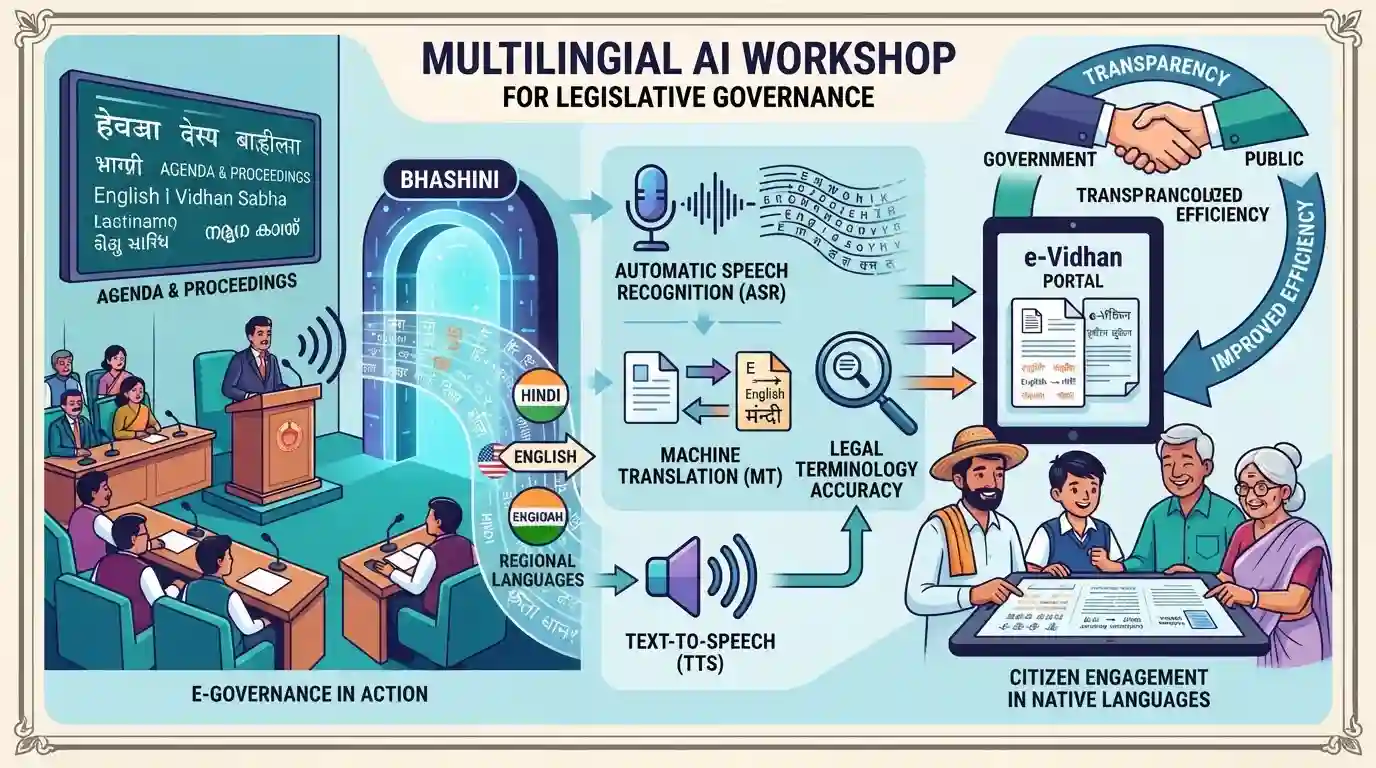
The Digital India BHASHINI Division, under the Ministry of Electronics and Information Technology (MeitY), organized a Multilingual AI Workshop for the Haryana Vidhan Sabha to promote 'Language-First Legislative Governance'. The initiative aims to deploy AI-driven Natural Language Processing (NLP) tools, including Automatic Speech Recognition (ASR), Machine Translation, and Text-to-Speech (TTS), to translate legislative documents and proceedings seamlessly between Hindi, English, and regional languages. By maintaining the accuracy of complex legal terminology across translations, the initiative seeks to overcome linguistic barriers in the legislative process. Integrating these technologies with the e-Vidhan system will foster greater transparency, improve legislative efficiency, and ensure that citizens can better engage with democratic processes in their native languages.
Key Points
- The Digital India BHASHINI Division conducted a workshop for the Haryana Vidhan Sabha to integrate multilingual AI technologies into legislative governance.
- The initiative utilizes Artificial Intelligence and Natural Language Processing (NLP) tools like Automatic Speech Recognition (ASR) and Text-to-Speech (TTS) for real-time translation of legislative documents.
- The project focuses on accurately translating complex legal terminology to preserve the integrity and authenticity of legislative proceedings across different languages.
- This 'Language-First' approach enhances e-governance by making legislative processes more accessible, transparent, and citizen-centric.
- The AI translation capabilities are being aligned with the e-Vidhan system to fully digitize and streamline the state assembly's operations.
Important Terms
BHASHINI

An AI-driven multilingual platform launched in 2022 to reduce language barriers by providing translation, speech-to-text, and text-to-speech services across 22 scheduled Indian languages.
UPSC context
GS Paper III (AI/technology applications) and GS Paper II (e-governance and digital public infrastructure for inclusive development).
National e-Vidhan Application (NeVA)
A Digital India Mission Mode Project designed to digitize and streamline state and union territory legislatures, enabling paperless, transparent, and digitally integrated assembly proceedings under 'One Nation-One Application'.
UPSC context
GS Paper II (e-governance, administrative transparency, and functioning of state legislatures).
National Language Translation Mission (NLTM)
A national initiative implemented by MeitY that leverages artificial intelligence and natural language processing to break language barriers, making digital services and governance content bilingually accessible.
UPSC context
GS Paper III (Science and Technology policies) and GS Paper II (e-governance for digital inclusion).
Digital India BHASHINI Division
An Independent Business Division under Digital India Corporation (MeitY) that implements BHASHINI, driving AI-based language solutions through collaboration with startups, academia, and government.
UPSC context
GS Paper II (e-governance institutional mechanisms) and GS Paper III (technology-driven development, AI ecosystem, and industry collaboration).
Digital India
A flagship program launched in 2015 to transform India into a digitally empowered society and knowledge economy by improving digital infrastructure, literacy, and online delivery of public services.
UPSC context
GS Paper II (e-governance) and GS Paper III (infrastructure development, digital economy, and inclusive growth).
Prelims Trap
The National e-Vidhan Application (NeVA) is administratively owned and executed by the Ministry of Electronics and Information Technology (MeitY).
While NeVA is a core digital infrastructure scheme under the Digital India umbrella, its nodal administrative ministry is the Ministry of Parliamentary Affairs (MoPA), not MeitY.
Static Concepts Connected
Constitutional provisions for legislative languages
- Article 120: Mandates Hindi or English for parliamentary business, allowing the Presiding Officer to permit mother-tongue usage.
- Article 210: Applies similar language rules to state legislatures, authorizing transactions in state official languages, Hindi, or English.
- Eighth Schedule: Lists the 22 languages eligible for state-level official status, acting as the baseline target for translation missions.
What is the National e-Vidhan Application (NeVA) framework?
- Nodal Ministry: The Ministry of Parliamentary Affairs (MoPA) serves as the nodal ministry for implementing NeVA across states.
- Core Philosophy: Operates on the 'One Nation, One Application' theme to convert all state legislatures into paperless, digital bodies.
- Funding Pattern: Assistance is shared on a 60:40 basis with normal states, and 90:10 with Northeastern and hilly states.
Cross-Topic Patterns
Digital Federalism and Linguistic Rights
Integrating BHASHINI with state assemblies aligns technical DPI with federalism, ensuring states can govern in local languages without losing integration with central frameworks.
DPI and Democratic Access
Using crowdsourced AI models (Bhasha Daan) to translate complex legal drafting bridges the information gap between English-dominated legislation and vernacular-speaking electorates.

The intersection of state legislative language mandates (Art 210) and AI-driven platforms like NeVA/BHASHINI is a prime GS-2/GS-3 target.
Linked PYQs · 2
Linked PYQs · 2
- 2024MainsGS2
e-governance is not just about the routine application of digital technology in service delivery process. It is as much about multifarious interactions for ensuring transparency and accountability. In this context evaluate the role of the 'Interactive Service Model' of e-governance.
- 2020PrelimsGS1
With the present state of development, Artificial Intelligence can effectively do which of the following? 1. Bring down electricity consumption in industrial units 2. Create meaningful short stories and songs 3. Disease diagnosis 4. Text-to-Speech Conversion 5. Wireless transmission of electrical energy Select the correct answer using the code given below:
