Implementation Challenges of SC/ST Prevention of Atrocities Act
Source:PIB ↗
આ શા માટે મહત્વનું છે
The article highlights the interplay of federal distribution of powers (Seventh Schedule) and social justice mechanisms in protecting marginalized communities. The data on low conviction rates and high case pendency are crucial for analyzing the effectiveness of special laws and the challenges in the criminal justice system in UPSC Mains.
સારાંશ
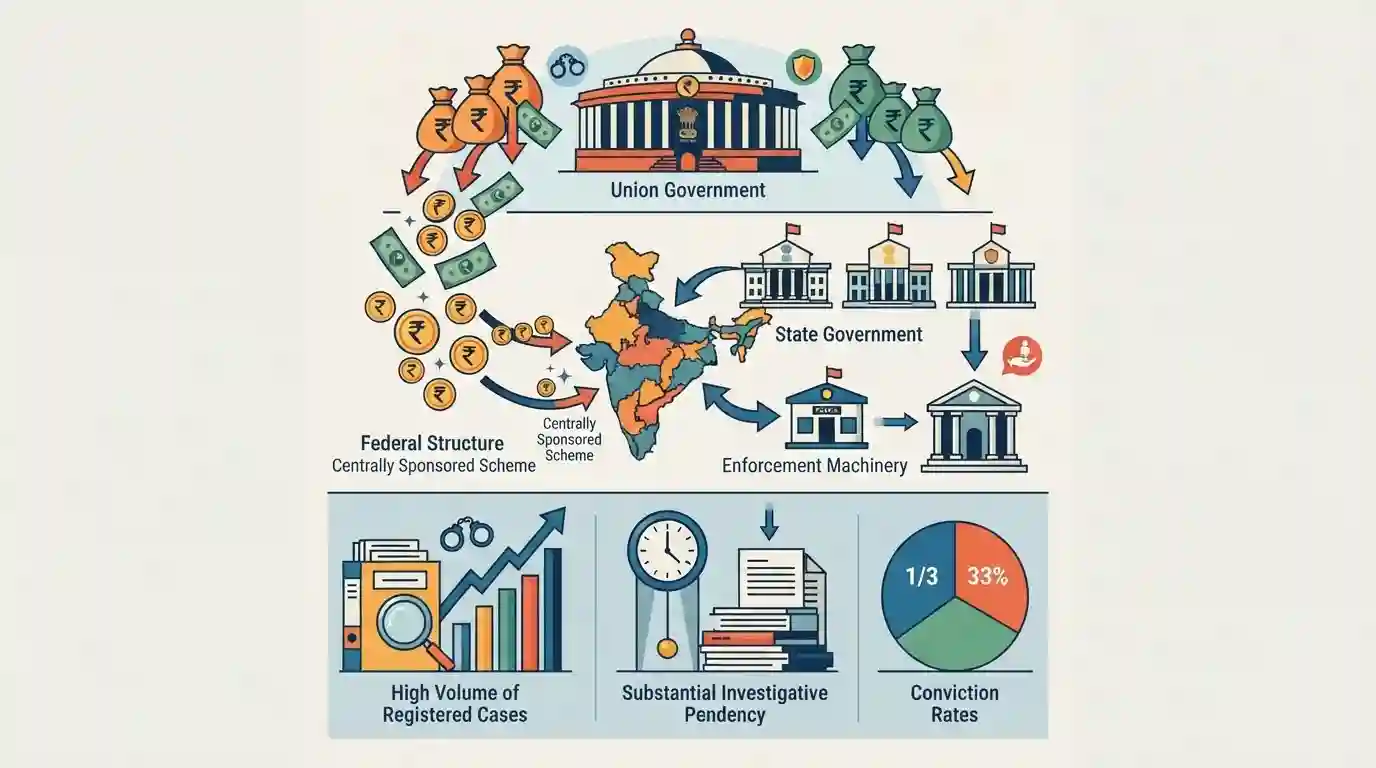
The Union Government is strengthening the implementation of the SC/ST (Prevention of Atrocities) Act, 1989 and the Protection of Civil Rights (PCR) Act, 1955 through a Centrally Sponsored Scheme. Under the scheme, over ₹1,420 crore has been released from 2022-23 to 2024-25 to assist victims and support enforcement machinery. Since 'Police' and 'Public Order' are State subjects, State governments hold the primary responsibility for enforcement. National Crime Records Bureau (NCRB) data reveals high volumes of registered cases, substantial investigative pendency, and relatively low conviction rates (around 33%) under the Act.
મુખ્ય મુદ્દા
- The Ministry of Social Justice and Empowerment implements a Centrally Sponsored Scheme (CSS) to assist States and Union Territories in implementing the SC/ST (Prevention of Atrocities) Act, 1989 and the Protection of Civil Rights (PCR) Act, 1955.
- Federal Structure: Under the Seventh Schedule of the Constitution, 'Police' and 'Public Order' are State subjects. State Governments and UT Administrations are primarily responsible for investigating offences and preventing crimes against SCs and STs, while the Union Government issues advisories and provides financial assistance.
- Financial Allocations: Under the Centrally Sponsored Scheme, Central Assistance released was ₹392.71 crore in 2022-23 (benefiting 88,172 victims), ₹535.30 crore in 2023-24 (benefiting 79,667 victims), and ₹495.29 crore in 2024-25 (benefiting 99,965 victims).
- NCRB Crime Trends: In 2024, 55,685 cases under the SC/ST PoA Act were registered for crimes against Scheduled Castes, and 9,961 cases for crimes against Scheduled Tribes. Additionally, 17,123 SC cases and 7,219 ST cases remained pending investigation.
- Conviction Rates: The All India conviction rate for cases under the SC/ST PoA Act remains relatively low, ranging between 32% to 34% for SC cases and 24% to 33% for ST cases over the 2022-2024 period.
મહત્વપૂર્ણ શબ્દો
Scheduled Castes and the Scheduled Tribes (Prevention of Atrocities) Act, 1989

A landmark law enacted to prevent atrocities and hate crimes against marginalized communities, establishing special courts for speedy trials and providing relief and rehabilitation to victims.
UPSC context
Crucial for GS Paper 2 (Social Justice), testing knowledge of legislative frameworks protecting vulnerable sections from caste-based violence.
Protection of Civil Rights (PCR) Act, 1955
A federal law implementing Article 17 of the Indian Constitution, making the practice of untouchability and the enforcement of any disability arising from it a punishable criminal offense.
UPSC context
Important for GS Paper 2, it tests the statutory mechanisms used to enforce Fundamental Rights and eliminate social discrimination.
Centrally Sponsored Scheme (CSS)
A funding mechanism where the Union Government provides financial assistance to States and Union Territories to implement specific national goals, such as strengthening anti-atrocity enforcement machinery.
UPSC context
Relevant to GS Paper 2 and 3, highlighting the shared financial and administrative responsibilities between the Centre and States.
National Crime Records Bureau (NCRB)
An agency under the Ministry of Home Affairs that collects, compiles, and analyzes crime data across India, publishing key annual reports like Crime in India to guide policy.
UPSC context
Vital for GS Paper 2 and 3, acting as a foundational data source for analyzing crime trends and policing effectiveness.
Ministry of Social Justice & Empowerment
The nodal central ministry responsible for the welfare, empowerment, and social inclusion of disadvantaged and marginalized sections, including Scheduled Castes, Other Backward Classes, and persons with disabilities.
UPSC context
Essential for GS Paper 2 (Welfare Schemes), testing awareness of institutional mechanisms and government bodies dedicated to vulnerable populations.
પ્રિલિમ્સ ટ્રેપ
State legislatures hold concurrent power to prescribe punishments for offences under Article 17 since 'Police' and 'Public Order' are State subjects.
Under Article 35(a)(ii), only Parliament has the power to prescribe punishment for Part III offences. State legislatures cannot do so, even though policing is a state subject.
સંલગ્ન સ્થિર ખ્યાલો
What is the constitutional relationship between Article 17 and Article 35?
- Article 17: Abolishes untouchability and mandates that enforcement of this disability shall be an offence punishable in accordance with law.
- Article 35(a)(ii): Vests exclusive legislative power in Parliament—not state legislatures—to prescribe punishments for acts declared as offences under Part III.
- Legislative Impact: This dual framework ensures uniform penal laws across India, resulting in the PCR Act 1955 and the SC/ST (PoA) Act 1989.
How do Centrally Sponsored Schemes (CSS) operate in federal social funding?
- Funding Split: Jointly funded by the Union and States (e.g., 50:50 for PCR/PoA Act implementation) but executed by State administration.
- State Discretion: Unlike Central Sector Schemes (100% Union funded), CSS relies on State fiscal cooperation and physical machinery to deliver results.
- UT Exception: Union Territories generally receive 100% Central funding under CSS models to offset their lack of independent fiscal capacity.
આંતર-વિષય પેટર્ન
Fiscal Federalism + Civil Rights Enforcement
Analyzes how the Center uses CSS funding splits (50:50) to steer state police priorities toward civil rights enforcement, balancing federal sovereignty with social welfare directives.
Criminal Justice Bottlenecks + Special Courts
Connects the SC/ST Act's ~33% conviction rate and high investigative pendency to the structural limits of judicial infrastructure and the need for exclusive special courts.

Parliament's exclusive power under Article 35 vs state police enforcement under List II will likely feature in a 2026 analytical question.
સંલગ્ન PYQ · 3
સંલગ્ન PYQ · 3
- 2023MainsGS2
“Development and welfare schemes for the vulnerable, by its nature, are discriminatory in approach.” Do you agree? Give reasons for your answer.
- 2020PrelimsGS1
Which part of the Constitution of India declares the ideal of Welfare State?
- 2015PrelimsGS1
The provisions in Fifth Schedule and Sixth Schedule in the Constitution of India are made in order to
