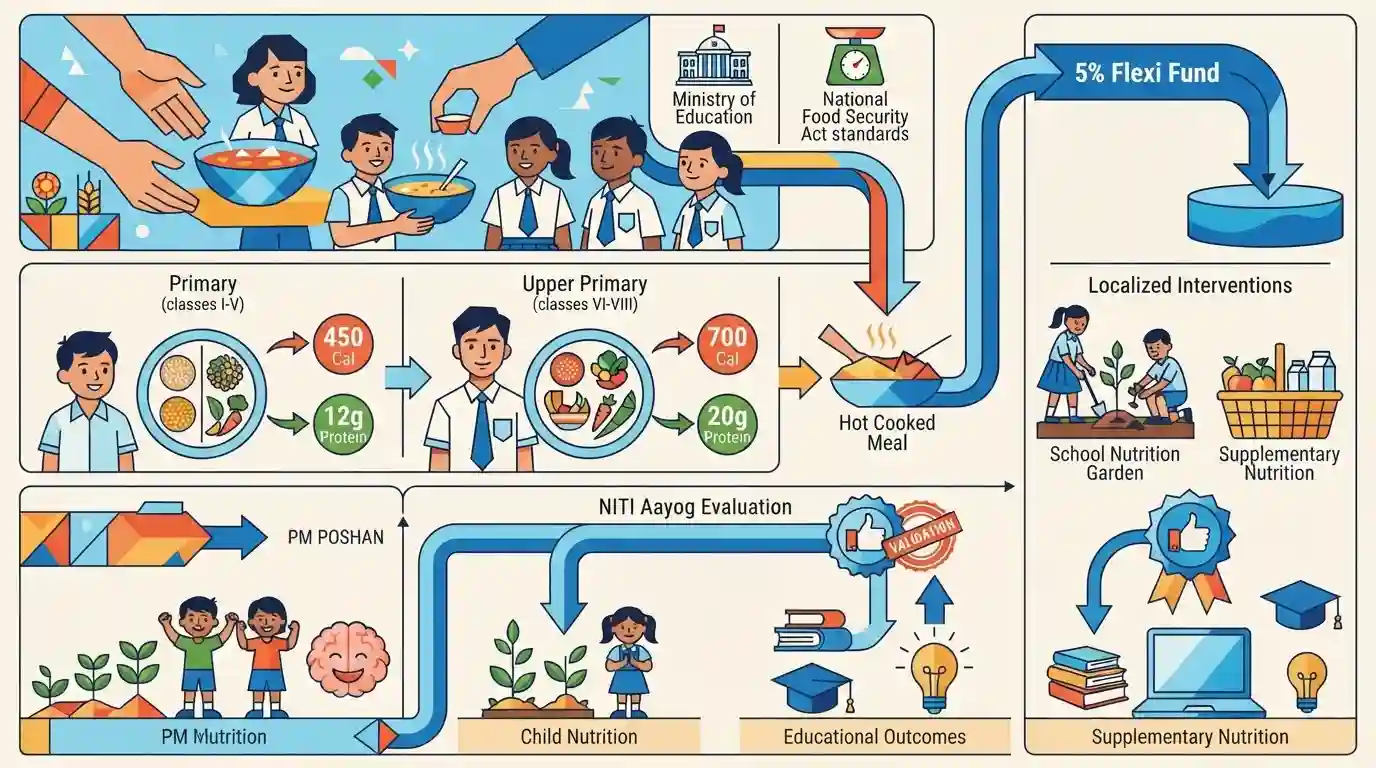
Nutritional Standards and Implementation Framework of PM POSHAN
Source:PIB ↗
આ શા માટે મહત્વનું છે
Understanding the PM POSHAN Scheme is essential for UPSC aspirants as it lies at the intersection of public health, education, and food security. It serves as a prime example of a government intervention designed to break the vicious cycle of poverty and malnutrition, which directly impacts India's human capital formation. Awareness of its statutory backing (NFSA) and recent evaluations (NITI Aayog) is critical for GS2 and GS3 answers.
સારાંશ
The Ministry of Education has reiterated the nutritional standards underpinning the PM POSHAN Scheme, which replaced the Mid-Day Meal Scheme. Aligned with the National Food Security Act, 2013, the scheme mandates the provision of hot cooked meals with specific calorie and protein targets (450 calories/12g protein for primary; 700 calories/20g protein for upper primary) to students in government and government-aided schools. It includes a 5% flexi fund for States to implement localized interventions like School Nutrition Gardens. A recent NITI Aayog evaluation validated the scheme's effectiveness in simultaneously improving child nutrition and educational outcomes.
મુખ્ય મુદ્દા
- PM POSHAN is a Centrally Sponsored Scheme implemented in partnership with States and UTs to provide hot cooked meals to children in Bal Vatika (pre-primary) and classes I to VIII.
- The nutritional standards are legally backed by the National Food Security Act (NFSA), 2013.
- The mandated nutritional norms are 450 calories and 12g protein for primary students, and 700 calories and 20g protein for upper primary students.
- States and UTs have the flexibility to utilize 5% of their total recurring budget to establish School Nutrition Gardens (SNGs) and provide supplementary nutrition.
- A 2025-26 NITI Aayog evaluation confirmed the scheme's positive impact on combating child malnutrition and enhancing learning outcomes.
મહત્વપૂર્ણ શબ્દો
PM POSHAN Scheme

A centrally sponsored scheme providing one hot cooked meal daily to students in government and government-aided schools (pre-primary to Class VIII) to improve nutrition, combat classroom hunger, and increase enrollment.
UPSC context
GS Paper II (Welfare Schemes); tests knowledge of child nutrition, institutional food security, and social safety nets.
National Food Security Act, 2013
Landmark Indian legislation providing legal entitlement to subsidized foodgrains to approximately two-thirds of the population, shifting the country's food security paradigm from a welfare to a rights-based approach.
UPSC context
GS Paper II (Governance) & GS Paper III (Food Security); tests legislative provisions, PDS reforms, and socio-economic rights.
Mid-Day Meal Scheme
A historic, nationwide school meal program launched in 1995 to reduce malnutrition and classroom hunger, revamped and renamed as PM POSHAN in September 2021.
UPSC context
GS Paper II (Welfare Schemes); tests evolution of child welfare policies, nutrition standards, and human resource development.
NITI Aayog
India's apex policy think tank, established in 2015 to replace the Planning Commission, mandated to design strategic long-term policies and foster cooperative federalism.
UPSC context
GS Paper II (Statutory/Regulatory Bodies); tests institutional frameworks, federal dynamics, and bottom-up developmental planning.
Ministry of Education
The central ministry responsible for formulating educational policies, implementing flagship programs like Samagra Shiksha, and administering school nutrition initiatives like PM POSHAN in India.
UPSC context
GS Paper II (Governance/Policies); tests ministerial roles, administration of centrally sponsored programs, and education sector reforms.
પ્રિલિમ્સ ટ્રેપ
"The PM POSHAN Scheme is administered by the Ministry of Women and Child Development."
Aspirants confuse PM POSHAN with Poshan Abhiyaan. PM POSHAN (formerly Mid-Day Meal) is for schools under the Ministry of Education, not MWCD.
સંલગ્ન સ્થિર ખ્યાલો
What are the statutory entitlements for children under the National Food Security Act (NFSA), 2013?
- Pre-school Nutrition: Age-appropriate free meals through local anganwadis (under ICDS) for pregnant women, lactating mothers, and children up to 6 years.
- School Age (6-14): One free hot cooked mid-day meal every day (except holidays) in all government and government-aided schools.
- Food Security Allowance: States must pay beneficiaries a Food Security Allowance if the entitled meal or foodgrains are not provided.
How do funding mechanisms work for Centrally Sponsored Schemes (CSS) like PM POSHAN?
- Implementation vs Funding: A scheme implemented by State governments but largely funded by the Central government with a defined state share.
- Cost Sharing Ratio: Typically 60:40 (Centre:State) for general category states, and 90:10 for North-Eastern and Himalayan states.
- Specific Central Components: The Centre bears 100% of the cost of foodgrains and their transportation, while cooking costs are shared.
આંતર-વિષય પેટર્ન
Nutrition Gardens & Fortified Rice
The 5% flexi fund for School Nutrition Gardens connects welfare to agriculture. Expect questions linking PM POSHAN with the distribution of fortified rice through PDS to tackle hidden hunger.
Human Capital Formation & SDGs
NITI Aayog's evaluation underscores a dual-impact model: nutritional interventions directly correlating with cognitive development and school retention rates, bridging SDG 2 (Zero Hunger) and SDG 4 (Quality Education).

Expect a 2026 prelims question contrasting PM POSHAN (Education Ministry) and Poshan Abhiyaan (MWCD) alongside NFSA statutory rights.
સંલગ્ન PYQ · 4
સંલગ્ન PYQ · 4
- 2024MainsGS2
Poverty and malnutrition create a vicious cycle, adversely affecting human capital formation. What steps can be taken to break the cycle ?
- 2021MainsGS3
What are the salient features of the National Food Security Act, 2013? How has the Food Security Bill helped in eliminating hunger and malnutrition in India?
- 2013MainsGS3
Food Security Bill is expected to eliminate hunger and malnutrition in India. Critically discuss various apprehensions in its effective implementation along with the concerns it has generated in WTO.
- 2018PrelimsGS1
With reference to the provisions made under the National Food Security Act, 2013, consider the following statements : 1. The families coming under the category of 'below poverty line (BPL)' only are eligible to receive subsidised food grains. 2. The eldest woman in a household, of age 18 years or above, shall be the head of the household for the purpose of issuance of a ration card. 3. Pregnant women and lactating mothers are entitled to a 'take-home ration' of 1600 calories per day during pregnancy and for six months thereafter. Which of the statements given above is/are correct?
