Jal Jeevan Mission Extended to 2028 with Decentralized Focus
Source:PIB ↗
কেন এটি গুরুত্বপূর্ণ
The transition to JJM 2.0 demonstrates a critical shift in public policy from merely building infrastructure to ensuring its sustainable operation and maintenance. By mandating the handover of water supply schemes to Panchayati Raj Institutions (PRIs) and involving women SHGs in operations, it provides a strong case study for decentralized governance, women\'s empowerment, and community-led development for UPSC Mains GS-2.
সারসংক্ষেপ
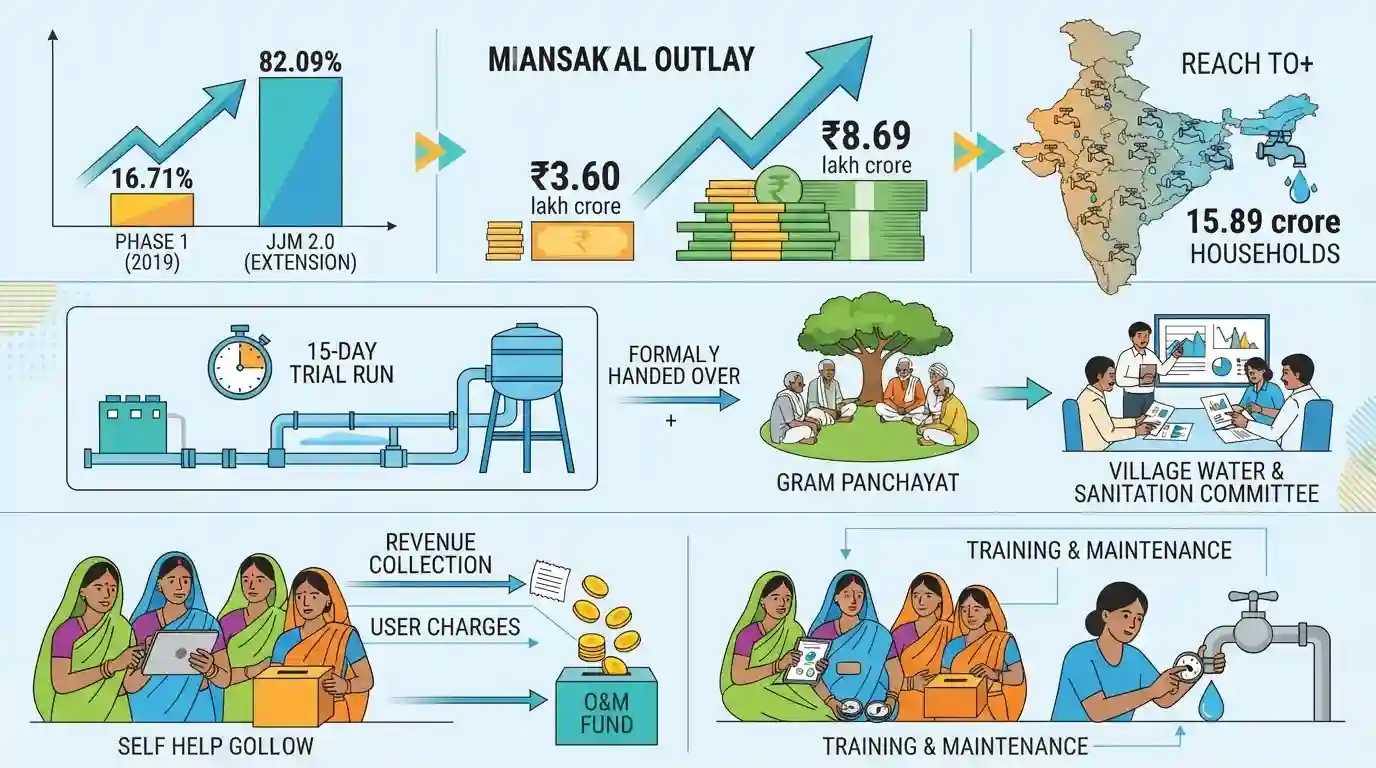
The Union Government has announced the extension of the Jal Jeevan Mission (JJM) up to December 2028 under the restructured "JJM 2.0" phase, accompanied by a massive increase in financial outlay from ₹3.60 lakh crore to ₹8.69 lakh crore. Since its inception in August 2019, JJM has successfully scaled rural tap water connections from 16.71% to 82.09% (over 15.89 crore households). Moving toward sustainability, the mission now heavily emphasizes decentralization and community ownership. Through the \'Jal Arpan\' initiative, completed water supply schemes will undergo a 15-day trial run before being transferred to Gram Panchayats and Village Water & Sanitation Committees (VWSCs). Furthermore, states are advised to formulate clear Operations and Maintenance (O&M) policies that empower local bodies to levy user charges and engage women Self Help Groups (SHGs) for revenue collection, thereby ensuring the long-term viability of rural water infrastructure.
মূল বিষয়
- The Jal Jeevan Mission (JJM) has significantly increased rural tap water coverage from 16.71% in August 2019 to 82.09% by July 2026, reaching 15.89 crore rural households.
- The Union Cabinet has extended JJM up to December 2028 as JJM 2.0, substantially increasing the total financial outlay from ₹3.60 lakh crore to ₹8.69 lakh crore to focus on structural reforms.
- The \'Jal Arpan\' initiative and a new Handbook on Community-Managed Piped Water Systems mandate a 15-day trial run for the smooth transfer of water schemes to local bodies like Gram Panchayats and VWSCs/Pani Samitis.
- While drinking water is a state subject, states are directed to empower local bodies to levy and collect user charges, notably by engaging women Self Help Groups (SHGs) to ensure long-term Operation & Maintenance (O&M) sustainability.
- A new Comprehensive Implementation and Reform Plan (CIRP) will serve as the guiding framework for all planning, fund allocation, and monitoring under JJM 2.0.
গুরুত্বপূর্ণ শব্দ
Jal Jeevan Mission (JJM)

A centrally sponsored scheme launched in August 2019 aiming to provide safe and adequate drinking water through Functional Household Tap Connections (FHTC) to all rural households in India.
UPSC context
GS Paper II: Governance, government schemes, and social sector management.
JJM 2.0
The restructured and extended phase of the Jal Jeevan Mission, approved in March 2026, which shifts focus from infrastructure creation to a citizen-centric, utility-based water service delivery model.
UPSC context
GS Paper II: Government interventions and structural reforms in basic services.
Jal Arpan initiative
A community-led initiative under JJM 2.0 that promotes long-term sustainability by mandating trial runs and a standardized handbook to smoothly hand over water supply schemes to Gram Panchayats.
UPSC context
GS Paper II: Devolution of powers and local-level public service delivery.
Comprehensive Implementation and Reform Plan (CIRP)
A strategic, time-bound operational framework prepared by States and UTs under JJM 2.0, outlining scheme-wise completion timelines, financial allocations, and governance reform milestones.
UPSC context
GS Paper II: Center-State relations, financial planning, and fiscal federalism.
Village Water & Sanitation Committees (VWSCs)
Gram Panchayat sub-committees (with at least 50% women membership) responsible for planning, designing, implementing, operating, and maintaining in-village drinking water supply systems.
UPSC context
GS Paper II: Devolution of powers to local bodies and women empowerment.
Pani Samitis
Village-level sub-committees of Gram Panchayats responsible for planning, managing, operating, and maintaining drinking water supply systems under decentralized governance.
UPSC context
GS Paper II: Grassroots democracy, local governance, and decentralized resource management.
Har Ghar Jal
A key vision and certification status under the Jal Jeevan Mission, ensuring 100% of households in a village or district have verified access to safe tap water.
UPSC context
GS Paper II: Welfare schemes and basic amenities for vulnerable rural communities.
প্রিলিমস ফাঁদ
Drinking water is a Concurrent List subject due to joint Union-State funding under JJM.
Water is strictly a State Subject (Entry 17). The Union provides scheme funding and guidelines, but states and Panchayats retain legislative and tariff-setting authority.
সংযুক্ত স্থির ধারণা
How is 'Water' distributed across Constitutional schedules?
- State List: Water supplies, irrigation, canals, and drainage are listed under Entry 17 of the State List.
- Union List: Inter-state rivers and river valleys fall under Entry 56 of the Union List for regulation and development.
- 11th Schedule: Item 11 of the 11th Schedule explicitly lists 'Drinking Water' as a subject to be devolved to Panchayats.
What is the composition and role of VWSCs?
- Status: They are standing committees of the Gram Panchayat, often known as Pani Samitis, responsible for planning and managing village water supply.
- Gender Parity: Guidelines mandate that at least 50% of the VWSC members must be women to ensure gender-inclusive water governance.
- Social Inclusion: Membership must include proportional representation for SC/ST communities and representation from weaker sections of the village.
আন্তঃবিষয় প্যাটার্ন
SHGs in utility governance
The engagement of women SHGs for water revenue collection and testing reflects a wider governance trend of evolving SHGs from microfinance groups to front-line public utility agents.
Outcome-based welfare financing
JJM 2.0's Comprehensive Implementation and Reform Plan (CIRP) mirrors Swachh Bharat Mission ODF+, marking a policy transition from rapid physical asset creation to structural O&M sustainability and outcome-linked funding.

A 2026 Prelims question will likely fuse JJM 2.0’s VWSC composition rules (50% women) with the Constitutional status of drinking water.
সংযুক্ত PYQ · 4
সংযুক্ত PYQ · 4
- 2020MainsGS2
Micro-Finance as an anti-poverty vaccine, is aimed at asset creation and income security of the rural poor in India". Evaluate the role of the Self Help Groups in achieving the twin objectives along with empowering women in rural India.
- 2017MainsGS2
To ensure effective implementation of policies addressing water, sanitation and hygiene needs the identification of the beneficiary segments is to be synchronized with the anticipated outcomes." Examine the statement in the context of the WASH scheme.
- 2024MainsGS2
Analyse the role of local bodies in providing good governance at local level and bring out the pros and cons merging the rural local bodies with the urban local bodies.
- 2015MainsGS2
In absence of a well-educated and organized local level government system, 'Panchayats' and 'Samitis' have remained mainly political institutions and not effective instruments of governance. Critically discuss.
