Rajya Sabha Prarambh Workshop and Parliamentary Oversight
Source:PIB ↗
কেন এটি গুরুত্বপূর্ণ
This provides a practical overview of the core functions of the Rajya Sabha. UPSC frequently tests the intricacies of Parliamentary devices (like Question Hour), the utility of Parliamentary Standing Committees, and the comparative role of the Upper House.
সারসংক্ষেপ
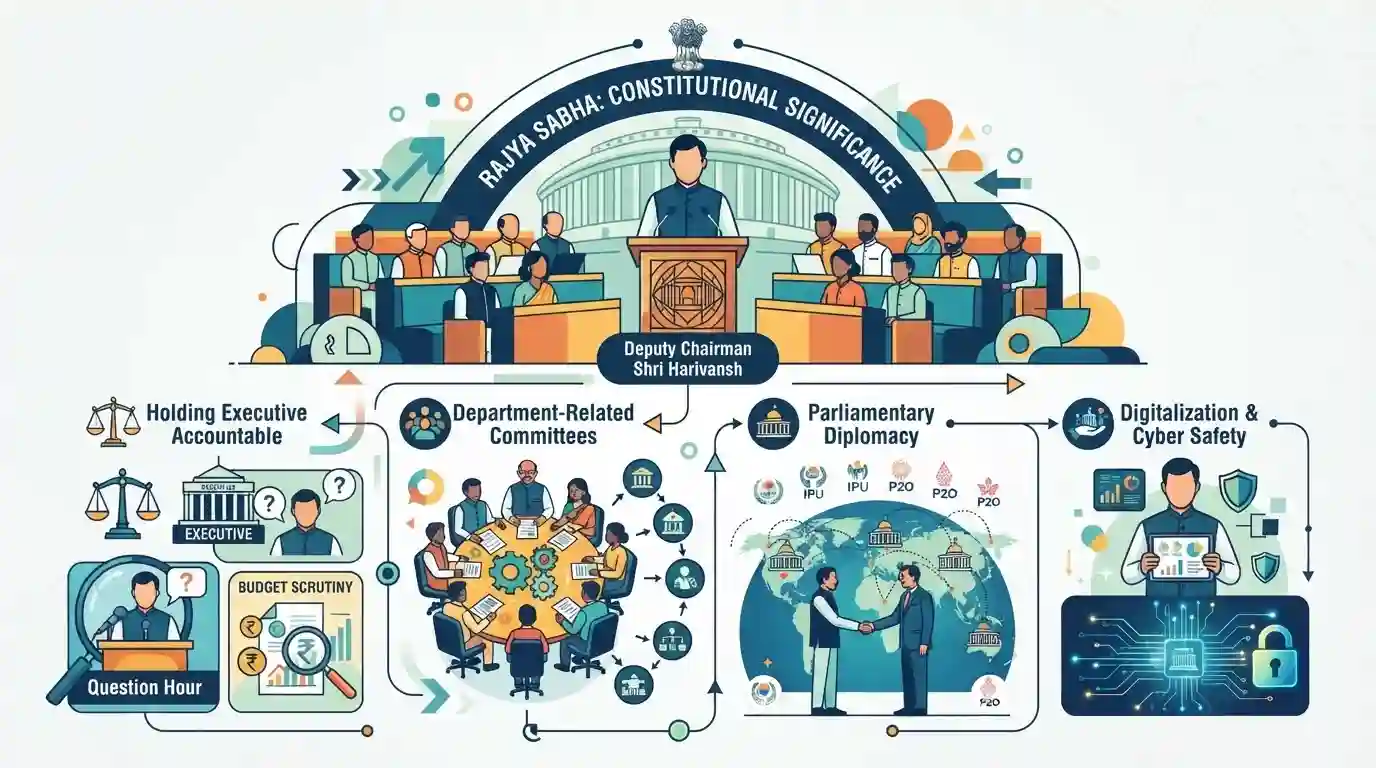
During the valedictory session of the 'Prarambh' orientation workshop for newly elected Rajya Sabha members, Deputy Chairman Shri Harivansh underscored the constitutional significance of the Upper House. He detailed how parliamentary devices such as Question Hour and Department-related Parliamentary Committees serve to hold the executive accountable and rigorously scrutinize budgets. Furthermore, he highlighted the emerging significance of parliamentary diplomacy in international forums like the IPU and P20, and stressed the necessity for MPs to embrace digitalization while ensuring cyber safety.
মূল বিষয়
- Rajya Sabha Deputy Chairman Shri Harivansh emphasized the critical role of the Upper House (Council of States) in ensuring institutional checks and balances.
- The orientation highlighted how Parliamentary devices like Starred and Unstarred questions during Question Hour enforce executive accountability.
- Department-related Parliamentary Committees (DRSCs) were characterized as 'Mini Parliaments' that perform vital, in-depth scrutiny of budgets and legislation away from the political grandstanding of the main chamber.
- Parliamentary diplomacy was stressed as a growing area, with MPs urged to leverage platforms like the Inter-Parliamentary Union (IPU), P20, and BRICS to project India's interests globally.
- The push toward a paperless Parliament requires MPs to adapt to digital tools while remaining cautious about cyber safety and digital threats.
গুরুত্বপূর্ণ শব্দ
Rajya Sabha Secretariat

An independent body established under Article 98 of the Indian Constitution, providing secretarial assistance and administrative support to the Rajya Sabha under the control of its Chairman.
UPSC context
GS Paper II (Polity). Tests knowledge of constitutional provisions for legislative independence and parliamentary administration.
Inter-Parliamentary Union (IPU)
A global organization of national parliaments established in 1889 to promote democratic governance, peace, and international parliamentary diplomacy.
UPSC context
GS Paper II (International Relations). Covers multilateral institutions and global parliamentary diplomacy.
Commonwealth Parliamentary Association (CPA)
An international network of over 180 Commonwealth parliaments and legislatures established in 1911 to promote democratic governance, youth engagement, and gender equality.
UPSC context
GS Paper II (Polity & IR). Relevant for parliamentary forums and India's regional engagement.
Parliament 20 (P20)
A G20 engagement group of parliamentary speakers established in 2010 to align global governance goals with national legislative frameworks.
UPSC context
GS Paper II (International Relations). Tests G20 platforms and India’s global leadership roles.
প্রিলিমস ফাঁদ
All 24 DRSCs are administratively governed by the Lok Sabha Speaker to maintain uniformity in budget scrutiny.
DRSCs are split: 16 work under the Lok Sabha Speaker, while 8 work under the Rajya Sabha Chairman, keeping the bicameral administrative structure distinct.
সংযুক্ত স্থির ধারণা
What is the structure, administration, and mandate of Department-related Standing Committees (DRSCs)?
- Administrative Split: There are 24 committees; 16 function under the Lok Sabha Speaker, and 8 under the Rajya Sabha Chairman.
- Membership and Tenure: Each consists of 31 members (21 LS, 10 RS) nominated for a one-year term. Ministers are strictly excluded from joining.
- Financial Limitations: DRSCs examine Demands for Grants but are barred from proposing cut motions, which is the exclusive domain of the whole House.
How do Starred and Unstarred questions differ in their procedural requirements during Question Hour?
- Starred Questions: Require oral answers on the floor, allowing members to ask follow-up supplementary questions with the Chair's permission.
- Unstarred Questions: Require written answers laid on the table. No supplementary questions are permitted under this category.
আন্তঃবিষয় প্যাটার্ন
AI Translation + Linguistic Federalism
The deployment of AI-driven 'Vani Setu' in Rajya Sabha bridges technology and eighth schedule provisions, facilitating real-time multi-lingual legislative debates.
Parliamentary Diplomacy + Foreign Policy
MPs leveraging platforms like the IPU and P20 represents the intersection of constitutional legislative roles and India's global soft-power diplomacy.

Expect questions linking DRSC composition, the bar on cut motions, and the procedural differences of Starred vs Unstarred questions in 2026.
সংযুক্ত PYQ · 4
সংযুক্ত PYQ · 4
- 2020MainsGS2
Rajya Sabha has been transformed from a 'useless stepney tyre' to the most useful supporting organ in past few decades. Highlight the factors as well as the areas in which this transformation could be visible.
- 2026PrelimsGS1
Consider the following statements in respect of questions asked by the Members in the Parliament of India : 1. Unstarred questions are those to which a Member desires an oral answer in the House. 2. Starred questions are those to which a Member desires a written answer. 3. No supplementary question can be asked on an unstarred question. Which one of the following conclusions based on the above statements is correct ?
- 2021MainsGS2
Do Department-related Parliamentary Standing Committees keep the administration on its toes and inspire reverence for parliamentary control? Evaluate the working of such committees with suitable examples.
- 2019PrelimsGS1
In India, which of the following review the independent regulators in sectors like telecommunications, insurance, electricity, etc.? 1. Ad Hoc Committees set up by the Parliament 2. Parliamentary Department Related Standing Committees 3. Finance Commission 4. Financial Sector Legislative Reforms Commission 5. NITI Aayog Select the correct answer using the code given below.
