Task Force on Public Examination Reforms and Integrity
Source:PIB ↗
কেন এটি গুরুত্বপূর্ণ
The integrity of public examinations in India is critical to human resource development and national meritocracy. With recent leaks causing widespread disruption, a high-level task force led by a digital transformation pioneer indicates a shift toward technology-driven, secure, and transparent examination processes—making it highly relevant for questions on GS2 Governance, Education, and Technology applications.
সারসংক্ষেপ
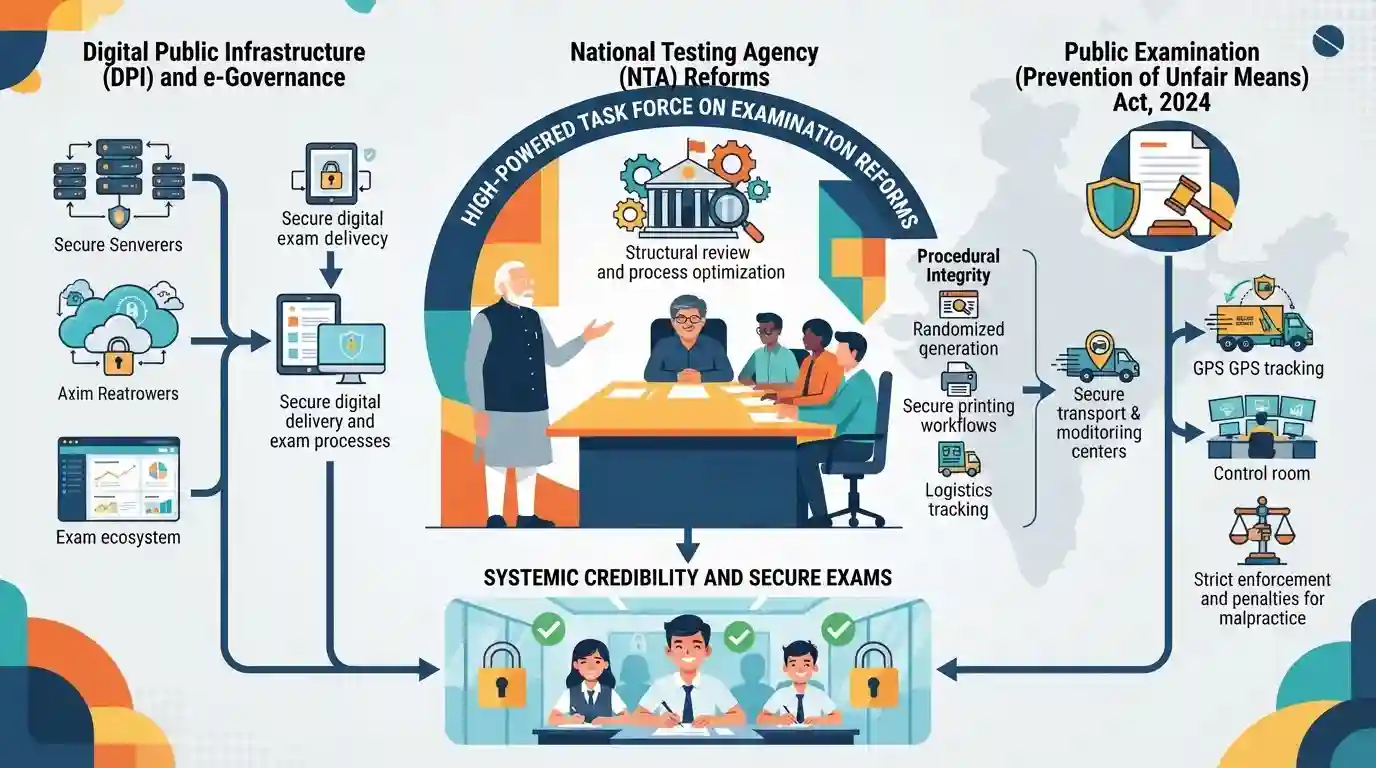
Prime Minister Narendra Modi announced the creation of a high-powered task force on examination reforms, chaired by former UIDAI chief Nandan Nilekani. The task force aims to review and reform the conducting of public exams in India, focusing on administrative, structural, and technological enhancements to prevent paper leaks and restore systemic credibility.
মূল বিষয়
- Prime Minister Narendra Modi announced the constitution of a high-powered task force on examination reforms under the leadership of Shri Nandan Nilekani.
- The task force is established against the backdrop of systemic challenges, integrity issues, and paper leaks associated with national-level high-stakes examinations.
- Nandan Nilekani, known for pioneering India's digital public infrastructure (Aadhaar), is expected to lead efforts in integrating technology-driven security, digital questioning systems, and robust oversight mechanisms to secure examinations.
- This development builds on recent legal frameworks aimed at checking systemic anomalies, such as the Public Examination (Prevention of Unfair Means) Act, 2024.
গুরুত্বপূর্ণ শব্দ
Public Examination (Prevention of Unfair Means) Act, 2024

A central legislation enacted to curb paper leaks, organized cheating, and systemic malpractices in public recruitment and entrance exams through stringent penalties and structural safeguards.
UPSC context
GS Paper 2 (Governance): Highlights statutory mechanisms and transparency measures to ensure accountability and meritocracy in competitive testing.
National Testing Agency (NTA)
An autonomous, self-sustained organization under the Ministry of Education tasked with conducting efficient, transparent, and standardized national-level entrance examinations for higher educational institutions.
UPSC context
GS Paper 2 (Governance): Pertinent to institutional reform, assessing the efficacy of regulatory bodies, and recent controversies regarding exam integrity.
Digital Public Infrastructure (DPI)
Shared technological frameworks—such as digital identity, payment systems, and data exchange networks—that enable the secure, inclusive, and large-scale delivery of public and private services.
UPSC context
GS Paper 3 (Science & Tech): Important for understanding e-governance, digital transformation, and leveraging technology to enhance administrative service delivery.
High-Powered Task Force on Examination Reforms
A committee chaired by Nandan Nilekani, constituted in 2026 to recommend technological, structural, and administrative improvements to secure India's competitive examination ecosystem against malpractices.
UPSC context
GS Paper 2 (Governance): Focuses on recent administrative interventions aimed at restoring public trust and reforming the national educational testing framework.
প্রিলিমস ফাঁদ
"The Public Examinations Act, 2024 automatically covers all state-level university and school board examinations."
The 2024 Act strictly applies to central authorities (UPSC, NTA, SSC, etc.). It does not automatically govern state education boards or state university exams unless explicitly adopted.
সংযুক্ত স্থির ধারণা
What are the key provisions of the Public Examinations (Prevention of Unfair Means) Act, 2024?
- Jurisdiction: Primarily covers central recruiting and testing agencies like UPSC, SSC, NTA, RRB, and IBPS.
- Nature of Offense: Offenses are classified as cognizable, non-bailable, and non-compoundable to ensure strict enforcement.
- Stringent Penalties: Prescribes 3 to 10 years of imprisonment and fines up to ₹1 crore for organized examination malpractice.
How does Digital Public Infrastructure (DPI) enhance transparency in public institutions?
- Identity Verification: Foundational ID systems like Aadhaar eliminate duplicate identities and prevent impersonation during critical service delivery and exams.
- Systemic Security: Enables secure digital questioning systems and encrypted logistics, minimizing human intervention and physical vulnerabilities in the supply chain.
আন্তঃবিষয় প্যাটার্ন
DPI + Governance Accountability
Nilekani’s appointment signals a shift from purely administrative fixes to deploying Digital Public Infrastructure (like biometric verification) to enforce structural accountability in high-stakes environments.
Fast-Track Courts + Statutory Frameworks
The 2026 amendment introducing fast-track courts for exam leaks parallels the institutional mechanisms set up under the POCSO Act, emphasizing swift justice delivery in acute governance crises.

Expect a Prelims question on the jurisdiction of the 2024 Public Exams Act, specifically testing if it applies to state universities.
সংযুক্ত PYQ · 3
সংযুক্ত PYQ · 3
- 2024MainsGS2
What are the aims and objects of recently passed and enforced, The Public Examination (Prevention of Unfair Means) Act, 2024? Whether University/State Education Board examinations, too, are covered under the Act ?
- 2024MainsGS2
e-governance is not just about the routine application of digital technology in service delivery process. It is as much about multifarious interactions for ensuring transparency and accountability. In this context evaluate the role of the 'Interactive Service Model' of e-governance.
- 2023MainsGS2
e-governance, as a critical tool of governance, has ushered in effectiveness, transparency and accountability in governments. What inadequacies hamper the enhancement of these features ?
