FCV Tobacco Market Review and Agricultural Export Policy
Source:PIB ↗
Why It Matters
FCV tobacco is a highly regulated, export-oriented cash crop that significantly contributes to India's agricultural export basket. Understanding how the government manages crop size, e-auctions, and farmer welfare through statutory bodies like the Tobacco Board is crucial for topics on agricultural marketing and supply chain management (GS3) and statutory bodies (GS2). It also highlights the policy balance between promoting lucrative commercial agriculture and enforcing environmental sustainability.
Summary
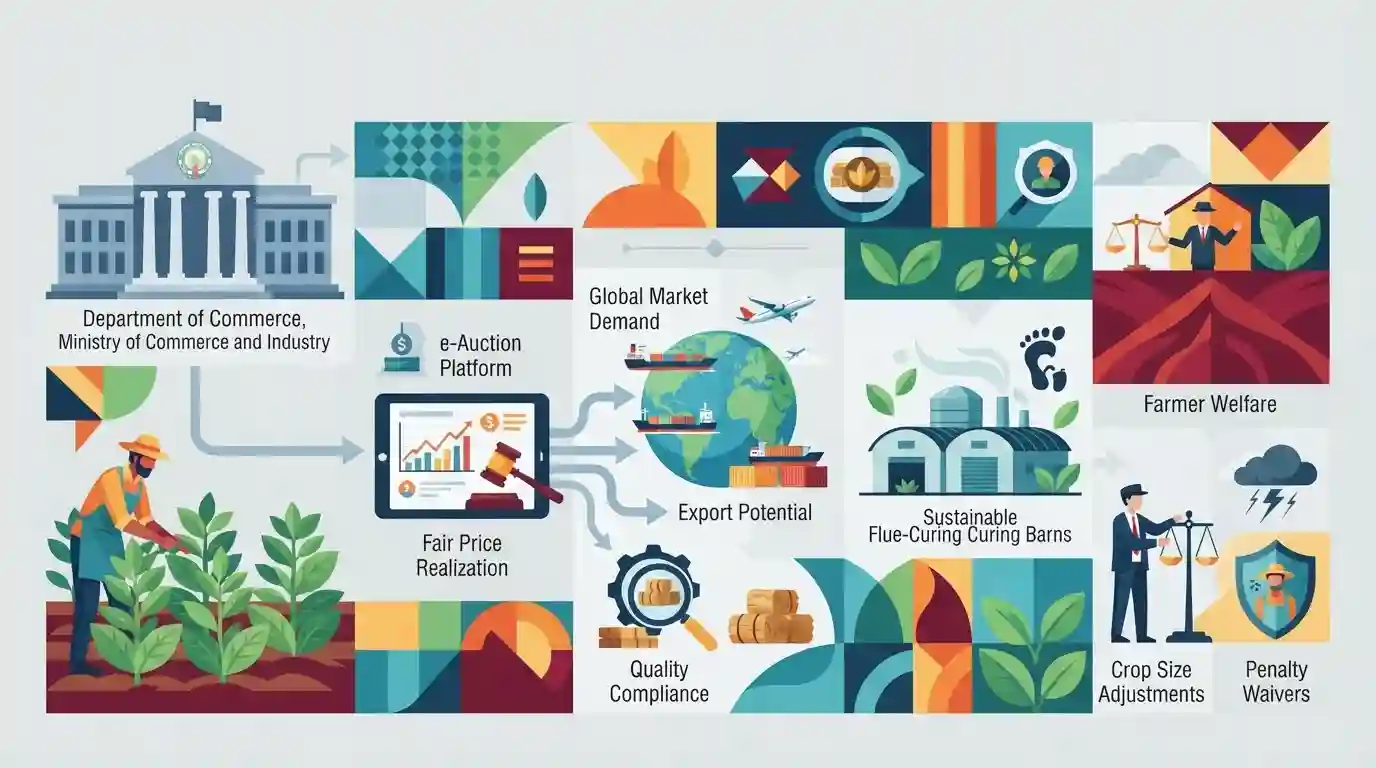
The Department of Commerce (Ministry of Commerce and Industry) recently conducted a comprehensive review of the market situation, auction progress, and export potential of Flue-Cured Virginia (FCV) tobacco in Andhra Pradesh. FCV tobacco is a major commercial crop heavily reliant on structured e-auctions organized by the Tobacco Board. The review focused on ensuring fair price realization for farmers, maximizing export opportunities driven by robust global demand, and overseeing the smooth functioning of transparent auction platforms. Additionally, the meeting addressed critical themes such as maintaining quality compliance for international markets, promoting sustainable flue-curing methods to reduce the industry's carbon footprint, and deploying regulatory relief measures—like crop size adjustments and penalty waivers—to support farmer welfare amidst climate-induced vulnerabilities.
Key Points
- The Department of Commerce reviewed the ongoing e-auction process for FCV tobacco in Andhra Pradesh, noting that strong global demand has led to highly remunerative prices for farmers across various crop grades.
- India is a leading exporter of tobacco. The review emphasized the need to maintain strict quality standards, such as compliance with international pesticide residue limits, to boost export earnings in global markets like Europe and the Americas.
- The Tobacco Board plays a crucial regulatory role in fixing crop size to ensure supply-demand equilibrium, while providing policy interventions like penalty waivers on excess or unregistered production during climatic distress (e.g., cyclones).
- A key focus is ensuring a sustainable agricultural supply chain by modernizing the traditional, fuel-intensive flue-curing process. This involves transitioning to energy-efficient, solar-assisted, or biomass-based curing barns to meet global ESG (Environmental, Social, and Governance) mandates.
Important Terms
Tobacco Board of India

A statutory body established in 1976 under the Ministry of Commerce and Industry, headquartered in Guntur, Andhra Pradesh, responsible for regulating and promoting India's tobacco industry, particularly Flue-Cured Virginia tobacco production and exports.
UPSC context
GS Paper III (Agriculture/Statutory Bodies): Tests understanding of public institutions regulating commercial crops, trade, and farmer welfare.
Tobacco Board Act, 1975
The legislative framework enacted by Parliament to establish the Tobacco Board of India, enabling planned development of the tobacco industry, regulation of growers, and export facilitation.
UPSC context
GS Paper II (Government Acts): Tests knowledge of statutory legislation governing domestic marketing and international trade of agricultural commodities.
Flue-Cured Virginia (FCV) Tobacco
A premium, high-sugar, bright golden-leaf tobacco variety cured using controlled heat from flues. It is a major exportable cash crop predominantly grown in Andhra Pradesh and Karnataka.
UPSC context
GS Paper III (Agriculture & Geography): Relevant for cropping patterns, economic significance of commercial agriculture, and export-led growth.
Ministry of Commerce and Industry
A central Union ministry in India responsible for formulating and implementing national policies related to international trade, domestic industry, foreign direct investment, and trade negotiations.
UPSC context
GS Paper II (Institutions): Tests administrative structure of departments regulating India's trade, investment, and industrial policy.
Department of Commerce
An executive department under the Ministry of Commerce and Industry tasked with formulating India's Foreign Trade Policy, managing multilateral trade relations, and executing export promotion schemes.
UPSC context
GS Paper III (Foreign Trade): Relevant for trade policy formulation, export-import promotion, and international economic agreements.
Prelims Trap
The Tobacco Board of India regulates production quotas, registrations, and e-auctions for all varieties of tobacco grown in India.
The Tobacco Board's regulatory powers (such as fixing crop size, registering growers, and conducting mandatory e-auctions) apply exclusively to Virginia (FCV) tobacco. Non-Virginia varieties like bidi tobacco are unregulated by the Board.
Static Concepts Connected
What is the mandate and jurisdiction of the Tobacco Board of India?
- Statutory framework: Established under the Tobacco Board Act, 1975, as a statutory body under the Ministry of Commerce and Industry, headquartered in Guntur, Andhra Pradesh.
- Exclusive jurisdiction: Its regulatory, crop-planning, and auction-organizing powers are strictly limited to Virginia tobacco; other varieties like bidi and chewing tobacco remain unregulated.
- Key functions: Monitors production, registers growers, operates e-auctions for fair price discovery, and works to improve yields and export potential.
What is Flue-Cured Virginia (FCV) tobacco and its curing process?
- Geographic concentration: A high-grade tobacco variety primarily grown in Andhra Pradesh and Karnataka, which together account for approximately 99% of India's FCV output.
- Flue-curing process: A method where harvested leaves are hung in closed barns and dried using heat radiated from hot-air pipes (flues), avoiding direct exposure to smoke.
- Environmental transition: Traditionally fuel-intensive (reliant on wood/coal), driving a modern push toward solar-assisted and biomass-based curing to reduce carbon footprints.
Cross-Topic Patterns
Statutory control vs. Market-driven cash crops
While the Tobacco Board strictly controls FCV crop sizes and auctions, other commercial crops like cotton operate under market dynamics, showcasing divergent state intervention strategies in agriculture.
Global ESG mandates and domestic supply chains
Stricter international pesticide residue limits and green curing mandates (ESG) require fast capital upgrades, creating compliance challenges for smallholder commercial farmers.

Expect questions contrasting overall tobacco (Gujarat) with FCV (AP/Karnataka) and the selective statutory reach of the Tobacco Board.
Linked PYQs · 5
Linked PYQs · 5
- 2022PrelimsGS1
With reference to the "Tea Board" in India, consider the following statements : 1. The Tea Board is a statutory body. 2. It is a regulatory body attached to the Ministry of Agriculture and Farmers Welfare. 3. The Tea Board's Head Office is situated in Bengaluru. 4. The Board has overseas offices at Dubai and Moscow. Which of the statements given above are correct?
- 2025PrelimsGS1
With reference to India, consider the following pairs : Organization Union Ministry I. The National Automotive Board : Ministry of Commerce and Industry II. The Coir Board : Ministry of Heavy Industries III. The National Centre for Trade Information : Ministry of Micro, Small and Medium Enterprises How many of the above pairs are correctly matched?
- 2025MainsGS3
Elaborate the scope and significance of supply chain management of agricultural commodities in India.
- 2021MainsGS3
What are the present challenges before crop diversification? How do emerging technologies provide an opportunity for crop diversification?
- 2025MainsGS3
Explain the factors influencing the decision of the farmers on the selection of high value crops in India.
