Bharat CPSEs Consultative Conclave and Infrastructure Execution
Source:PIB ↗
ఇది ఎందుకు ముఖ్యం
CPSEs play a vital role in India's infrastructure, energy, and mining sectors. Improving their project execution through capacity building and modern platforms like PM Gati Shakti is crucial for reducing delays, lowering logistics costs, and accelerating India's economic growth. This ties directly to GS3 (Infrastructure and Economy) and GS2 (Governance/Capacity Building).
సారాంశం
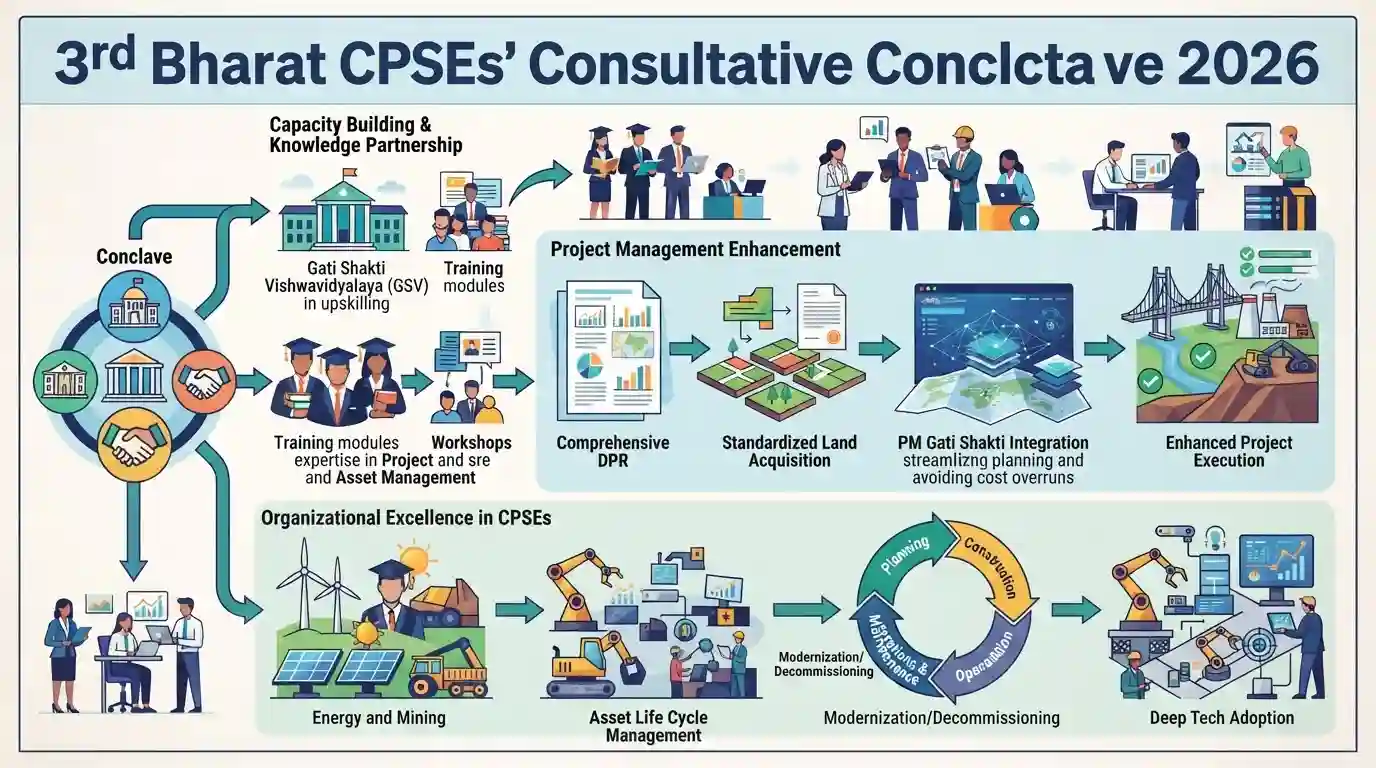
The 3rd Bharat CPSEs' Consultative Conclave 2026, jointly organized by the Capacity Building Commission (CBC) and the Department of Public Enterprises (DPE) with Gati Shakti Vishwavidyalaya (GSV) as the Knowledge Partner, recently concluded. Focusing on the Energy and Mining sectors, the conclave centered on 'Project and Asset Management' to enhance project execution and organizational excellence in Central Public Sector Enterprises (CPSEs). It stressed the integration of the PM Gati Shakti platform to streamline planning and avoid cost overruns. Discussions also highlighted the importance of comprehensive Detailed Project Reports (DPRs), standardized land acquisition, asset life cycle management, deep tech adoption, and the crucial role of GSV in upskilling professionals.
ముఖ్య అంశాలు
- The 3rd Bharat CPSEs' Consultative Conclave 2026 focused on 'Project and Asset Management' for CPSEs in the Energy and Mining sectors.
- It was organized jointly by the Capacity Building Commission (CBC) and the Department of Public Enterprises (DPE), with Gati Shakti Vishwavidyalaya (GSV) acting as the Knowledge Partner.
- The conclave emphasized integrating the PM Gati Shakti National Master Plan into project planning to prevent time and cost overruns in infrastructure development.
- Key discussions revolved around capacity building, drafting comprehensive Detailed Project Reports (DPRs), standardizing land acquisition processes, and adopting deep tech for asset management.
- GSV was highlighted as a critical institutional asset for upskilling professionals across ministries and departments for better logistics and project execution.
ముఖ్యమైన పదాలు
PM Gati Shakti National Master Plan

A GIS-based digital platform and master plan launched in 2021 to ensure integrated, multi-modal infrastructure planning, coordination among ministries, and the reduction of logistics costs in India.
UPSC context
GS Paper III (Infrastructure), tests understanding of multi-modal planning, logistics cost reduction, and infrastructure-led economic growth.
Capacity Building Commission (CBC)
An executive body established in 2021 under the Mission Karmayogi framework to standardize civil services training, harmonize learning across departments, and prepare future-ready public officials.
UPSC context
GS Paper II (Governance), tests understanding of civil service reforms, administrative capacity, and the implementation of Mission Karmayogi.
Department of Public Enterprises (DPE)
The nodal department under the Ministry of Finance responsible for formulating policy guidelines, evaluating performance, and overseeing capital expenditures of Central Public Sector Enterprises (CPSEs) in India.
UPSC context
GS Paper III (Economy), tests knowledge of public sector undertaking (PSU) governance, strategic disinvestment, and resource mobilization.
Gati Shakti Vishwavidyalaya (GSV)
A Central University in Vadodara, sponsored by the Ministry of Railways, established in 2022 to deliver specialized training, education, and research in transportation, logistics, and infrastructure sectors.
UPSC context
GS Paper II & III, tests understanding of specialized educational initiatives designed to address skill deficits in logistics and infrastructure sectors.
Central Public Sector Enterprises (CPSEs)
Government-owned companies, in which the Central Government holds 51% or more of the equity shares directly or indirectly, categorized into Maharatna, Navratna, and Miniratna statuses.
UPSC context
GS Paper III (Economy), tests knowledge of public enterprises, classification criteria (Maharatna, Navratna), and policy on strategic sectors.
ప్రిలిమ్స్ ఉచ్చు
Gati Shakti Vishwavidyalaya is a central university functioning under the administrative control of the Ministry of Education.
While it is a Central University, it operates directly under the Ministry of Railways, created by upgrading the National Rail and Transportation Institute.
అనుసంధానమైన స్థిర భావనలు
What is the mandate and composition of the Capacity Building Commission (CBC)?
- Mandate: Standardizes civil services training, audits training institutions, and assists in creating annual capacity building plans.
- Structure: An independent executive body with three members, supported by its own secretariat under Mission Karmayogi.
What is Gati Shakti Vishwavidyalaya (GSV) and its administrative positioning?
- Origin: Established in 2022 by upgrading the National Rail and Transportation Institute (NRTI) in Vadodara, Gujarat.
- Parent Ministry: It is a Central University operating under the administrative control of the Ministry of Railways.
అంతర-అంశ నమూనాలు
Administrative Shifts & Fiscal Alignment
Shifting the DPE to the Ministry of Finance unites public capital expenditure, asset monetization, and disinvestment strategies under a single fiscal authority.
Spatial Planning & Civil Competency
Integrating GIS-based PM Gati Shakti with Capacity Building Commission frameworks reforms civil service execution capabilities for high-value infrastructure projects.

PM Gati Shakti's GIS integration and CBC's institutional mandate under Mission Karmayogi are prime targets for multi-statement 2026 MCQs.
అనుసంధాన PYQలు · 4
అనుసంధాన PYQలు · 4
- 2021MainsGS3
“Investment in infrastructure is essential for more rapid and inclusive economic growth.” Discuss in the light of India's experience.
- 2022MainsGS3
Why is Public Private Partnership (PPP) required in infrastructural projects ? Examine the role of PPP model in the redevelopment of Railway Stations in India.
- 2020MainsGS2
Institutional quality is a crucial driver of economic performance". In this context suggest reforms in Civil Service for strengthening democracy.
- 2017MainsGS2
Initially Civil Services in India were designed to achieve the goals of neutrality and effectiveness, which seems to be lacking in the present context. Do you agree with the view that drastic reforms are required in Civil Services? Comment.
