Kargil Vijay Diwas and Strategic Shift in Border Management
Source:PIB ↗
কেন এটি গুরুত্বপূর্ণ
It underlines the official geopolitical stance on PoJK and the 1994 Parliament resolution, which is vital for GS2 International Relations. It also highlights the shift in India's defense strategy and border management, highly relevant for GS3 Internal Security.
সারসংক্ষেপ
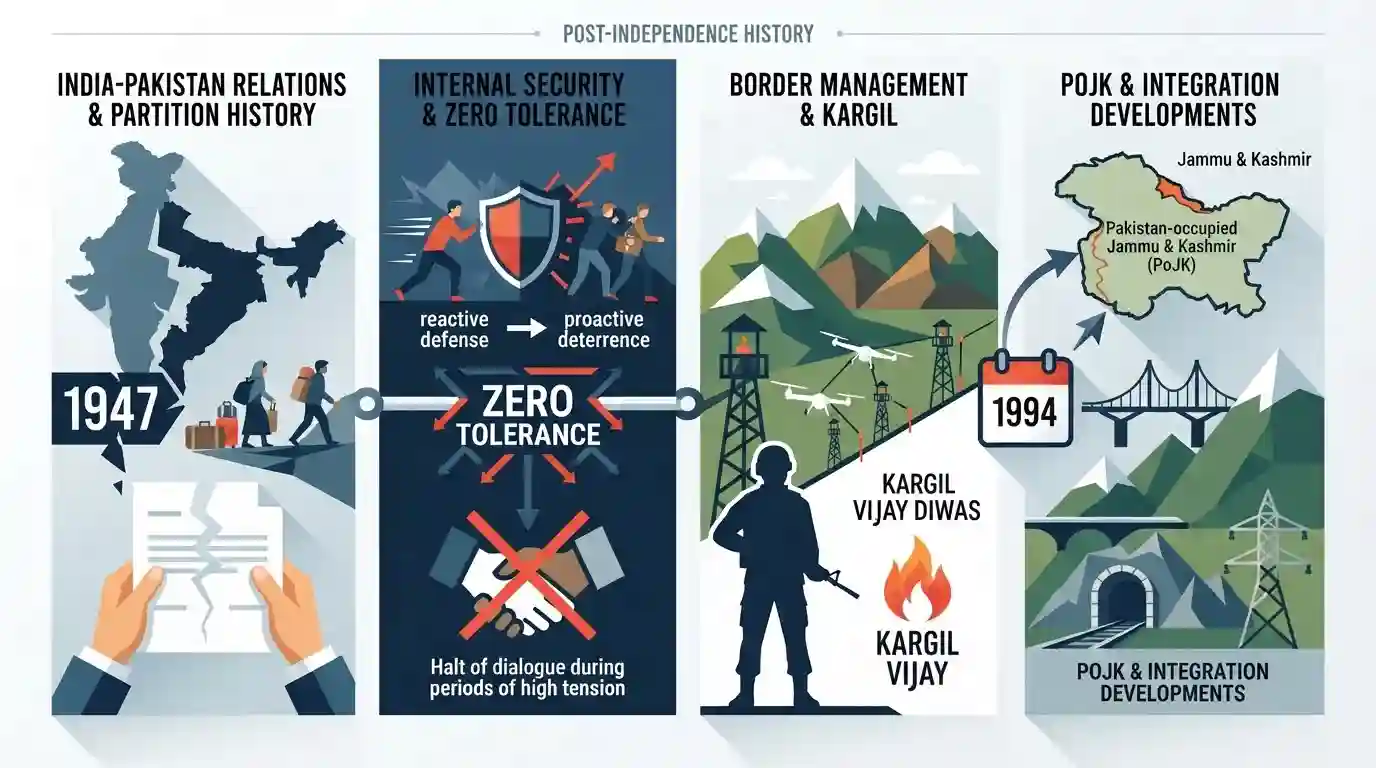
On the 27th Kargil Vijay Diwas, Union Minister Dr. Jitendra Singh highlighted a paradigm shift in India's border management, noting a transition from reactive defense to proactive deterrence and zero tolerance for terrorism. He labeled the 1947 Partition as the 'greatest blunder of history,' citing it as the root cause of the Kashmir dispute. Reaffirming the 1994 unanimous Parliamentary resolution, he stated that the retrieval of Pakistan-occupied Jammu & Kashmir (PoJK) remains the only unresolved bilateral issue with Pakistan. The Minister also noted significant recent developments in J&K's infrastructure and integration under the current administration.
মূল বিষয়
- The 27th Kargil Vijay Diwas marks a strategic shift in India's border management from a reactive stance to proactive deterrence.
- The Partition of India was characterized by the Minister as the 'greatest blunder of history', directly leading to the Kashmir issue.
- Retrieval of Pakistan-occupied Jammu & Kashmir (PoJK) is asserted as the only pending issue between India and Pakistan.
- The government reaffirmed its commitment to the 1994 unanimous Parliamentary resolution regarding the reclamation of PoJK.
- Current security policies emphasize a 'Zero Tolerance' approach toward terrorism along with rapid infrastructure development in J&K.
গুরুত্বপূর্ণ শব্দ
1994 Parliament Resolution on PoJK

A unanimous resolution adopted by both Houses of the Indian Parliament on February 22, 1994, declaring that Jammu & Kashmir is an integral part of India and demanding that Pakistan vacate illegally occupied areas.
UPSC context
GS-II (International Relations) & GS-I (Post-Independence); tests understanding of India's official, legally-binding diplomatic and territorial stance on Jammu & Kashmir.
Kargil Vijay Diwas
Celebrated annually on July 26, this day commemorates India's decisive victory over Pakistani infiltrators during the 1999 Kargil War (Operation Vijay) and honors the supreme sacrifices of the Indian Armed Forces.
UPSC context
GS-I (Post-Independence History) & GS-III (Security); tests awareness of military conflicts, nuclearized South Asian geopolitics, and subsequent border management reforms.
PoJK (Pakistan-occupied Jammu & Kashmir)
The portion of the erstwhile princely state of Jammu & Kashmir under illegal Pakistani military occupation since 1947, recognized by India as its sovereign, integral territory under the 1994 parliamentary mandate.
UPSC context
GS-II (International Relations) & GS-III (Internal Security); evaluates bilateral disputes, territorial integrity, and national security challenges in India's border regions.
Border Management
The strategic, legal, and physical regulation of a nation's land, maritime, and aerial borders to maintain security, counter cross-border terrorism, prevent smuggling, and facilitate legitimate trade.
UPSC context
GS-III (Internal Security); tests knowledge of security challenges in border areas, infrastructure development, and inter-agency coordination along international frontiers.
Parliament of India
The supreme legislative body of the Republic of India, comprising the President, Lok Sabha, and Rajya Sabha, possessing the constitutional power to enact laws and declare national consensus.
UPSC context
GS-II (Polity & Governance); tests understanding of legislative procedures, parliamentary sovereignty, executive accountability, and constitutional provisions regarding state boundaries.
প্রিলিমস ফাঁদ
The Department of Border Management under the MHA is responsible for managing all land borders including the Line of Control.
The Line of Control (LoC) with Pakistan and Line of Actual Control (LAC) with China are under the Ministry of Defence, not the MHA.
সংযুক্ত স্থির ধারণা
What institutional reforms in India's border management arose from the Kargil Review Committee?
- One Border One Force: Assigned unique border guarding forces to specific international borders (e.g., BSF for Pakistan/Bangladesh) to prevent operational overlap.
- Border Management Department: Created under the Ministry of Home Affairs (MHA) in 2004 to oversee border infrastructure and integration.
- Intelligence Integration: Established the Multi-Agency Centre (MAC) for streamlined, real-time intelligence sharing among security agencies.
What is the constitutional and historical status of the 1994 Parliamentary Resolution on J&K?
- Integral Status: Unanimously declared that the entire state of Jammu and Kashmir is and shall remain an integral part of the Indian Union.
- Vacation of Aggression: Demanded that Pakistan must vacate all areas of Jammu & Kashmir occupied through aggression.
- Non-Interference: Firmly rejected any external interference in India's internal affairs regarding the J&K region.
আন্তঃবিষয় প্যাটার্ন
Infrastructure as border deterrence
Links transport infrastructure (Chenab Bridge, USBRL) to national security, showing how physical connectivity serves as a strategic force multiplier in border areas.
Nuclear deterrence and conflict limits
Analyzes the 1999 Kargil conflict to study how nuclear-armed states manage limited conventional wars without triggering a full-scale nuclear exchange.

Expect questions on India's border defense technology (CIBMS/BOLD-QIT) and the institutional division of border management.
সংযুক্ত PYQ · 4
সংযুক্ত PYQ · 4
- 2020MainsGS3
Analyze internal security threats and transborder crimes along Myanmar, Bangladesh and Pakistan borders including Line of Control (LoC). Also discuss the role played by various security forces in this regard.
- 2015MainsGS2
Terrorist activities and mutual distrust have clouded India-Pakistan relations. To what extent the use of soft power like sports and cultural exchanges could help generate goodwill between the two countries? Discuss with suitable examples.
- 2023MainsGS3
Winning of 'Hearts and Minds' in terrorism-affected areas is an essential step in restoring the trust of the population. Discuss the measures adopted by the Government in this respect as part of the conflict resolution in Jammu and Kashmir.
- 2025MainsGS3
Terrorism is a global scourge. How has it manifested in India? Elaborate with contemporary examples. What are the counter measures adopted by the State? Explain.
