Mission Jal Raksha and Groundwater Conservation in Chhattisgarh
Source:PIB ↗
ఇది ఎందుకు ముఖ్యం
This initiative offers an exceptional, replicable district-level case study for Mains GS3 (Environment & Water Security) and GS2 (Local Governance/Administrative Best Practices). It illustrates how local administration can combine state-of-the-art spatial technology (GIS, remote sensing) with behavioral change (crop diversification, water budgeting) and local employment generation to tackle the national challenge of depleting groundwater tables.
సారాంశం
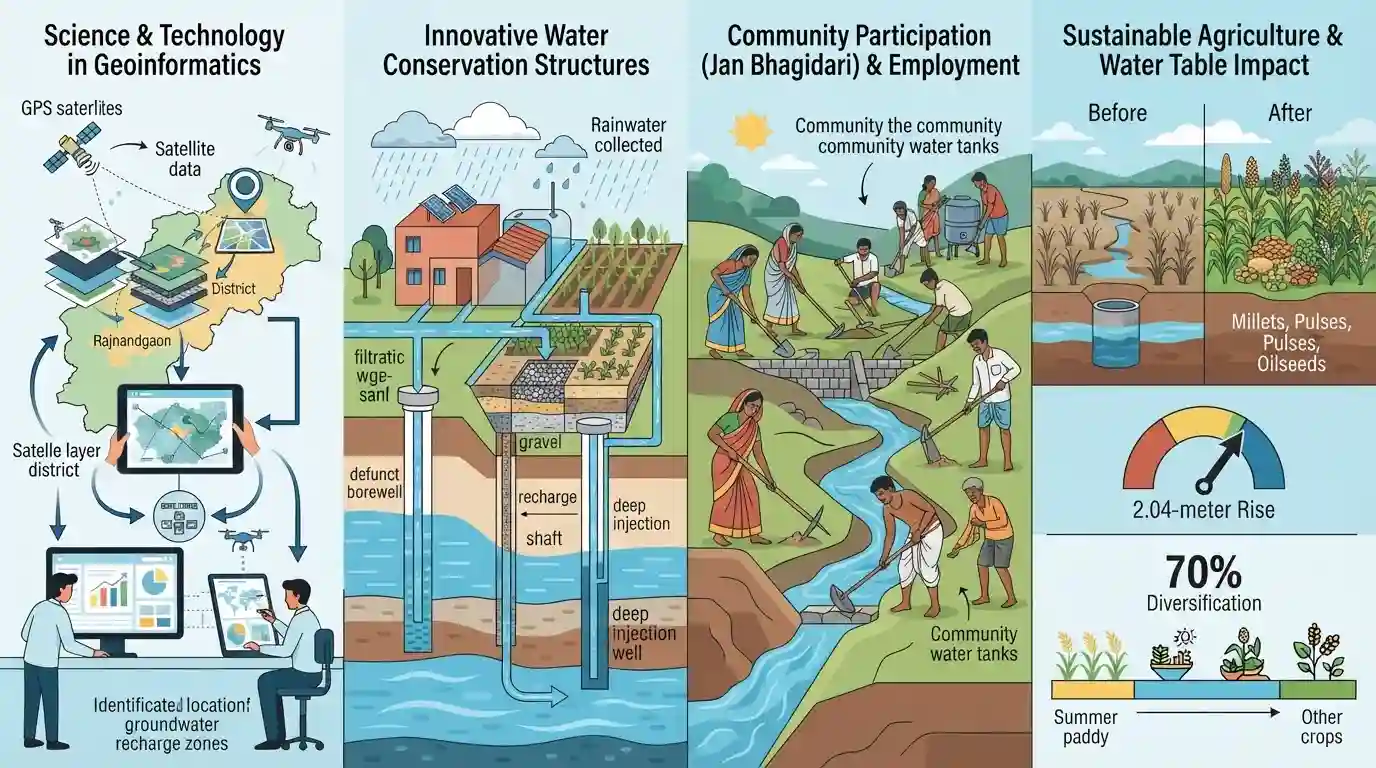
The article highlights 'Mission Jal Raksha', an exemplary science-driven and community-led water conservation initiative in Rajnandgaon district, Chhattisgarh. Run in coordination with the Ministry of Jal Shakti's national 'Catch the Rain' campaign, the program utilizes advanced geoinformatic mapping and innovative structures (like deep injection wells and recharge shafts converted from defunct borewells) alongside active 'Jan Bhagidari' (community participation) to address groundwater depletion. The efforts successfully secured a 2.04-meter rise in local water tables, promoted crop diversification by shifting 70% of summer paddy to less water-intensive crops, and generated substantial rural employment.
ముఖ్య అంశాలు
- Context: Rajnandgaon district in Chhattisgarh has emerged as a leader in monsoon-preparedness and rainwater harvesting through its regional initiative 'Mission Jal Raksha', in alignment with the national '#CatchTheRain' campaign of the Ministry of Jal Shakti.
- Science-Driven Infrastructure: The district combined advanced geoinformatics—including GIS mapping, remote sensing, aquifer mapping, Digital Elevation Models (DEM), and 'ridge-to-valley' planning—to identify the most strategic and scientifically accurate locations for groundwater recharge.
- Innovative Field Interventions: Structural solutions implemented include converting over 500 defunct borewells into active recharge shafts, constructing 600+ deep injection wells integrated with 1,700+ mini percolation tanks to recharge hard-rock aquifers, and geo-tagging over 2,500 water bodies. In total, 60,000+ water conservation and recharge structures were built across 662 villages.
- Community-Led Jan Bhagidari: Local communities, farmers, youth, and women actively engaged in water budgeting and awareness. This behavioral shift led to nearly 70% of summer paddy cultivation being replaced by less water-intensive crop alternatives (crop diversification), easing the strain on groundwater.
- Measurable Socio-Ecological Impacts: The mission resulted in an average increase in the local groundwater level by approximately 2.04 meters, secured irrigation and drinking water supply, and generated over 51 lakh person-days of rural employment.
ముఖ్యమైన పదాలు
Mission Jal Raksha

A localized, technology-driven water conservation initiative in Rajnandgaon, Chhattisgarh, combining GIS mapping and innovative recharge structures to address groundwater depletion and secure local climate resilience.
UPSC context
GS Paper III (Water Resources). Tests understanding of decentralized water conservation models and technology integration.
Jal Shakti Abhiyan
A nationwide water conservation campaign launched in 2019 by the Government of India to promote rainwater harvesting, water security, and groundwater recharge in water-stressed districts.
UPSC context
GS Paper II & III (Government Schemes). Tests knowledge of national environmental missions and sustainable development.
Catch the Rain Campaign
An annual initiative under the Jal Shakti Abhiyan with the tagline "Catch the rain, where it falls, when it falls" to promote intensive pre-monsoon rainwater harvesting.
UPSC context
GS Paper III (Conservation). Tests knowledge of citizen-led rainwater harvesting and climate adaptation measures.
Ministry of Jal Shakti
The central ministry in India established in 2019 to consolidate all water-related matters, administering national programs like the Jal Jeevan Mission and Jal Shakti Abhiyan.
UPSC context
GS Paper II (Government Ministries). Tests understanding of unified institutional frameworks for water security.
Gram Panchayats
The grassroots tier of local self-government in rural India, constitutionally established under the 73rd Amendment, responsible for executing rural development schemes and local natural resource management.
UPSC context
GS Paper II (Panchayati Raj). Tests understanding of decentralized governance and grassroots community participation.
ప్రిలిమ్స్ ఉచ్చు
Artificial recharge shafts in hard-rock aquifers depend on natural, gravity-based surface percolation through topsoil layers.
Deep injection wells and recharge shafts do not rely on slow surface percolation; they are engineered to bypass impermeable geological layers to directly access deeper, confined aquifers.
అనుసంధానమైన స్థిర భావనలు
What is the 'Ridge-to-Valley' approach in watershed management?
- Sequence of Treatment: Treatment begins at the highest elevation (ridge) to check run-off velocity and prevent soil erosion before treating the lower valley.
- Upper-Slope Structures: Involves continuous contour trenches and loose boulder check dams to harvest water and control sediment at the upper reaches.
- Lower-Valley Structures: Focuses on farm ponds, percolation tanks, and check dams to store harvested run-off in flatter terrains.
What is the difference between shallow and deep aquifers?
- Shallow Aquifers: Located above the first confining layer, directly linked to surface percolation, and highly susceptible to seasonal fluctuations and surface pollution.
- Deep Aquifers: Located below impermeable rock layers (confined), recharging slowly over decades unless aided by artificial injection wells.
అంతర-అంశ నమూనాలు
Geoinformatics in Resource Management
Integrating GIS, remote sensing, and 3D aquifer mapping under NAQUIM transforms local watershed planning from unscientific guessing to high-precision resource allocation.
Crop Diversification & Virtual Water
Replacing summer paddy with water-resilient crops directly reduces India's high 'virtual water' export footprint, aligning trade policy with domestic ecological survival.

UPSC 2026 may contrast artificial recharge mechanisms (injection wells) with natural percolation in hard-rock aquifers under GS-1/GS-3.
అనుసంధాన PYQలు · 3
అనుసంధాన PYQలు · 3
- 2020MainsGS3
What are the salient features of the Jal Shakti Abhiyan launched by the Government of India for water conservation and water security?
- 2020MainsGS3
Suggest measures to improve water storage and irrigation system to make its judicious use under depleting scenario.
- 2015MainsGS1
India is well endowed with fresh water resources. Critically examine why it still suffers from water scarcity.
