Implementation Framework and Capacity Building for New Criminal Laws
Source:PIB ↗
આ શા માટે મહત્વનું છે
The overhaul of the IPC, CrPC, and Evidence Act represents a watershed moment in India's polity. For UPSC aspirants, understanding the practical implementation challenges—such as training bottlenecks, forensic infrastructure deficits, and the role of digital governance (e-Courts, CCTNS)—is crucial for answering GS2 questions on governance and justice delivery, as well as GS3 questions on internal security and investigative agency modernization.
સારાંશ
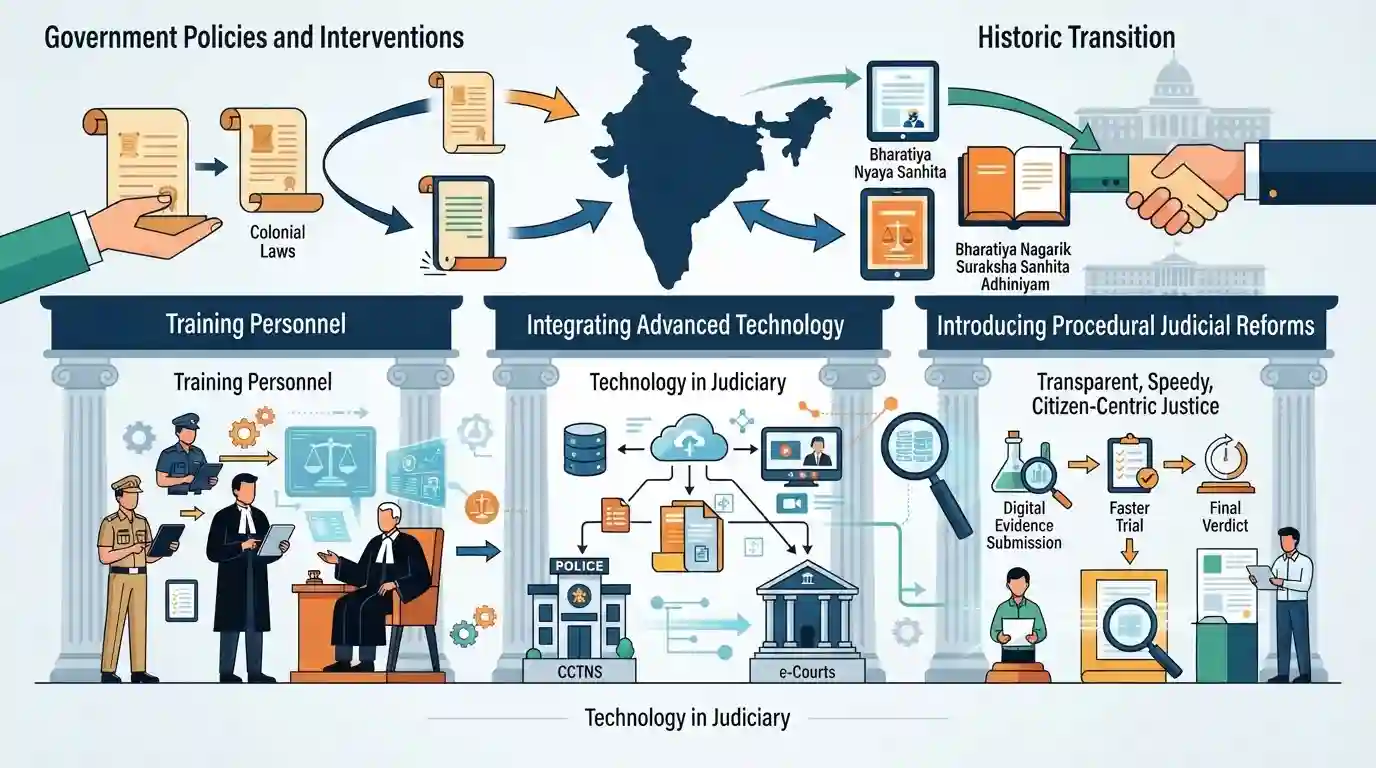
The government is actively strengthening the nationwide implementation of the newly enacted criminal laws—Bharatiya Nyaya Sanhita, Bharatiya Nagarik Suraksha Sanhita, and Bharatiya Sakshya Adhiniyam. To facilitate this historic transition from colonial-era laws, massive efforts are being undertaken in three core areas: training personnel (police, prosecutors, and judiciary), integrating advanced technology (like CCTNS and e-Courts), and introducing procedural judicial reforms. These measures emphasize digital and forensic evidence to ensure transparent, speedy, and citizen-centric justice delivery.
મુખ્ય મુદ્દા
- The Government of India is heavily investing in capacity building and training programs to ensure the smooth rollout and implementation of the three new criminal laws (BNS, BNSS, BSA).
- A massive technological integration is underway, leveraging platforms like CCTNS and the e-Courts project to digitize investigations, evidence management, and judicial proceedings.
- The new legal framework mandates the use of forensic science and digital evidence in serious crimes, necessitating rapid modernization of forensic laboratories across the country.
- The reforms aim to transition the criminal justice system from a colonial, penal-centric approach to a modern, citizen-centric, and justice-oriented model.
મહત્વપૂર્ણ શબ્દો
Bharatiya Nyaya Sanhita (BNS)

India's primary criminal code defining offences and punishments. Enacted in 2023, it came into force on July 1, 2024, replacing the colonial-era Indian Penal Code of 1860.
UPSC context
Tests candidate's understanding of judicial reforms and criminal justice system under GS Paper II (Polity and Governance).
Bharatiya Nagarik Suraksha Sanhita (BNSS)
The procedural law in India that governs arrest, investigation, trial, and bail. Enacted in 2023, it came into force on July 1, 2024, replacing the Code of Criminal Procedure of 1973.
UPSC context
Essential for GS Paper II (Polity and Governance) to evaluate criminal procedure reforms, police empowerment, and legal efficiency.
Bharatiya Sakshya Adhiniyam (BSA)
India's new law on evidence that outlines rules and principles for fair trials. Effective July 1, 2024, it replaced the Indian Evidence Act of 1872, incorporating electronic and digital records.
UPSC context
Relevant for GS Paper II (Judiciary) regarding modern evidence rules, digital forensics, and procedural justice.
e-Courts Project
A pan-India Mission Mode Project funded by the Department of Justice to transform the Indian judiciary through ICT enablement of district and subordinate courts.
UPSC context
Key topic in GS Paper II (Governance/E-Governance) evaluating technology integration for affordable, transparent, and speedy justice.
Crime and Criminal Tracking Network & Systems (CCTNS)
A nationwide e-governance initiative under the Ministry of Home Affairs to create a comprehensive, integrated system for tracking crimes and criminals. It connects over 17,000 police stations across India.
UPSC context
Part of GS Paper II (E-Governance) and GS Paper III (Internal Security/Police Reforms), highlighting technology-driven policing.
National Crime Records Bureau (NCRB)
A central government agency under the Ministry of Home Affairs established in 1986. It collects, compiles, and analyzes national crime data while implementing the CCTNS project.
UPSC context
Crucial for GS Paper II and III, testing knowledge of crime statistics, law enforcement tools, and digital databases.
Bureau of Police Research and Development (BPR&D)
An agency established in 1970 under the Ministry of Home Affairs to promote modernization of police forces. It conducts research, develops police technology, and coordinates training.
UPSC context
Important for GS Paper II (Governance) and GS Paper III (Police Reforms and Internal Security).
પ્રિલિમ્સ ટ્રેપ
"Forensic investigation is legally mandated for all cognizable offenses under the BNSS."
Under the BNSS, forensic evidence collection is mandatory only for offenses carrying a punishment of seven years or more, not for all crimes.
સંલગ્ન સ્થિર ખ્યાલો
What are the core pillars of the Inter-operable Criminal Justice System (ICJS)?
- System Integration: Seamlessly links CCTNS (Police), e-Courts (Judiciary), e-Prisons, Forensics, and Prosecution databases into a single unified IT system.
- Core Principle: Follows "One Data One Entry" ensuring that data entered once by the police is accessible to courts and prisons without recreation.
Which key committees recommended structural criminal justice reforms in India?
- Malimath Committee: Established in 2000, it famously recommended incorporating elements of the inquisitorial system to improve the country's low conviction rates.
- Madhava Menon Committee: Tasked in 2007 with drafting a National Policy on Criminal Justice, emphasizing victim compensation and standardized investigation protocols.
આંતર-વિષય પેટર્ન
CCTNS + Federalism friction
Law and order is a State subject. The mandate for centralized tech grids like CCTNS often highlights federal funding and data-sharing friction between the Centre and States.
Colonial laws + Decolonization trend
The shift from 'Dand' (punishment) to 'Nyaya' (justice) in the new laws aligns with the broader constitutional push to shed colonial administrative legacies in Indian polity.

Expect a 2026 Prelims multi-statement question testing exact BNSS statutory timelines against the 7-year mandatory forensics threshold.
સંલગ્ન PYQ · 3
સંલગ્ન PYQ · 3
- 2023MainsGS3
What are the internal security challenges being faced by India? Give out the role of Central Intelligence and Investigative Agencies tasked to counter such threats.
- 2024MainsGS2
e-governance is not just about the routine application of digital technology in service delivery process. It is as much about multifarious interactions for ensuring transparency and accountability. In this context evaluate the role of the 'Interactive Service Model' of e-governance.
- 2020MainsGS2
The emergence of Fourth Industrial Revolution (Digital Revolution) has initiated e-Governance as an integral part of government". Discuss.
