Recent Constitutional Amendments and Parliamentary Amending Powers
Source:PIB ↗
આ શા માટે મહત્વનું છે
This compilation serves as a crucial retrospective on the evolution of the Indian Constitution over the past decade. It acts as an invaluable summary for aspirants preparing for GS2, providing ready examples of constitutional dynamism, Parliament's amending powers, and landmark legislative interventions targeting social equity, cooperative federalism, and women's representation.
સારાંશ
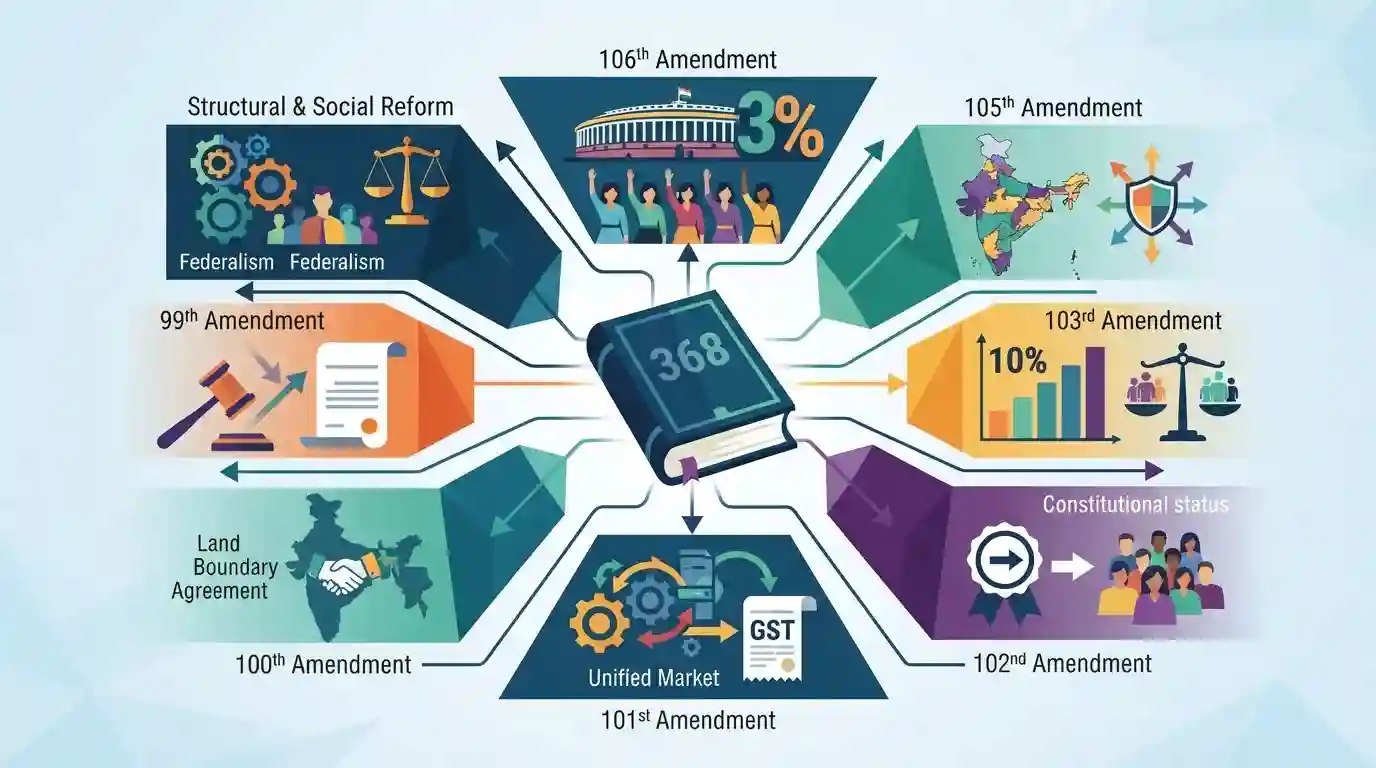
The Government of India has apprised Parliament regarding the enactment of eight Constitutional Amendments over the last 12 years, highlighting a period of significant structural, economic, and social reform. Notable among these are the 101st Amendment which implemented the Goods and Services Tax (GST), and the 100th Amendment which formalized the Land Boundary Agreement with Bangladesh. Several amendments strongly focused on social inclusion: the 102nd gave constitutional status to the National Commission for Backward Classes (NCBC), the 103rd introduced a 10% quota for Economically Weaker Sections (EWS), and the 105th restored states' powers to identify backward classes. Crucially, the recent 106th Amendment (Nari Shakti Vandan Adhiniyam) enacted a 33% reservation for women in the Lok Sabha and State Assemblies. The list also includes the 99th Amendment regarding the National Judicial Appointments Commission (NJAC), which was later invalidated by the Supreme Court. Together, these amendments illustrate the ongoing evolution of the Constitution under Article 368 to address contemporary federal, economic, and representation challenges.
મુખ્ય મુદ્દા
- The Government informed Parliament that eight Constitution Amendments have been enacted over the past twelve years, reflecting major governance and social reforms.
- Key economic and diplomatic milestones include the 100th Amendment (Land Boundary Agreement with Bangladesh) and the 101st Amendment (introduction of the Goods and Services Tax).
- Several amendments prioritized social justice, including granting constitutional status to the NCBC (102nd), introducing 10% EWS reservation (103rd), and restoring states' rights to identify OBCs (105th).
- The 106th Amendment (Nari Shakti Vandan Adhiniyam) marks a historic step by reserving 33% of seats for women in the Lok Sabha and State Legislative Assemblies.
- The 99th Amendment, which sought to establish the National Judicial Appointments Commission (NJAC), was also enacted during this period but was subsequently struck down by the Supreme Court.
મહત્વપૂર્ણ શબ્દો
Article 368

Located in Part XX of the Constitution, it empowers Parliament to amend constitutional provisions through special majorities, subject to the judicially established 'basic structure' doctrine.
UPSC context
GS Paper II (Polity). Tests the balance of power, amendment procedure, and parliamentary versus judicial supremacy.
99th Constitution Amendment Act
Passed in 2014, it sought to establish the National Judicial Appointments Commission (NJAC) to replace the collegium system, but was struck down by the Supreme Court in 2015.
UPSC context
GS Paper II (Judiciary). Tests judicial independence, separation of powers, and the Basic Structure doctrine.
101st Constitution Amendment Act (Goods and Services Tax)
Enacted in 2016, it introduced the Goods and Services Tax (GST) in India, creating a unified indirect tax regime and establishing the cooperative federal body, the GST Council.
UPSC context
GS Paper III (Economy) & GS Paper II (Federalism). Tests cooperative federalism and indirect tax structures.
103rd Constitution Amendment Act (EWS Reservation)
Passed in 2019, it inserted Articles 15(6) and 16(6) to provide up to a 10% reservation for the Economically Weaker Sections (EWS) in education and public employment.
UPSC context
GS Paper II (Social Justice). Tests reservation principles, affirmative action, and fundamental rights.
105th Constitution Amendment Act
Enacted in 2021, it amended Article 342A to clarify and restore the power of state governments and union territories to identify and maintain their own lists of SEBCs.
UPSC context
GS Paper II (Polity & Social Justice). Tests federalism, state-center dynamics, and OBC listings.
106th Constitution Amendment Act (Nari Shakti Vandan Adhiniyam)
Enacted in 2023, it mandates a 33% reservation for women in the Lok Sabha, state legislative assemblies, and the National Capital Territory of Delhi for 15 years.
UPSC context
GS Paper II (Social Justice & Governance). Tests political empowerment of women and gender parity in legislative bodies.
પ્રિલિમ્સ ટ્રેપ
The 106th Amendment provides 33% reservation for women across all houses of Parliament and State Legislatures.
The reservation applies exclusively to the Lok Sabha and State Legislative Assemblies (including Delhi). It does NOT extend to the Rajya Sabha or State Legislative Councils.
સંલગ્ન સ્થિર ખ્યાલો
Which constitutional provisions require ratification by half the states under Article 368?
- Federal Structure: Provisions affecting the election of the President, the extent of Union and State executive powers, and the representation of States in Parliament.
- Judiciary and Lists: Any changes to the Supreme Court, High Courts, or the legislative distribution in the Seventh Schedule.
- Article 368 itself: Any amendment to the actual amending power and procedure laid down in Article 368 requires state ratification.
When is a Constitutional Amendment required for altering Indian territory?
- Settling Disputes: Mere settlement of a genuine international boundary dispute does not require an amendment; it can be done by executive action.
- Ceding Territory: Transferring Indian territory to a foreign state strictly requires a Constitutional Amendment under Article 368, as established in the Berubari Union ruling.
- Internal Reorganization: Altering boundaries or names of internal states requires only a simple majority under Article 3, which is explicitly exempt from Article 368.
આંતર-વિષય પેટર્ન
EWS and shifting Basic Structure
The SC's validation of the 103rd Amendment (EWS) fractured the rigid 50% reservation ceiling set by Indira Sawhney, significantly altering how economic affirmative action interacts with the Basic Structure.
Fiscal federalism via GST Council
The 101st Amendment's GST Council established a unique weighted voting matrix (Union 1/3, States 2/3), serving as a recurring flashpoint in contemporary fiscal federalism and State revenue debates.

A Prelims question mapping recent Constitutional Amendments (100th-106th) to their specific inserted Articles (e.g., 338B, 342A) is highly probable.
સંલગ્ન PYQ · 5
સંલગ્ન PYQ · 5
- 2019MainsGS2
“Parliament's power to amend the Constitution is a limited power and it cannot be enlarged into absolute power." In the light of this statement explain whether Parliament under Article 368 of the Constitution can destroy the Basic Structure of the Constitution by expanding its amending power?
- 2025MainsGS2
Indian Constitution has conferred the amending power on the ordinary legislative institutions with a few procedural hurdles. In view of this statement, examine the procedural and substantive limitations on the amending power of the Parliament to change the Constitution.
- 2024PrelimsGS1
As per Article 368 of the Constitution of India, the Parliament may amend any provision of the Constitution by way of : 1. Addition 2. Variation 3. Repeal Select the correct answer using the code given below:
- 2017MainsGS2
Critically examine the Supreme Court's judgement on 'National Judicial Appointments Commission Act, 2014' with reference to appointment of judges of higher judiciary in India.
- 2023MainsGS2
Discuss the contribution of civil society groups for women's effective and meaningful participation and representation in state legislatures in India.
