Special Intensive Revision of Electoral Rolls by Election Commission
Source:PIB ↗
ఇది ఎందుకు ముఖ్యం
Updates to electoral rolls and electoral reforms are recurring themes in UPSC, especially under the Representation of the People Act and the constitutional mandate of the ECI (Article 324). Understanding the legal backing and Supreme Court observations provides critical material for GS2 Polity and Governance answers.
సారాంశం
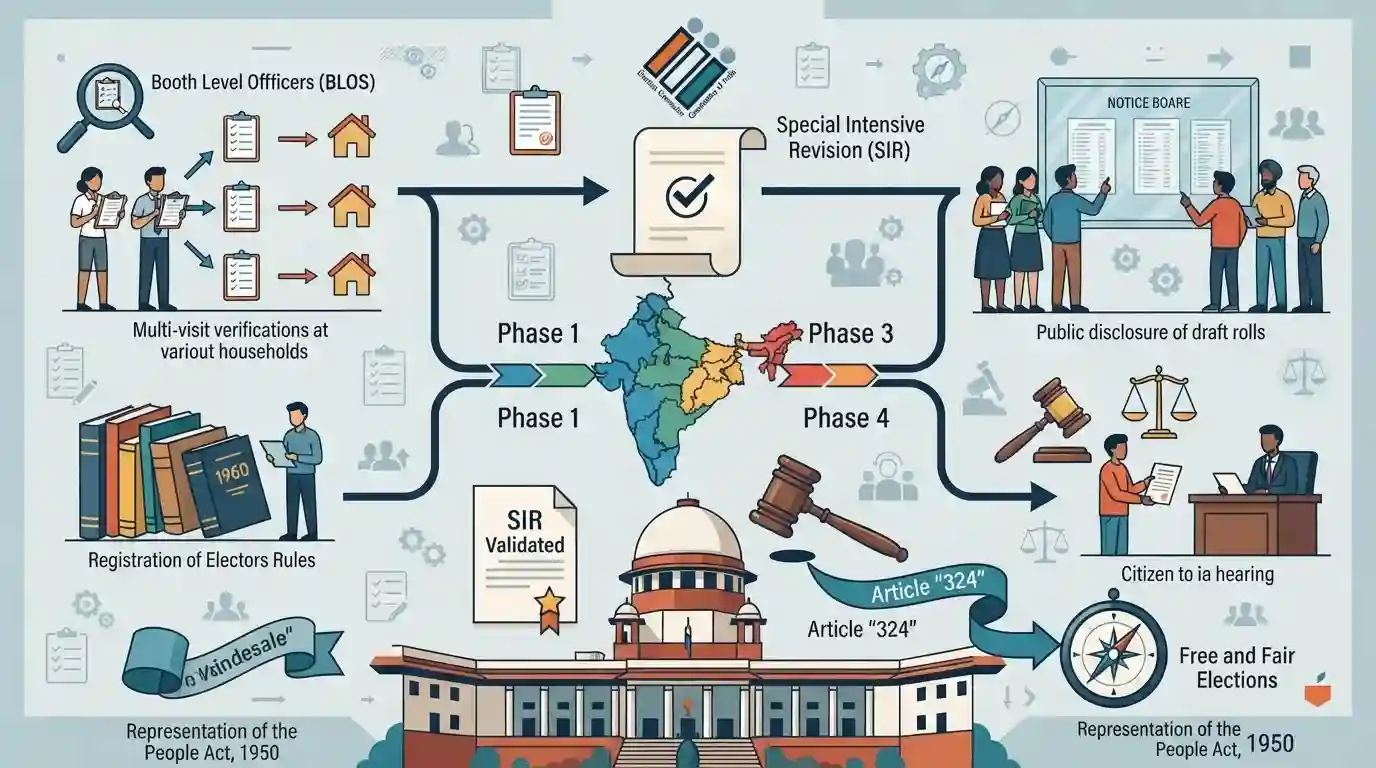
The Election Commission of India (ECI) is executing a multiphase Special Intensive Revision (SIR) of electoral rolls to ensure updated, accurate voter lists nationwide. The initiative implements robust safeguards against wrongful deletions, including multi-visit verifications by Booth Level Officers, strict adherence to the Registration of Electors Rules (1960), public disclosure of draft rolls for claims and objections, and provisions for appeal. A recent 2026 Supreme Court judgment upheld the SIR's legality, validating it under the Representation of the People Act, 1950, and affirming the ECI's constitutional mandate under Article 324 to conduct free and fair elections.
ముఖ్య అంశాలు
- The ECI is conducting a multi-phase Special Intensive Revision (SIR) of electoral rolls to ensure accuracy and remove duplicate/ineligible voters without excluding eligible ones.
- Deletions are based on specific grounds (death, shift in residence, duplicates, untraceable) and involve multiple safeguards like door-to-door verification by Booth Level Officers (BLOs).
- The Supreme Court in 'ADR vs. ECI' (2026) upheld the legality of the SIR process under the Representation of the People Act, 1950, and Article 324 of the Constitution.
- Safeguards against wrongful deletion include a statutory claims and objections period, appeals to the designated appellate authority or Chief Electoral Officer, and deployment of Booth Level Agents (BLAs).
ముఖ్యమైన పదాలు
Election Commission of India (ECI)

A permanent and independent constitutional body established to conduct free, fair, and impartial elections to India's Parliament, State Legislatures, and the offices of the President and Vice-President.
UPSC context
GS Paper II (Polity and Governance); tests knowledge of constitutional bodies, their powers, responsibilities, and electoral administration.
Article 324 of the Constitution
The constitutional provision that vests the superintendence, direction, and control of the preparation of electoral rolls and the conduct of elections in the Election Commission of India.
UPSC context
GS Paper II (Indian Constitution); tests understanding of constitutional provisions, institutional independence, and the ECI's plenary power.
Representation of the People Act, 1950
An Act of Parliament that governs the pre-election framework, outlining seat allocation, delimitation of constituencies, voter qualifications, and the preparation and revision of electoral rolls.
UPSC context
GS Paper II (Salient features of RPA); tests understanding of laws governing delimitation, voter eligibility, and compilation of voter lists.
Registration of Electors Rules, 1960
Procedural rules framed under the Representation of the People Act, 1950, detailing the administrative processes for the preparation, correction, publication, revision, and deletion of entries in electoral rolls.
UPSC context
GS Paper II (Polity and Electoral reforms); tests understanding of voter registration procedures, claims, objections, and administrative transparency.
Association for Democratic Reforms (ADR)
An Indian non-profit organization established in 1999 that promotes political and electoral reforms, transparency, and accountability in governance through public-interest litigation and database analysis.
UPSC context
GS Paper II (Role of civil society, NGOs, electoral reforms); tests contribution to democratic accountability and electoral transparency.
ప్రిలిమ్స్ ఉచ్చు
The ECI is statutorily empowered to make a final and binding determination of citizenship under the Citizenship Act, 1955.
The Supreme Court (2026) clarified that ECI's inquiry is strictly limited to voter eligibility and does not constitute a final legal determination under the Citizenship Act, 1955.
అనుసంధానమైన స్థిర భావనలు
What is the primary difference in scope between the Representation of the People Acts of 1950 and 1951?
- RPA 1950 focus: Governs the delimitation of constituencies, qualifications of voters, and preparation/revision of electoral rolls.
- RPA 1951 focus: Governs the actual conduct of elections, qualifications/disqualifications of members of legislatures, corrupt practices, and election disputes.
How does the 'deemed deputation' clause protect the independence of election staff?
- Statutory basis: Section 13CC of RPA 1950 and Section 13G of RPA 1951 place designated election staff on deemed deputation to the ECI.
- Disciplinary control: During the election or revision period, deputed staff are under the exclusive superintendence, control, and discipline of the ECI, not their parent departments.
అంతర-అంశ నమూనాలు
ECI's staff deputation & cooperative federalism
State administrative friction often arises because Booth Level Officers (state employees) are placed under ECI's exclusive disciplinary control under Section 13CC of RPA 1950 during revisions.
Voter enumeration vs. Citizenship determination
The overlap between ECI's power to verify voter rolls and the Home Ministry's sovereign authority to determine citizenship highlights the delicate separation of constitutional and statutory powers.

ECI's limited inquiry into voter citizenship vis-à-vis the Citizenship Act, 1955 will likely be framed as a multi-statement question in 2026.
అనుసంధాన PYQలు · 3
అనుసంధాన PYQలు · 3
- 2017MainsGS2
To enhance the quality of democracy in India the Election Commission of India has proposed electoral reforms in 2016. What are the suggested reforms and how far are they significant to make democracy successful?
- 2017PrelimsGS1
Right to vote and to be elected in India is a
- 2017PrelimsGS1
For election to the Lok Sabha, a nomination paper can be filed by
