Accessible Legal Services and Digital Justice Reforms for PwDs
Source:PIB ↗
આ શા માટે મહત્વનું છે
These reforms directly enforce Constitutional mandates under Article 14 (Right to Equality) and Article 39A (Equal justice and free legal aid). Understanding these specific institutional responses (like NALSA's schemes and S3WaaS) is critical for UPSC Mains questions concerning the practical effectiveness of welfare models and user-centric e-governance for marginalized groups.
સારાંશ
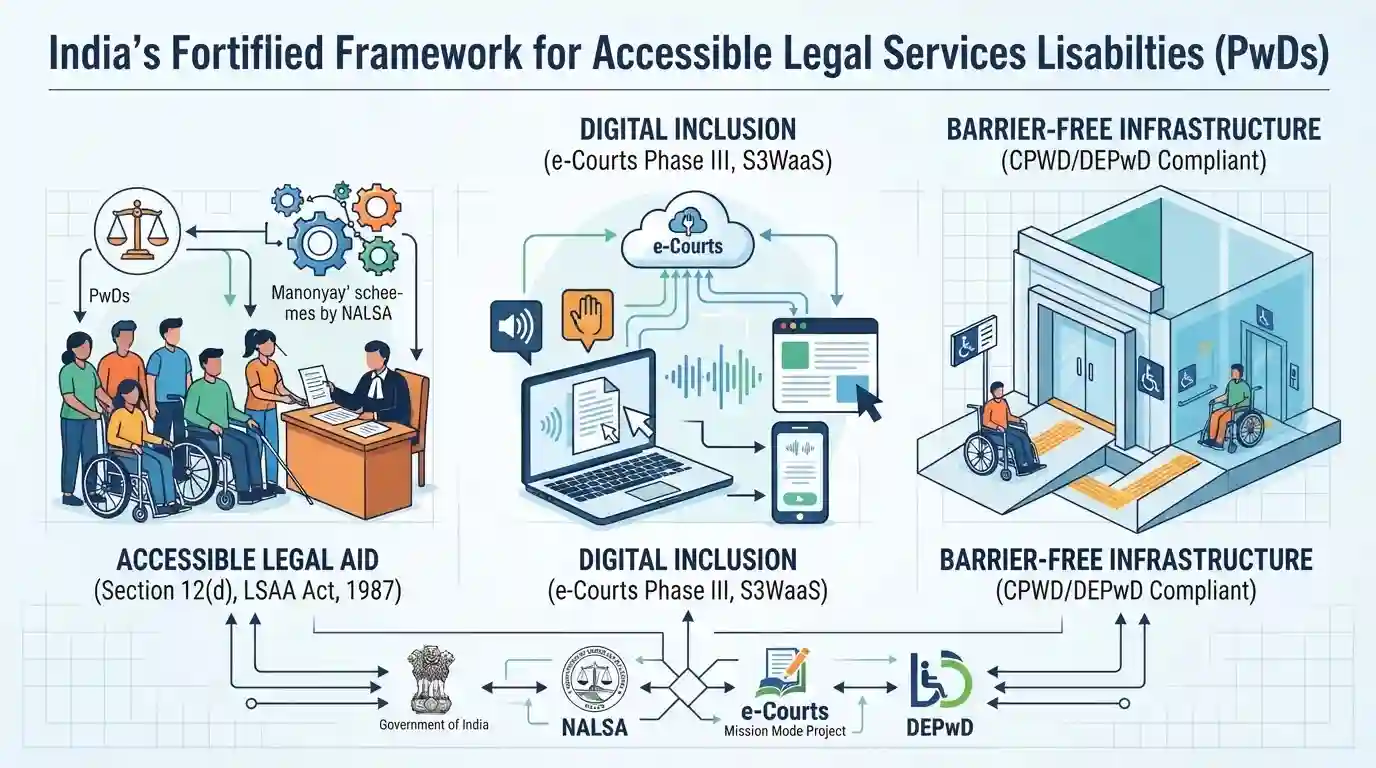
The Government of India has fortified its framework to ensure accessible legal services and inclusive digital justice for Persons with Disabilities (PwDs). The initiatives bridge the gap between statutory rights and actual justice delivery by focusing on two pillars: accessible legal aid and barrier-free infrastructure. Legally, Section 12(d) of the Legal Services Authorities Act, 1987 entitles PwDs to free legal aid, which is operationalized by NALSA's specialized schemes like the 'Manonyay' units. Technologically, the e-Courts Mission Mode Project Phase III incorporates the S3WaaS platform to make digital judicial records screen-reader accessible. Furthermore, Centrally Sponsored Schemes mandate CPWD/DEPwD-compliant disabled-friendly physical infrastructure across district and subordinate courts, ensuring that accessibility is holistic.
મુખ્ય મુદ્દા
- Under Section 12(d) of the Legal Services Authorities (LSA) Act, 1987, Persons with Disabilities are statutorily entitled to free legal services.
- NALSA has introduced the 'NALSA (Legal Services to Persons with Mental Illness and Persons with Intellectual Disabilities) Scheme, 2024', establishing specialized legal aid units termed 'Manonyay' (LSUM).
- The e-Courts Mission Mode Project Phase III, overseen by the Supreme Court e-Committee, focuses on inclusive digital justice by ensuring court portals are built on the S3WaaS platform, making them accessible to visually and hearing-impaired users.
- A Centrally Sponsored Scheme (CSS) for the judiciary mandates that all new district and subordinate court infrastructures adhere to barrier-free, disabled-friendly designs per CPWD and DEPwD standards.
મહત્વપૂર્ણ શબ્દો
Legal Services Authorities Act, 1987

An Indian legislation enacted to provide free and competent legal services to the weaker sections of society, ensuring that justice is not denied due to economic or other disabilities under Article 39A.
UPSC context
GS Paper II: Polity and Social Justice; tests statutory framework for legal aid and judicial accessibility.
National Legal Services Authority (NALSA)
A statutory body constituted under the Legal Services Authorities Act, 1987, to formulate policies, guide state legal authorities, and provide free, competent legal services to marginalized groups.
UPSC context
GS Paper II: Statutory Bodies; tests the institutional framework for legal aid and equal justice in India.
NALSA (Legal Services to Persons with Mental Illness and Persons with Intellectual Disabilities) Scheme, 2024
A specialized scheme designed to deliver free, responsive legal assistance and establish 'Manonyay' units to address the distinct civil and criminal needs of mentally ill and intellectually disabled individuals.
UPSC context
GS Paper II: Social Justice; tests welfare schemes for vulnerable groups and institutional mechanisms for physical and mental welfare.
Rights of Persons with Disabilities (RPwD) Act, 2016
Landmark legislation implementing the UNCRPD in India, recognizing 21 disability categories, and mandating non-discrimination, equal opportunities, physical/digital accessibility, and structural support systems across sectors.
UPSC context
GS Paper II: Social Justice; tests welfare schemes, rights-based legislation, and inclusive development for vulnerable sections.
e-Courts Mission Mode Project (Phase III)
A central sector scheme (2023-2027) with a ₹7,210 crore outlay aiming to construct a paperless, "digital-native" judicial system using cloud tech, online e-filing, virtual hearings, and AI-enabled tools.
UPSC context
GS Paper II: Governance; tests e-governance models, digital transformation of public institutions, and judicial reforms.
S3WaaS (Secure, Scalable and Sugamya Website as a Service)
A cloud-based platform developed by NIC allowing government entities to build secure, multilingual, and GIGW-compliant websites configured to ensure accessibility for visually and physically challenged citizens.
UPSC context
GS Paper II: E-governance; tests digital inclusion, government website accessibility, and technological delivery of services.
પ્રિલિમ્સ ટ્રેપ
Free legal aid under the LSA Act, 1987 is provided to Persons with Disabilities subject to a prescribed annual income limit.
Section 12(d) of the LSA Act, 1987 guarantees free legal services to all PwDs automatically, without applying any income-ceiling or means test that applies to general-category applicants.
સંલગ્ન સ્થિર ખ્યાલો
What is the constitutional and statutory framework governing free legal aid in India?
- Article 39A: Mandates the State to provide free legal aid to ensure justice is not denied to any citizen by reason of economic or other disabilities.
- Articles 14 & 21: Guarantee equality before the law and life with dignity, which the Supreme Court has interpreted to include the right to free legal aid.
- LSA Act, 1987: Established NALSA, State Legal Services Authorities (SALSA), and District Legal Services Authorities (DLSA) to operationalize free legal help.
What is the structure and implementation mechanism of the e-Courts Mission Mode Project?
- Joint Initiative: Implemented under the National e-Governance Plan (NeGP), specifically targeted at transforming the Indian judiciary through ICT enablement.
- Phase III Objectives: Focuses on central-sector funding for court digitisation, including cloud infrastructure, virtual courts, paperless courtrooms, and inclusive digital accessibility.
આંતર-વિષય પેટર્ન
DPI and Judicial Equity
Merging Digital India initiatives like S3WaaS with Article 21 highlights how robust digital public infrastructure acts as an essential precursor to guaranteeing fundamental legal remedies.
RPwD Act vs Judicial Infrastructure
Connecting physical accessibility mandates under RPwD Act 2016 with judicial infrastructure spending reveals administrative gaps between legislative intent and grassroots realization of justice.

UPSC may contrast the absolute statutory right of PwDs to legal aid under the LSA Act against general income-based criteria in 2026.
સંલગ્ન PYQ · 5
સંલગ્ન PYQ · 5
- 2023MainsGS2
Who are entitled to receive free legal aid? Assess the role of the National Legal Services Authority (NALSA) in rendering free legal aid in India.
- 2020PrelimsGS1
In India, Legal Services Authorities provide free legal services to which of the following type of citizens? 1. Person with an annual income of less than ₹ 1,00,000 2. Transgender with an annual income of less than ₹ 2,00,000 3. Member of Other Backward Classes (OBC) with an annual income of less than ₹ 3,00,000 4. All Senior Citizens Select the correct answer using the code given below:
- 2013PrelimsGS1
With reference to National Legal Services Authority, consider the following statements : 1. Its objective is to provide free and competent legal services to the weaker sections of the society on the basis of equal opportunity. 2. It issues guidelines for the State Legal Services Authorities to implement the legal programmes and schemes throughout the country. Which of the statements given above is/are correct?
- 2026PrelimsGS1
Which of the following statements with regard to the persons with disabilities in India is/are correct ? 1. The Rights of Persons with Disabilities Act, an Act passed by the Parliament of India in 2018, mandates reservation in education and employment, places a legal duty on Governments to ensure accessibility and non-discrimination. 2. The Sugamya Bharat Abhiyan focuses on achieving universal accessibility for Persons with Disabilities across three key domains — built infrastructure, transport systems and information and communication technology. 3. The National Divyangjan Finance and Development Corporation (NDFDC) is a public sector organisation set up by the Ministry of Corporate Affairs as a not-for-profit company to promote entrepreneurship among Persons with Disabilities (PwDs). Select the answer using the code given below :
- 2023MainsGS2
e-governance, as a critical tool of governance, has ushered in effectiveness, transparency and accountability in governments. What inadequacies hamper the enhancement of these features ?
