Tribunal Reforms and Judicial Independence in Administrative Justice
Source:PIB ↗
Why It Matters
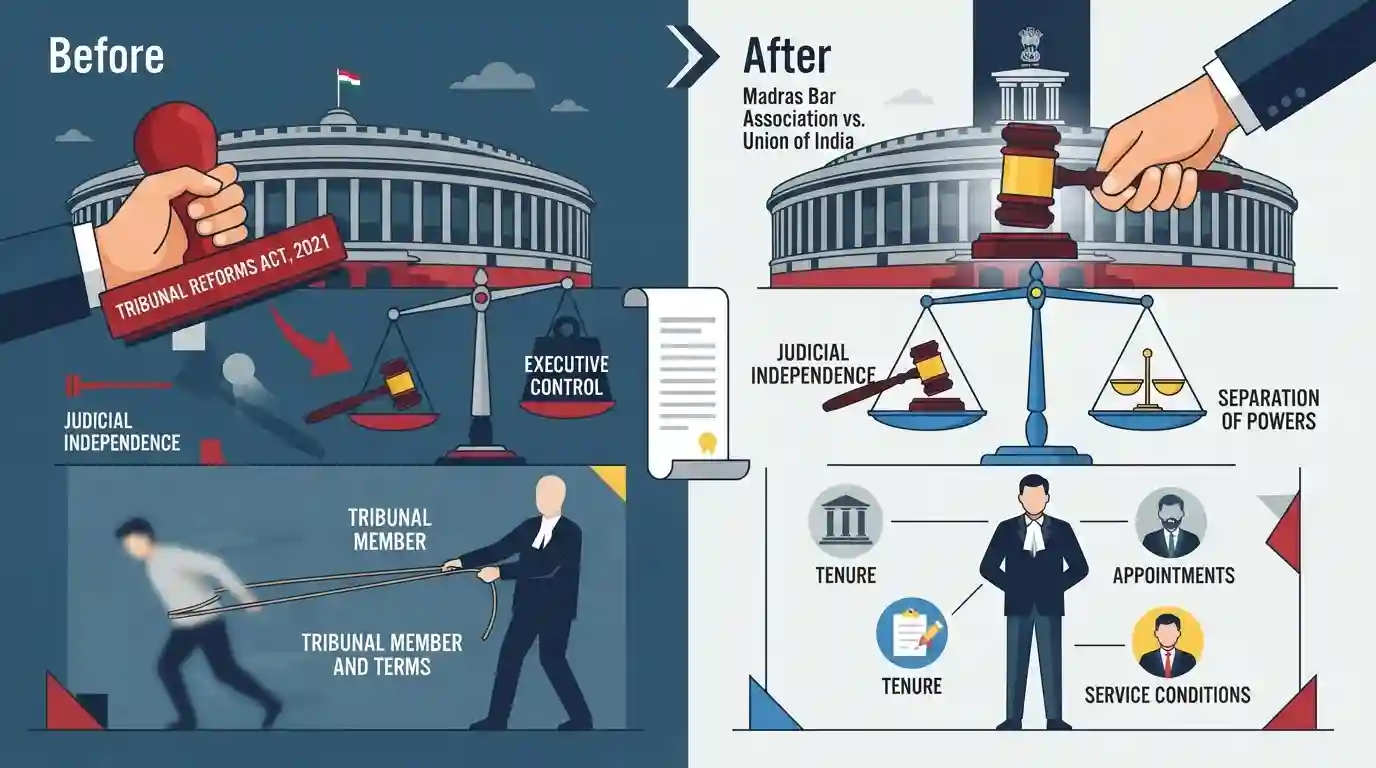
Tribunals function as specialized quasi-judicial bodies. Executive control over their appointments and tenures has historically threatened their independence, violating the separation of powers. A commitment to align statutory provisions with Supreme Court rulings (such as the Madras Bar Association cases) is a significant step toward institutional reform and ensuring speedy, independent administrative justice.
Summary
The Union Minister of Law and Justice, Arjun Ram Meghwal, informed the Lok Sabha that any future legislation governing tribunals will comply with Supreme Court rulings, particularly the November 2025 judgment in Madras Bar Association vs. Union of India which struck down parts of the Tribunal Reforms Act, 2021. This ensures that the appointments, tenure, and service conditions of tribunal members will preserve judicial independence and separation of powers.
Key Points
- The Union Ministry of Law and Justice clarified in the Lok Sabha that future tribunal laws will holistically align with the Supreme Court's judgments, particularly regarding appointments, tenure, and service conditions.
- The Supreme Court, in its judgment dated November 19, 2025 (Madras Bar Association vs. Union of India), struck down specific provisions of the Tribunal Reforms Act, 2021.
- This alignment is aimed at safeguarding and upholding the judicial independence of quasi-judicial tribunals in India.
- The ongoing conflict between the legislature and judiciary regarding tribunal administration centers on search-cum-selection committees, terms of office, and age limits of members.
Important Terms
Tribunal Reforms Act, 2021

A 2021 law that abolished several appellate tribunals and transferred their functions to courts. It also sought to standardize the appointment, tenure, and service conditions of tribunal members, sparking judicial scrutiny over executive control.
UPSC context
GS Paper 2 (Statutory Bodies). Tests the balance between executive control and judicial independence in India's tribunalisation process.
Madras Bar Association
A prominent lawyers' association founded in 1865 that has filed multiple successful writ petitions in the Supreme Court to strike down executive-dominated tribunal frameworks and safeguard judicial independence.
UPSC context
GS Paper 2 (Judiciary). Essential case laws (MBA vs. Union of India) for analyzing tribunal reforms, executive overreach, and separation of powers.
Supreme Court of India
The highest judicial court and final court of appeal under the Constitution of India, responsible for judicial review and safeguarding basic constitutional features like judicial independence.
UPSC context
GS Paper 2 (Judiciary). Tests constitutional provisions, powers of judicial review, and its role in protecting the basic structure and separation of powers.
Ministry of Law and Justice
The Union government ministry responsible for the management of legal affairs, legislative drafting, and administration of justice, including framing rules for tribunal appointments and service conditions.
UPSC context
GS Paper 2 (Executive/Governance). Relevant for understanding the Union's role in drafting legislation and administering India's legal and quasi-judicial infrastructure.
Lok Sabha
The lower house of India's bicameral Parliament, composed of directly elected representatives, where legislative bills like tribunal reforms are debated, scrutinized, and passed.
UPSC context
GS Paper 2 (Parliament). Tests the structure, functioning, and legislative process of the lower house, including its role in enacting statutory reforms.
Prelims Trap
Both Parliament and State Legislatures can concurrently establish administrative tribunals under Article 323A.
Under Article 323A, ONLY Parliament can establish administrative tribunals. State legislatures can only establish tribunals under Article 323B for specific matters like taxation and land.
Static Concepts Connected
What are the core differences between Article 323A and Article 323B?
- Establishing Authority: Article 323A tribunals can only be established by Parliament, whereas Article 323B tribunals can be established by both Parliament and State Legislatures.
- Subject Matter: Article 323A is exclusively for public service matters. Article 323B covers diverse subjects like taxation, industrial disputes, and land reforms.
- Hierarchy: Article 323A does not permit a hierarchy of tribunals, while Article 323B allows for a multi-level hierarchical structure.
What did the L. Chandra Kumar case (1997) establish regarding tribunals?
- Basic Structure: Declared the High Courts' power of judicial review under Articles 226 and 227 as part of the Constitution's basic structure.
- Appellate Jurisdiction: Ruled that tribunal decisions are not final and remain subject to scrutiny by the jurisdictional High Court.
- Unconstitutional Clauses: Struck down clauses in Article 323A and 323B that originally sought to completely exclude the jurisdiction of High Courts.
Cross-Topic Patterns
Separation of Powers & Appointments
The tussle over tribunal tenure and search-cum-selection committees mirrors recent debates over the Election Commission's appointment process and the NJAC, highlighting a recurring Mains theme of executive encroachment on independent bodies.
Legislative Overrides vs Judicial Review
Re-enacting provisions previously struck down by the Supreme Court forms a classic 'legislative override' debate, heavily relevant for Mains GS-2 questions on checks and balances.

Expect a 2026 Prelims question mixing Art 323A/323B distinctions with the L. Chandra Kumar ruling on High Court writ jurisdiction.
Linked PYQs · 2
Linked PYQs · 2
- 2025MainsGS2
Comment on the need of administrative tribunals as compared to the court system. Assess the impact of the recent tribunal reforms through rationalization of tribunals made in 2021.
- 2019MainsGS2
“The Central Administrative Tribunal which was established for redressal of grievances and complaints by or against central government employees, nowadays is exercising its powers as an independent judicial authority.” Explain.
