Fast Track Special Courts and Criminal Justice System Reforms
Source:PIB ↗
Why It Matters
Fast Track Special Courts are a crucial institutional mechanism to address the severe backlog of cases in the subordinate judiciary, particularly concerning sensitive crimes against women and children. The scheme's extension underscores the State's commitment to speedy justice, a core component of the Right to Life and Personal Liberty (Article 21), and reinforces protections under the POCSO Act.
Summary
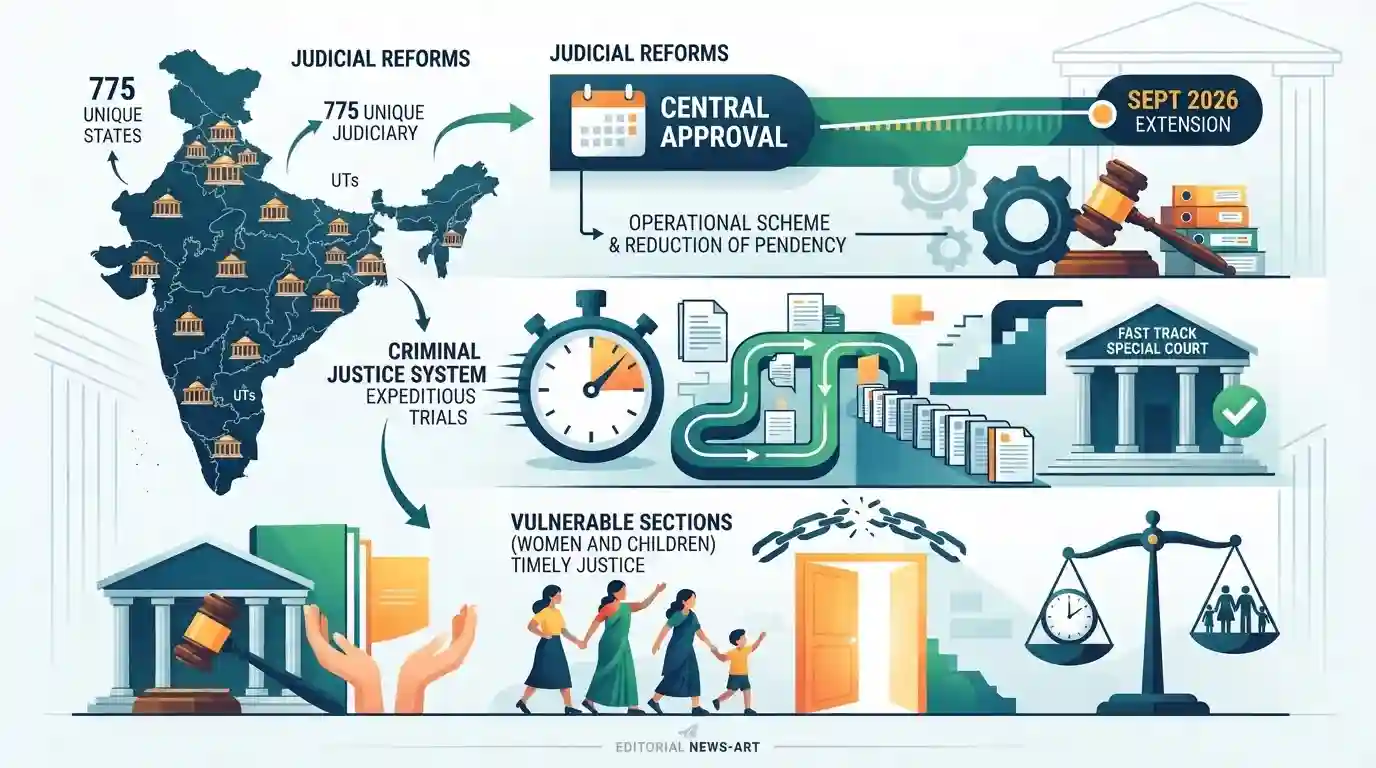
The Centre has approved the extension of the Fast Track Special Courts (FTSC) scheme until September 2026. Designed as a Centrally Sponsored Scheme under the Department of Justice, the initiative targets the expeditious trial of cases related to rape and the Protection of Children from Sexual Offences (POCSO) Act. Presently, 775 such courts are operational across 29 States and UTs, aiming to reduce judicial pendency and provide timely justice for victims of sexual violence.
Key Points
- The Central Government has extended the Fast Track Special Court (FTSC) scheme till September 2026.
- Currently, 775 FTSCs are fully functional across 29 States and Union Territories in the country.
- The scheme is a Centrally Sponsored Scheme aimed at the expeditious trial and disposal of pending cases pertaining to rape and the Protection of Children from Sexual Offences (POCSO) Act.
- The extension reflects a continued institutional focus on clearing judicial backlogs concerning sensitive crimes against women and children.
Important Terms
Protection of Children from Sexual Offences (POCSO) Act

A comprehensive 2012 Indian law enacted to protect children below 18 years of age from sexual abuse, exploitation, and pornography, featuring a gender-neutral framework and establishing dedicated special courts.
UPSC context
GS Paper II (Polity & Governance) and GS Paper I (Social Issues). Tests legislative frameworks for vulnerable sections and child rights.
Fast Track Special Court (FTSC) Scheme
A Centrally Sponsored Scheme launched in 2019 to set up dedicated courts across India for the expeditious trial and disposal of pending rape and POCSO Act cases, funded under the Nirbhaya Fund.
UPSC context
GS Paper II (Governance and Judicial Reforms). Tests knowledge of Centrally Sponsored Schemes aimed at reducing judicial pendency.
Fast Track Special Courts (FTSCs)
Specialized, dedicated courts established under a Centrally Sponsored Scheme to ensure swift dispensation of justice and time-bound trial of sensitive sexual offence cases, specifically rape and child abuse under the POCSO Act.
UPSC context
GS Paper II (Subordinate Judiciary and Judicial Reforms). Tests structure, jurisdiction, and efficiency of specialized criminal courts in India.
Department of Justice
A department within the Ministry of Law and Justice responsible for judicial administration, including appointment of judges, judicial infrastructure, and implementing schemes like the Fast Track Special Courts in India.
UPSC context
GS Paper II (Governance and Judicial Administration). Tests the organizational framework and administrative functions of departments handling justice delivery.
Ministry of Law & Justice
The apex ministry of the Government of India that oversees legal affairs, legislative activities, and the administration of justice through its departments, ensuring law-making alignment with the Constitution.
UPSC context
GS Paper II (Polity and Governance). Tests understanding of the executive organ responsible for judicial policy and legal reforms.
Prelims Trap
FTSCs are Central Sector Schemes funded entirely by the Ministry of Women and Child Development via a lapsable corpus.
It is a Centrally Sponsored Scheme (60:40 share). Funding comes from the non-lapsable Nirbhaya Fund, administered by the Ministry of Finance, not MWCD.
Static Concepts Connected
What distinguishes Central Sector from Centrally Sponsored Schemes?
- Funding Ratio: Central Sector is 100% funded by the Centre; Centrally Sponsored involves cost-sharing (e.g., 60:40) with States.
- Syllabus Domain: Central Sector targets Union List subjects; Centrally Sponsored targets State or Concurrent List subjects implemented by States.
How is the Nirbhaya Fund structured and administered?
- Character: A non-lapsable corpus established in 2013 dedicated to enhancing women's safety and security across India.
- Governance: Administered by Department of Economic Affairs (Ministry of Finance), with the Ministry of Women and Child Development as the nodal assessment body.
Cross-Topic Patterns
Judicial reforms vs Fiscal Federalism
Centrally Sponsored judicial schemes depend on state matching-grants and administrative staffing, showing how fiscal relations directly limit or enable local judicial capacity.
POCSO Act and Procedural Hurdles
FTSCs tackle trial delays, but true justice requires coupling fast-track courts with improved forensic capacities and victim-centric deposition infrastructure under POCSO.

Questions on judicial pendency in GS2 will likely test the structural limits of ad-hoc/temporary courts like FTSCs.
Linked PYQs · 2
Linked PYQs · 2
- 2023MainsGS2
Explain the constitutional perspectives of Gender Justice with the help of relevant Constitutional Provisions and case laws.
- 2025MainsGS2
The National Commission for Protection of Child Rights has to address the challenges faced by children in the digital era. Examine the existing policies and suggest measures the Commission can initiate to tackle the issue.
