Ninth Schedule Inclusion Requests and Judicial Review of Reservations
Source:PIB ↗
Why It Matters
This development serves as a perfect case study for the friction between state legislative populism (breaching the 50% reservation cap) and constitutional boundaries. It brings into focus the mechanics of the Ninth Schedule, Article 31B, and the Supreme Court's limits on judicial immunity (I.R. Coelho case), making it highly relevant for Prelims questions on constitutional amendments and Mains questions on judicial review and social justice.
Summary
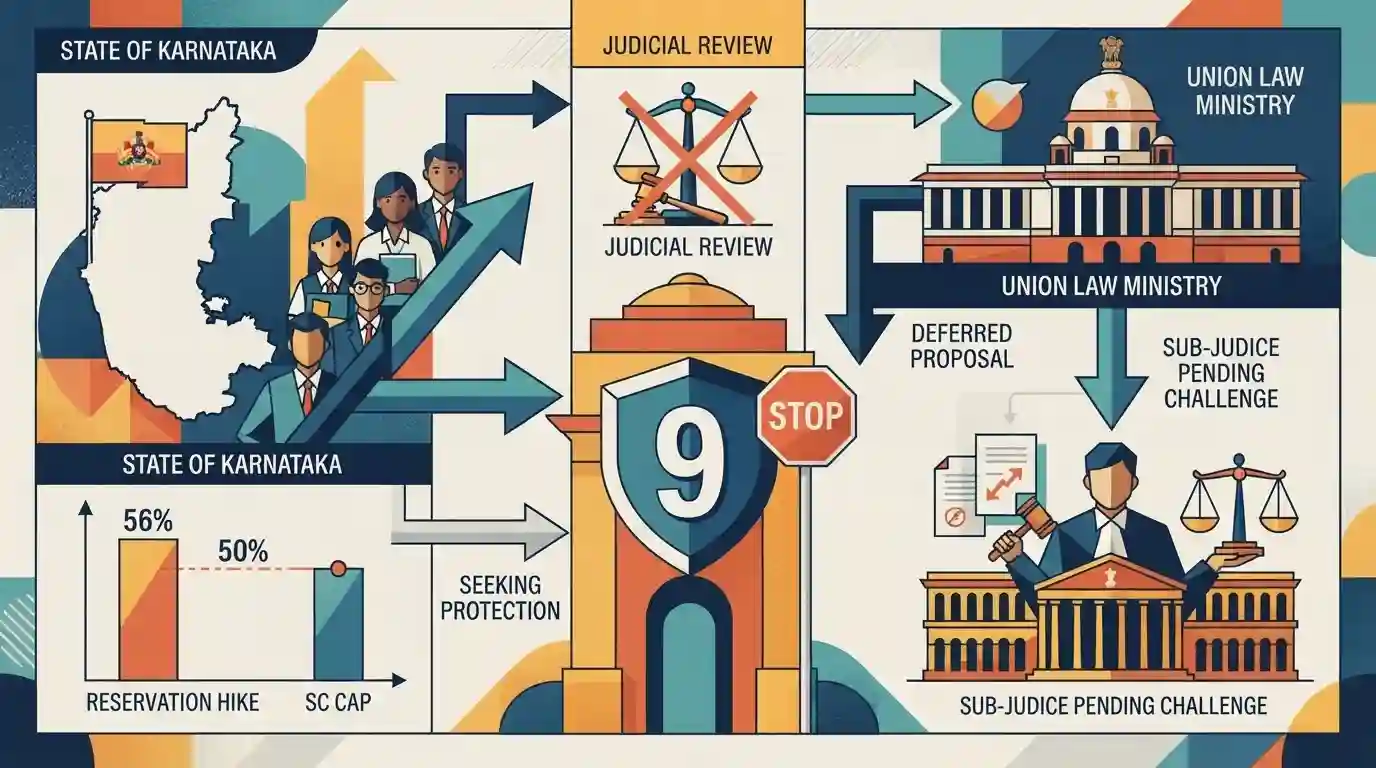
The Central Government has deferred a proposal to include the 'Karnataka Scheduled Castes and Scheduled Tribes (Reservation of Seats in Educational Institutions and of Appointments or Posts in the Services under the State) Act, 2022' into the Ninth Schedule of the Constitution. The legislation hikes total reservations in the state to 56%, exceeding the Supreme Court's 50% cap. Karnataka sought Ninth Schedule protection (under Article 31B) to immunize the law from judicial review. However, the Union Law Ministry stated that since the Act is currently facing legal challenges and is sub-judice before the High Court of Karnataka, it is not presently appropriate to process the State's request.
Key Points
- The Central Government has deferred Karnataka's proposal to include its 2022 Reservation Act in the Ninth Schedule of the Constitution.
- The Karnataka Act increases the reservation quota for SCs, STs, and OBCs to 56%, which breaches the 50% ceiling laid down by the Supreme Court in the Indra Sawhney judgment.
- The State sought to place the law in the Ninth Schedule under Article 31B to shield it from judicial review regarding violation of Fundamental Rights.
- Union Law Minister Arjun Ram Meghwal stated that because the Act has been challenged and the matter is currently sub-judice in the High Court of Karnataka, the Centre cannot process the inclusion at this time.
- The situation revives debates around the I.R. Coelho judgment (2007), which ruled that laws placed in the Ninth Schedule after April 24, 1973, are still open to judicial review if they violate the basic structure of the Constitution.
Important Terms
Ninth Schedule

A constitutional schedule added by the First Amendment (1951) containing central and state laws shielded from judicial review, though post-1973 entries are subject to scrutiny if they violate the basic structure.
UPSC context
GS Paper II (Constitution - Amendments). Tests limits of amending powers, judicial review, and the basic structure doctrine (I.R. Coelho case).
Article 31B
A constitutional provision added by the First Amendment (1951) that validates and immunizes laws included in the Ninth Schedule from being struck down for violating Fundamental Rights.
UPSC context
GS Paper II (Significant Provisions). Examines constitutional safeguards, separation of powers, and the relationship between Fundamental Rights and Schedule 9.
Karnataka Scheduled Castes and Scheduled Tribes (Reservation of Seats in Educational Institutions and of Appointments or Posts in the Services under the State) Act, 2022
A state legislation that increased SC/ST quotas, pushing total reservation to 56% in Karnataka, thereby breaching the Supreme Court's 50% limit established in the Indra Sawhney case.
UPSC context
GS Paper II (Social Justice). Tests understanding of reservation limits, constitutional amendments, and federal dynamics in affirmative action.
Ministry of Law and Justice
The Union ministry responsible for legislative drafting, legal advisory services to the central government, judicial administration, and processing constitutional amendments.
UPSC context
GS Paper II (Executive Machinery). Evaluates the role of administrative departments in legal governance and constitutional processing.
Prelims Trap
A State Legislature can directly insert its reservation laws into the Ninth Schedule to secure protection from judicial scrutiny.
Many aspirants mistakenly assume a state legislature can unilaterally place its own laws under the Ninth Schedule, whereas only Parliament can amend the Constitution to do so.
Static Concepts Connected
What are the constitutional mechanics and limitations of the Ninth Schedule?
- Origin and Purpose: Introduced by the First Amendment (1951) to protect agrarian reforms from being invalidated on the grounds of violating Fundamental Rights.
- I.R. Coelho Verdict: Ruled that laws added after April 24, 1973, do not enjoy blanket immunity and can be challenged if they damage the Basic Structure.
- Amendment Procedure: A state-enacted law requires Parliament to pass a Constitutional Amendment Bill under Article 368 to be placed in the Schedule.
What is the 50% reservation cap and how has it evolved?
- Indra Sawhney Case (1992): Established a strict 50% ceiling on reservation to balance merit with social justice, unless exceptional circumstances in remote areas apply.
- Janhit Abhiyan Case (2022): Upheld the 10% EWS quota, clarifying that the 50% ceiling applies specifically to SEBCs, SCs, and STs, not to economic reservations.
Cross-Topic Patterns
Asymmetric Federalism and State Quotas
State efforts to breach reservation caps test cooperative federalism, forcing the Centre to act as a gatekeeper using its exclusive constituent powers under Article 368.
Judicial Review vs. Legislative Escape Hatches
The judicial clawback of absolute immunity highlights the ongoing evolution of the Basic Structure doctrine against legislative bypasses like Article 31B.

Expect a multi-statement question on the procedural rules of Article 31B and the specific post-1973 judicial review limits of I.R. Coelho.
Linked PYQs · 3
Linked PYQs · 3
- 2016MainsGS2
What was held in the Coelho case? In this context, can you say that judicial review is of key importance amongst the basic features of the Constitution?
- 2019PrelimsGS1
The Ninth Schedule was introduced in the Constitution of India during the prime ministership of
- 2020PrelimsGS1
Consider the following statements: 1. The Constitution of India defines its 'basic structure' in terms of federalism, secularism, fundamental rights and democracy. 2. The Constitution of India provides for 'judicial review' to safeguard the citizens' liberties and to preserve the ideals on which the Constitution is based. Which of the statements given above is/are correct?
