Digital Justice Infrastructure and Legal Aid Framework in Odisha
Source:PIB ↗
ఇది ఎందుకు ముఖ్యం
Bridging the justice gap through digital intervention and decentralized dispute systems is a major administrative theme. Understanding the institutional links of eCourts, NALSA (LAP and LADCS components), and Gram Nyayalayas helps in formulating robust answers on judiciary administration, public service delivery, and constitutional directives on equal justice.
సారాంశం
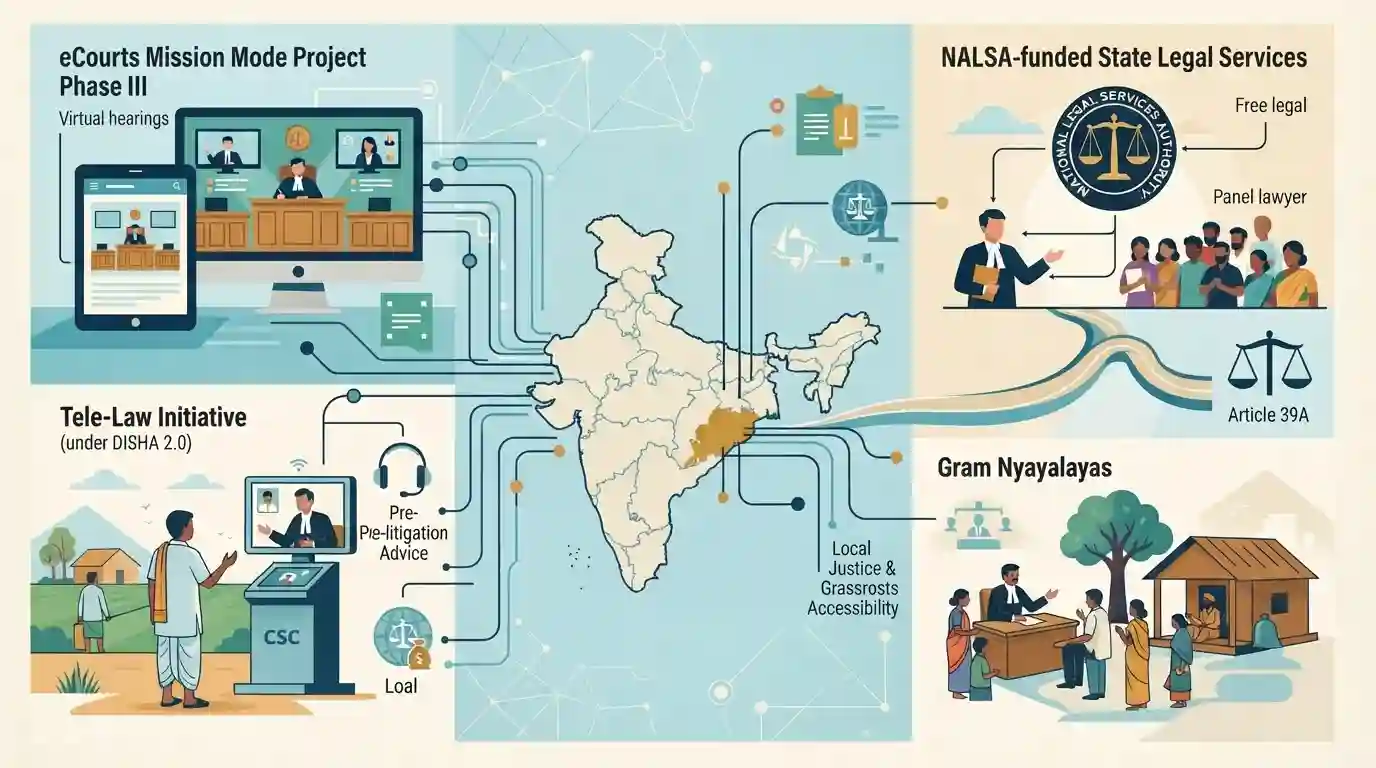
A Lok Sabha written reply by Union Minister Arjun Ram Meghwal details the central government's ongoing capital and administrative measures to strengthen digital justice and legal aid across India, with specific regional highlights for Odisha. Key pillars of this transformation include the eCourts Mission Mode Project Phase III, the Tele-Law initiative (under DISHA 2.0) facilitating pre-litigation advice through CSCs, NALSA-funded State Legal Services, and decentralized Gram Nyayalayas to achieve the constitutional mandate of free legal aid under Article 39A.
ముఖ్య అంశాలు
- eCourts Phase III Funding & Infrastructure: Under Phase III, Rs. 2,514.81 Cr was spent between FY2023-24 and FY2025-26. It involves equipping courtrooms with virtual facilities (817 out of 845 in Odisha), setting up asynchronous virtual traffic courts, and developing a Judicial Digital Preservation System (JDPS) with C-DAC.
- Tele-Law and Pre-Litigation Advice: Driven under the DISHA 2.0 framework, Tele-Law has registered over 1.13 crore pre-litigation advices nationally via Common Service Centres (CSCs). In Odisha alone, 6,797 CSCs are active, providing over 4.10 lakh legal consultations.
- Dual Funding under NALSA: State Legal Services Authorities receive distinct central grants for Legal Aid to Poor (LAP) and the Legal Aid Defence Counsel System (LADCS). Odisha SLSA was allocated Rs. 4.4 Cr for LAP and Rs. 5.75 Cr for LADCS in FY2025-26.
- Grassroots & Local Justice: Operationalized under the Gram Nyayalayas Act, 2008, 24 Gram Nyayalayas have been made functional in rural Odisha to provide swift, low-cost decentralized dispute resolution.
- Mediation and ADR Centres: Highlighting alternative dispute resolution, Odisha has constructed operational ADR Centres in 16 districts, while Mediation Centres operate in the remaining 14 districts under District Legal Services Authorities (DLSAs).
ముఖ్యమైన పదాలు
eCourts Mission Mode Project Phase III

A pan-India initiative (2023–2027) with a ₹7,210 crore outlay focusing on paperless courts, legacy digitisation, universal e-filing, and AI integration to modernize Indian judicial infrastructure.
UPSC context
GS Paper II: Governance & Judicial Reforms; tests understanding of technology-driven legal administration and reducing pendency.
Tele-Law Programme (DISHA 2.0)
A Union Government initiative under the DISHA 2.0 scheme (2026–2031) that provides free pre-litigation legal advice to marginalized and rural citizens via video conferencing at Common Service Centres.
UPSC context
GS Paper II: Welfare Schemes & Access to Justice; evaluates the role of e-governance in implementing Article 39A.
National Legal Services Authority (NALSA)
A statutory body established under the Legal Services Authorities Act, 1987, to provide free, competent legal services to weaker sections and organize Lok Adalats for dispute resolution.
UPSC context
GS Paper II: Statutory Bodies & Judicial Reforms; tests knowledge of constitutional mandates under Article 39A.
Legal Services Authorities Act, 1987
The landmark legislation providing the statutory framework for establishing NALSA, State Legal Services Authorities, and organizing Lok Adalats to ensure equal justice opportunities for all.
UPSC context
GS Paper II: Important Acts & Welfare Initiatives; tests statutory mechanisms for delivering free legal aid in India.
Gram Nyayalayas Act, 2008
A central act providing for the establishment of mobile village-level courts at the intermediate panchayat level to deliver affordable and speedy justice to rural citizens.
UPSC context
GS Paper II: Local Governance & Judiciary; tests understanding of decentralized justice systems and alternative dispute resolution.
eCommittee, Supreme Court of India
The governing body charged with formulating national policy and overseeing ICT implementation across Indian courts, assisting the Chief Justice of India in judicial digitization efforts.
UPSC context
GS Paper II: Judicial Organs & Reforms; tests awareness of institutional bodies steering digital transition in the judiciary.
ప్రిలిమ్స్ ఉచ్చు
Gram Nyayalayas are strictly bound by the rules of evidence and procedure of the Indian Evidence Act, 1872.
The 2008 Act explicitly exempts Gram Nyayalayas from strict rules of evidence, allowing them to be guided by natural justice for speedy, flexible local dispute resolution.
అనుసంధానమైన స్థిర భావనలు
What is the constitutional and statutory framework for Free Legal Aid in India?
- Constitutional Basis: Article 39A (inserted by the 42nd Amendment, 1976) mandates free legal aid, which is complemented by Articles 14 and 21.
- Statutory Authority: The Legal Services Authorities Act, 1987 created NALSA, SLSAs, and DLSAs to organize Lok Adalats and operationalize legal aid.
- Targeted Eligibility: Section 12 guarantees free aid to SCs/STs, women, children, industrial workers, and persons in custody, regardless of income.
What are the structural and jurisdictional features of Gram Nyayalayas?
- Dual Jurisdiction: Exercising both civil and criminal powers, they try petty offenses and local civil disputes outlined in the 2008 Act's schedules.
- Nyayadhikari Appointment: Presided over by a Nyayadhikari appointed by the State Government in consultation with the High Court, holding First Class Magistrate status.
- Mobile & Conciliatory: They are mobile courts that prioritize conciliation and mediation, choosing speed over rigid procedural formalities.
అంతర-అంశ నమూనాలు
e-Governance + Judicial Pendency
Deploying AI-driven platforms like VIDHI-Sanjeevani under eCourts Phase III directly aims to reduce India's five-crore case backlog, linking technology with structural judicial efficiency.
Article 39A + Digital Divide
Tele-Law via Common Service Centres ensures that rural populations overcome digital barriers to access constitutional legal aid, bridging the digital-justice gap.

LADCS's criminal-only mandate vs Gram Nyayalaya's dual jurisdiction likely to feature in 2026 prelims comparative statements.
అనుసంధాన PYQలు · 4
అనుసంధాన PYQలు · 4
- 2023MainsGS2
Who are entitled to receive free legal aid? Assess the role of the National Legal Services Authority (NALSA) in rendering free legal aid in India.
- 2020PrelimsGS1
In India, Legal Services Authorities provide free legal services to which of the following type of citizens? 1. Person with an annual income of less than ₹ 1,00,000 2. Transgender with an annual income of less than ₹ 2,00,000 3. Member of Other Backward Classes (OBC) with an annual income of less than ₹ 3,00,000 4. All Senior Citizens Select the correct answer using the code given below:
- 2013PrelimsGS1
With reference to National Legal Services Authority, consider the following statements : 1. Its objective is to provide free and competent legal services to the weaker sections of the society on the basis of equal opportunity. 2. It issues guidelines for the State Legal Services Authorities to implement the legal programmes and schemes throughout the country. Which of the statements given above is/are correct?
- 2024MainsGS2
e-governance is not just about the routine application of digital technology in service delivery process. It is as much about multifarious interactions for ensuring transparency and accountability. In this context evaluate the role of the 'Interactive Service Model' of e-governance.
