ECourts Phase Three and Judicial Pendency Reduction Measures
Source:PIB ↗
Why It Matters
Judicial pendency is a chronic issue in Indian governance, severely impacting the right to speedy justice. The eCourts Phase III project reflects a paradigm shift towards integrating digital public infrastructure, AI, and paperless ecosystems in the justice system, making it crucial for questions on e-governance applications and judicial reforms.
Summary
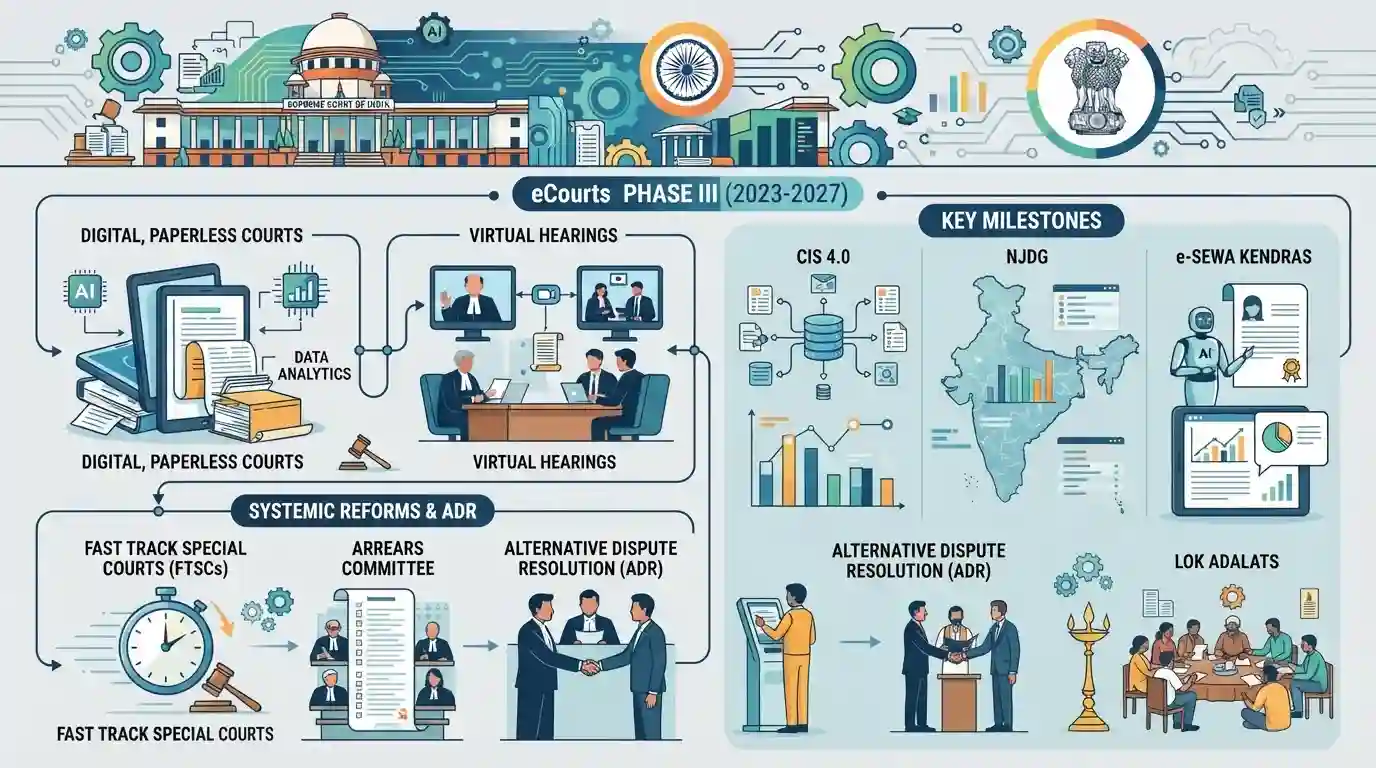
The Government of India is accelerating the digital transformation of the judiciary through eCourts Phase III (2023-2027) with a Rs. 7,210 crore outlay. The initiative aims to reduce case pendency by establishing digital, paperless courts and integrating emerging technologies like Artificial Intelligence (AI), OCR, and data analytics. Key milestones include the implementation of Case Information System (CIS) 4.0, extensive virtual hearings, the National Judicial Data Grid (NJDG), setting up e-Sewa Kendras, and introducing AI tools like Legal Research Analysis Assistant (LegRAA). Additionally, systemic reforms such as Fast Track Special Courts (FTSCs) for specific offenses, Arrears Committees for cases pending over five years, and the promotion of Alternative Dispute Resolution (ADR) and Lok Adalats are being pursued alongside legislative amendments to expedite justice delivery.
Key Points
- The e-Courts Phase-III project (2023-2027) was approved with an outlay of Rs.7,210 crore to establish a unified, digital, and paperless judiciary.
- Emerging technologies like Artificial Intelligence (AI) and Optical Character Recognition (OCR) are being integrated, notably through tools like the Legal Research Analysis Assistant (LegRAA).
- Significant digital infrastructure has been achieved, including over 4.15 crore virtual hearings, 1.21 crore cases filed via e-filing, and integration with the Inter-Operable Criminal Justice System (ICJS).
- To tackle severe judicial pendency, Arrears Committees have been set up at the High Court and District Court levels to clear cases pending for over five years.
- Systemic reforms such as Fast Track Special Courts (FTSCs) for Rape and POCSO cases, and Alternative Dispute Resolution (ADR) mechanisms are being actively promoted alongside legislative amendments.
Important Terms
e-Courts Mission Mode Project Phase-III

A central sector scheme (2023-2027) with a Rs 7,210 crore outlay focused on establishing paperless digital courts, transitioning from hardware installation to unified technology ecosystems using AI, e-filing, and online hearings.
UPSC context
GS Paper II (Judiciary & Governance). Tests understanding of technological intervention, digital transformation, and ease of justice.
National Judicial Data Grid (NJDG)
A comprehensive, near real-time online database under the eCourts Project that tracks and displays essential information about cases instituted, pending, and disposed of across Indian High Courts, District, and Subordinate Courts.
UPSC context
GS Paper II (Judiciary & Governance). Tests understanding of institutional transparency, accountability, and tracking pendency via MIS tools.
Inter-Operable Criminal Justice System (ICJS)
A national e-governance platform designed to digitally integrate major pillars of India's criminal justice system—police, courts, prisons, forensics, and prosecution—to enable paperless, real-time information and data sharing.
UPSC context
GS Paper II (Governance) & GS Paper III (Security). Tests knowledge of digital infrastructure, inter-agency coordination, and speedy trial delivery.
Crime and Criminal Tracking Network & Systems (CCTNS)
A nationwide digital project connecting police stations across India to track, record, and share real-time crime data, serving as the foundational police-side database for the Inter-Operable Criminal Justice System.
UPSC context
GS Paper II (Governance) & GS Paper III (Security). Tests familiarity with police modernization, digital public infrastructure, and internal security databases.
Commercial Courts (Amendment) Act, 2018
An amendment that reduced the minimum value of commercial disputes to Rs 3 lakh, established District-level Commercial Courts, and introduced mandatory Pre-Institution Mediation to reduce commercial case pendency.
UPSC context
GS Paper II (Judiciary) & GS Paper III (Economy). Tests understanding of fast-track dispute resolution and ease of doing business in India.
New Criminal Laws 2023
A legislative overhaul comprising the Bharatiya Nyaya Sanhita, Bharatiya Nagarik Suraksha Sanhita, and Bharatiya Sakshya Adhiniyam, replacing colonial-era criminal justice frameworks to prioritize citizen-centric and technology-driven justice.
UPSC context
GS Paper II (Criminal Justice Reforms). Tests knowledge of procedural changes, victim-centric provisions, and technological integration in the judicial process.
Prelims Trap
"Fast Track Special Courts (FTSCs) are fully funded by the Central Government as a Central Sector Scheme."
FTSCs are a Centrally Sponsored Scheme (CSS) with a standard 60:40 funding pattern, financed through the Nirbhaya Fund, not a Central Sector Scheme.
Static Concepts Connected
What are the core components and significance of the National Judicial Data Grid (NJDG)?
- Comprehensive Database: It is a centralized online platform created under the eCourts Project that tracks pending and disposed cases across district and subordinate courts, High Courts, and the Supreme Court.
- Pendency Management: It functions as a monitoring tool to identify, manage, and reduce pendency while providing open-access transparency for litigants to track case status.
What are the 5 IT pillars integrated under the Inter-Operable Criminal Justice System (ICJS)?
- Police: Implemented via the Crime and Criminal Tracking Network & Systems (CCTNS).
- e-Courts: Integrated management for judicial proceedings and case lifecycles.
- Forensics, Prosecution, Prisons: Forensic labs (e-Forensics), public prosecutors (e-Prosecution), and prison management (e-Prisons), allowing seamless data exchange without redundant manual entry.
Cross-Topic Patterns
AI in Justice vs Constitutional Rights
The deployment of AI tools like SUPACE and LegRAA in courts touches upon Articles 14 and 21, creating a GS2 intersection of digital governance and fundamental rights regarding potential algorithmic bias.
Nirbhaya Fund and Fast Track Courts
FTSCs being funded via the Nirbhaya Fund links judicial reforms to GS2 social justice, particularly the utilization and administrative bottlenecks of non-lapsable dedicated funds for women's safety.

Expect a 2026 Prelims multi-statement question mixing the implementation agencies of digital justice tools: ICJS (NCRB) vs eCourts (DoJ).
Linked PYQs · 3
Linked PYQs · 3
- 2025MainsGS2
e-governance projects have a built-in bias towards technology and back-end integration than user-centric designs. Examine.
- 2015MainsGS2
What are the major changes brought in the Arbitration and Conciliation Act, 1996 through the recent Ordinance promulgated by the President? How far will it improve India's dispute resolution mechanism? Discuss.
- 2025MainsGS2
Comment on the need of administrative tribunals as compared to the court system. Assess the impact of the recent tribunal reforms through rationalization of tribunals made in 2021.
