DISHA Two Point Zero Scheme and Technology Driven Legal Access
Source:PIB ↗
কেন এটি গুরুত্বপূর্ণ
DISHA 2.0 practically implements the constitutional mandate of Article 39A (Equal Justice and Free Legal Aid) by leveraging technology. It is highly relevant for UPSC questions regarding the role of NALSA, the effectiveness of the Legal Services Authorities Act, and the 'Interactive Service Model' of e-governance through AI-driven public service delivery.
সারসংক্ষেপ
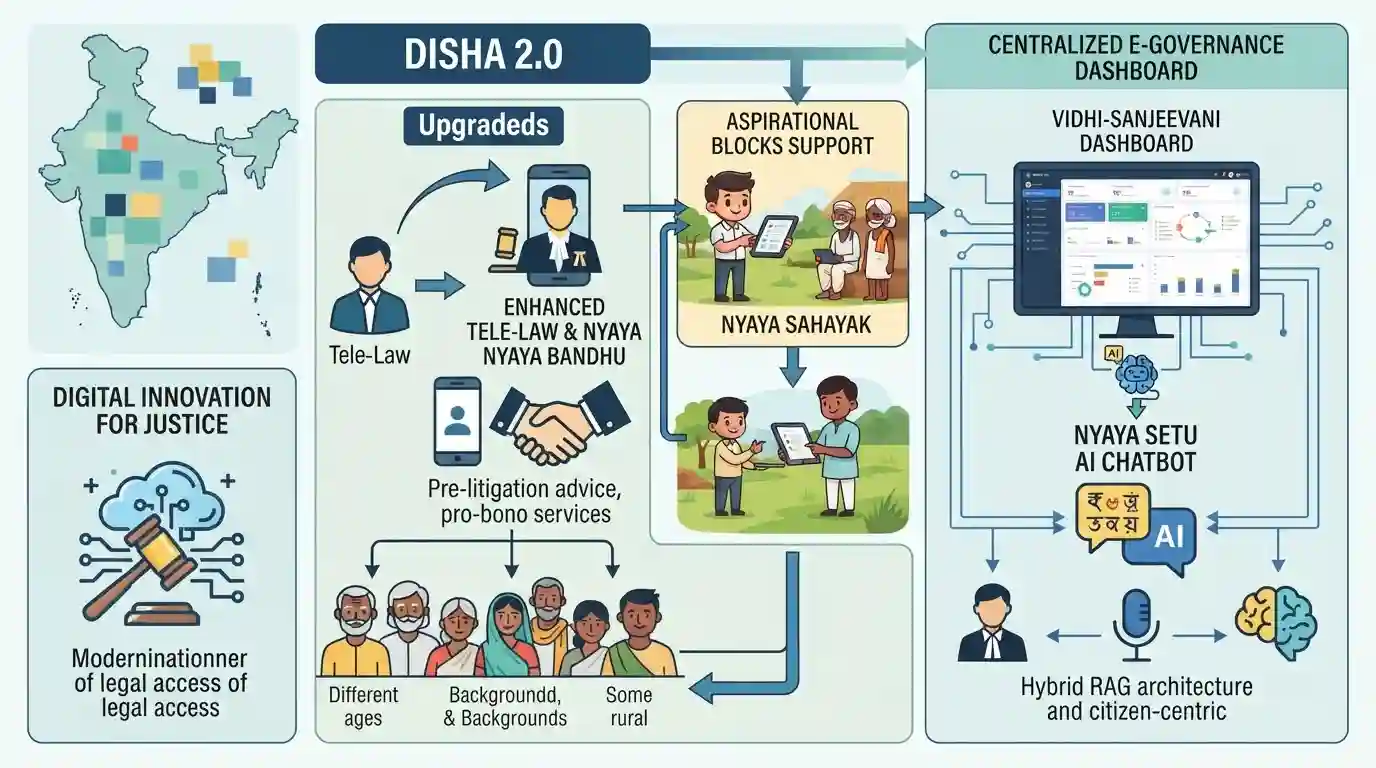
The Government of India has launched DISHA 2.0 (Designing Innovative Solutions for Holistic Access to Justice 2.0), an ambitious central sector scheme with an outlay of ₹255 crore for the period 2026-31. Aimed at bridging the justice gap through digital innovation, it features enhanced versions of the Tele-Law and Nyaya Bandhu programmes to provide pre-litigation advice and pro-bono legal services to marginalized communities eligible under the Legal Services Authorities Act, 1987. Key to the upgrade is the introduction of 'Nyaya Sahayaks' in Aspirational Blocks and the VIDHI-Sanjeevani centralized dashboard. Notably, the dashboard incorporates the Nyaya Setu AI Chatbot, which uses a Hybrid RAG architecture for multilingual text and voice support, reflecting an interactive, citizen-centric approach to e-governance and legal empowerment.
মূল বিষয়
- The Centre launched DISHA 2.0, a Central Sector Scheme with a ₹255 crore outlay (2026-31), to expand technology-driven access to justice across India.
- The scheme augments the Tele-Law Programme, providing pre-litigation advice via mobile apps and Common Service Centres (CSCs), and introduces 'Nyaya Sahayaks' in Aspirational Blocks.
- The Nyaya Bandhu programme continues to facilitate voluntary pro bono legal assistance to marginalized sections eligible under Section 12 of the Legal Services Authorities Act, 1987.
- The initiative introduces VIDHI-Sanjeevani, a centralized dashboard integrating the 'Nyaya Setu AI Chatbot', which utilizes a Hybrid RAG architecture for multilingual text and voice interactions to guide citizens.
গুরুত্বপূর্ণ শব্দ
DISHA 2.0 (Designing Innovative Solutions for Holistic Access to Justice)

A Central Sector Scheme (2026–2031) by the Ministry of Law and Justice that leverages digital technology and AI to expand free legal aid, legal literacy, and pre-litigation advice across India.
UPSC context
GS Paper II: Polity & Governance; tests understanding of judicial reforms, digital governance, and constitutional mandates like Article 39A.
Tele-Law Programme
A digital legal-aid initiative that connects common citizens with panel lawyers via Common Service Centres and mobile applications to provide free, accessible pre-litigation advice.
UPSC context
GS Paper II: E-Governance / Social Justice; tests knowledge of technology-driven civic empowerment and grassroots-level dispute resolution.
Nyaya Bandhu (Pro Bono Legal Services)
A digital platform under DISHA that facilitates voluntary pro-bono legal assistance by linking registered professional advocates with marginalized beneficiaries eligible under the law.
UPSC context
GS Paper II: Judiciary / Social Justice; tests legal aid delivery mechanisms and the role of voluntary professional services in governance.
Legal Services Authorities Act, 1987
A landmark Indian law enacted to fulfill the constitutional mandate of Article 39A, providing free, competent legal services to vulnerable sections and establishing Lok Adalats.
UPSC context
GS Paper II: Polity & Constitution; tests knowledge of statutory frameworks for alternative dispute resolution and access to justice.
National Legal Services Authority (NALSA)
The apex statutory body constituted under the 1987 Act to formulate policies, distribute funds, and oversee the implementation of free legal services and Lok Adalats nationwide.
UPSC context
GS Paper II: Statutory Bodies / Judiciary; frequently tested in Prelims/Mains regarding constitutional directives and dispute resolution mechanisms.
Legal Literacy and Legal Awareness Programme (LLLAP)
A key component of the DISHA scheme that builds grassroots capacity and spreads legal awareness through institutional partnerships, workshops, and informational campaigns.
UPSC context
GS Paper II: Social Justice; tests legal awareness interventions, capacity building of grassroots workers, and empowerment of marginalized groups.
প্রিলিমস ফাঁদ
Under the LSA Act, 1987, all specified beneficiaries, including transgender individuals, are entitled to free legal aid irrespective of income.
While women and children receive legal aid unconditionally, transgender persons and senior citizens are subject to specific income ceilings determined by state rules.
সংযুক্ত স্থির ধারণা
What are the constitutional and statutory foundations of free legal aid in India?
- Article 39A: Directs the State to provide free legal aid to ensure justice is not denied due to economic or other disabilities (42nd Amendment).
- Articles 14 & 21: Guarantee equality before law and right to life, which judicially encompasses the right to free legal representation and a fair trial.
- LSA Act 1987: Provides the statutory basis, establishing NALSA at the national level and equivalent bodies at state, district, and taluk levels.
How does the Legal Services Authorities Act, 1987 govern Lok Adalats?
- Statutory Status: Awards passed by Lok Adalats are deemed to be civil court decrees, carrying statutory enforceability under the Act.
- No Appeal: The award is final and binding on all parties; no appeal lies before any court against a Lok Adalat decision.
- Jurisdiction: Empowered to determine and compromise disputes pending before courts, as well as cases at the pre-litigation stage.
আন্তঃবিষয় প্যাটার্ন
E-governance and grassroots judicial reforms
Utilizing CSCs and AI-driven platforms like Nyaya Setu links digital literacy schemes (PMGDISHA) with the constitutional mandate of Article 39A.
Targeted governance in Aspirational Blocks
Deploying Nyaya Sahayaks in backward blocks connects digital welfare delivery to sub-district administrative machinery, optimizing local resource convergence.

DISHA 2.0 components combined with NALSA's statutory criteria will likely form a complex conceptual question on legal aid in 2026.
সংযুক্ত PYQ · 5
সংযুক্ত PYQ · 5
- 2013PrelimsGS1
With reference to National Legal Services Authority, consider the following statements : 1. Its objective is to provide free and competent legal services to the weaker sections of the society on the basis of equal opportunity. 2. It issues guidelines for the State Legal Services Authorities to implement the legal programmes and schemes throughout the country. Which of the statements given above is/are correct?
- 2020PrelimsGS1
In India, Legal Services Authorities provide free legal services to which of the following type of citizens? 1. Person with an annual income of less than ₹ 1,00,000 2. Transgender with an annual income of less than ₹ 2,00,000 3. Member of Other Backward Classes (OBC) with an annual income of less than ₹ 3,00,000 4. All Senior Citizens Select the correct answer using the code given below:
- 2023MainsGS2
Who are entitled to receive free legal aid? Assess the role of the National Legal Services Authority (NALSA) in rendering free legal aid in India.
- 2024MainsGS2
e-governance is not just about the routine application of digital technology in service delivery process. It is as much about multifarious interactions for ensuring transparency and accountability. In this context evaluate the role of the 'Interactive Service Model' of e-governance.
- 2023MainsGS2
e-governance, as a critical tool of governance, has ushered in effectiveness, transparency and accountability in governments. What inadequacies hamper the enhancement of these features ?
