Delhi NCR Winter Air Pollution Mitigation and Action Plan
Source:PIB ↗
কেন এটি গুরুত্বপূর্ণ
The severe winter air pollution in Delhi-NCR is a recurring, high-priority environmental challenge. Understanding state-level mitigation strategies—spanning e-mobility, agricultural residue management (in-situ/ex-situ), institutional enforcement (CAQM/CPCB), and tech-driven oversight (OCEMS, ANPR, SAMEER app)—is crucial for Mains GS3 (Environment/Agriculture) and provides factual context for Prelims questions on air pollutants and statutory bodies.
সারসংক্ষেপ
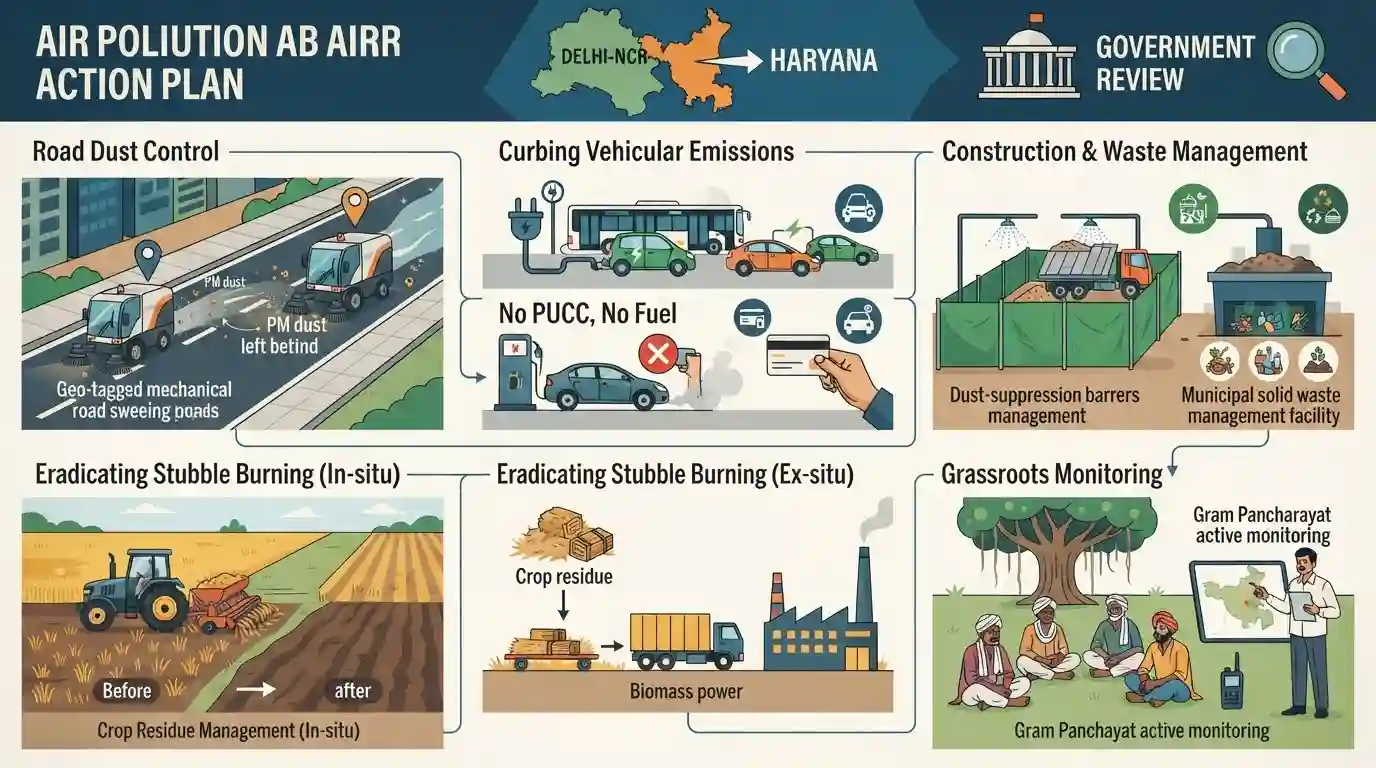
The Union Ministry of Environment, Forest and Climate Change (MoEFCC) held a comprehensive review of Haryana's Air Pollution Action Plan ahead of the winter season to mitigate air pollution in the Delhi-NCR region. The multi-pronged strategy focuses on controlling road dust through geo-tagged sweeping machines, curbing vehicular emissions by promoting e-mobility and the 'No PUCC, No Fuel' rule, and strictly managing construction and municipal solid waste. Special emphasis was placed on eradicating stubble burning through a mix of in-situ (Crop Residue Management machinery) and ex-situ (industrial biomass mapping) solutions, alongside active grassroots monitoring by Gram Panchayats.
মূল বিষয়
- The Union Environment Minister and Haryana CM reviewed the state's Air Pollution Action Plan to proactively tackle winter air pollution in Delhi-NCR.
- Measures to curb vehicular pollution include expediting e-bus deployment, expanding EV charging infrastructure, phasing out old vehicles (e.g., Parivartan Scheme), and strict enforcement of the 'No PUCC, No Fuel' rule using ANPR cameras.
- Dust and waste management strategies emphasize the deployment of geo-tagged Mechanical Road Sweeping Machines (MRSMs), 100% Municipal Solid Waste (MSW) collection, processing of Construction & Demolition (C&D) waste, and resolving road repair issues via the SAMEER app.
- To combat stubble burning, the state will ensure timely availability of Crop Residue Management (CRM) machinery through Custom Hiring Centres, map industrial biomass demand for ex-situ usage, and mobilize Gram Panchayats to identify hotspots and penalize defaulters.
- Industrial pollution will be monitored rigorously using Online Continuous Emission Monitoring Systems (OCEMS) and Air Pollution Control Devices (APCDs).
গুরুত্বপূর্ণ শব্দ
Parivartan Scheme

A Central Sector Scheme designed to accelerate the replacement of old, highly polluting commercial trucks and buses in Delhi-NCR with cleaner BS-VI compliant or electric vehicles through comprehensive financial incentives.
UPSC context
GS Paper III (Environmental Pollution); tests government policy interventions for vehicular emissions control and green transport transitions.
Crop Residue Management (CRM) scheme
A central scheme under the Ministry of Agriculture that provides financial assistance (50-80% subsidy) for crop residue machinery to prevent stubble burning in northern states via in-situ and ex-situ solutions.
UPSC context
GS Paper III (Agriculture & Pollution); tests measures to combat farm fires, promote sustainable farming, and protect soil fertility.
No PUCC, No Fuel Initiative
An environmental enforcement policy in Delhi-NCR mandating fuel stations to deny petrol or diesel to vehicles without a valid Pollution Under Control Certificate, monitored using Automatic Number Plate Recognition cameras.
UPSC context
GS Paper III (Environmental Degradation); tests administrative and technological interventions used to control urban air pollution.
Commission for Air Quality Management (CAQM)
A statutory body established in 2021 to ensure better coordination, planning, and resolution of issues relating to air quality in Delhi-NCR and adjoining states like Haryana, Punjab, and Uttar Pradesh.
UPSC context
GS Paper II & III (Governance & Environment); tests the mandate and jurisdiction of regional environmental regulatory bodies.
Central Pollution Control Board (CPCB)
A statutory apex organization established under the Water Act, 1974, responsible for nationwide environmental monitoring, air and water pollution control, and coordinating State Pollution Control Boards.
UPSC context
GS Paper II & III (Environmental Regulatory Bodies); tests the statutory framework, powers, and functions of national pollution watchdogs.
Ministry of Environment, Forest and Climate Change (MoEFCC)
The nodal central ministry responsible for planning, promoting, coordinating, and overseeing the implementation of India's environmental conservation, forestry, wildlife, and climate change policies.
UPSC context
GS Paper II & III (Administrative Structures); tests national environmental governance, policy planning, and conservation oversight.
প্রিলিমস ফাঁদ
"The SAMEER App is a mobile platform developed by the Commission for Air Quality Management (CAQM)."
While CAQM holds overarching authority for the NCR region, the SAMEER App is developed and managed by the Central Pollution Control Board (CPCB).
সংযুক্ত স্থির ধারণা
What is the statutory mandate and jurisdiction of the CAQM?
- Statutory backing: Established via the CAQM in NCR and Adjoining Areas Act, 2021 to coordinate and oversee air quality management.
- Territorial jurisdiction: Extends beyond Delhi to include adjoining areas in Punjab, Haryana, Rajasthan, and UP that impact NCR's air quality.
- Overriding powers: CAQM's directions possess binding, overriding authority over orders issued by the CPCB or State Pollution Control Boards.
How does stubble burning contribute to photochemical smog formation?
- Chemical precursors: Burning releases volatile organic compounds (VOCs), carbon monoxide (CO), and nitrogen oxides (NOx).
- Secondary pollutants: These precursors react under atmospheric conditions (even in winter sunlight) to produce ground-level ozone (O3), a major smog component.
- PM2.5 accumulation: Incomplete combustion directly emits fine particulate matter, which gets trapped by winter temperature inversions in the Indo-Gangetic plain.
আন্তঃবিষয় প্যাটার্ন
Ex-situ CRM + Bioenergy Supply Chains
Linking stubble management to industrial biomass co-firing and CBG (Compressed Biogas) plants bridges agricultural waste solutions with India's renewable energy targets (e.g., SATAT scheme).
Digital telemetry in environmental enforcement
The deployment of ANPR cameras for PUCC enforcement, geo-tagged sweepers, and OCEMS reflects a shift toward using digital telemetry and remote sensing for environmental compliance.

Expect a Prelims question contrasting CPCB and CAQM jurisdictions, or a Mains question on the economics of ex-situ crop residue management.
সংযুক্ত PYQ · 4
সংযুক্ত PYQ · 4
- 2018PrelimsGS1
How is the National Green Tribunal (NGT) different from the Central Pollution Control Board (CPCB)? 1. The NGT has been established by an Act whereas the CPCB has been created by an executive order of the Government. 2. The NGT provides environmental justice and helps reduce the burden of litigation in the higher courts whereas the CPCB promotes cleanliness of streams and wells, and aims to improve the quality of air in the country. Which of the statements given above is/are correct?
- 2019PrelimsGS1
Consider the following: 1. Carbon monoxide 2. Methane 3. Ozone 4. Sulphur dioxide Which of the above are released into atmosphere due to the burning of crop/biomass residue?
- 2021MainsGS3
Describe the key points of the revised Global Air Quality Guidelines (AQGs) recently released by the World Health Organisation (WHO). How are these different from its last update in 2005? What changes in India's National Clean Air Programme are required to achieve these revised standards?
- 2022MainsGS3
Discuss in detail the photochemical smog emphasizing its formation, effects and mitigation. Explain the 1999 Gothenburg Protocol.
