Direct Tax Administration Reforms and Responsive Governance
Source:PIB ↗
ఇది ఎందుకు ముఖ్యం
It outlines the foundational pillars of India's modernized direct tax architecture, particularly the historic introduction of the Income-tax Act 2025 and the integration of AI/Data Analytics into tax governance, essential for GS-3 Economy preparations regarding resource mobilization and technological interventions.
సారాంశం
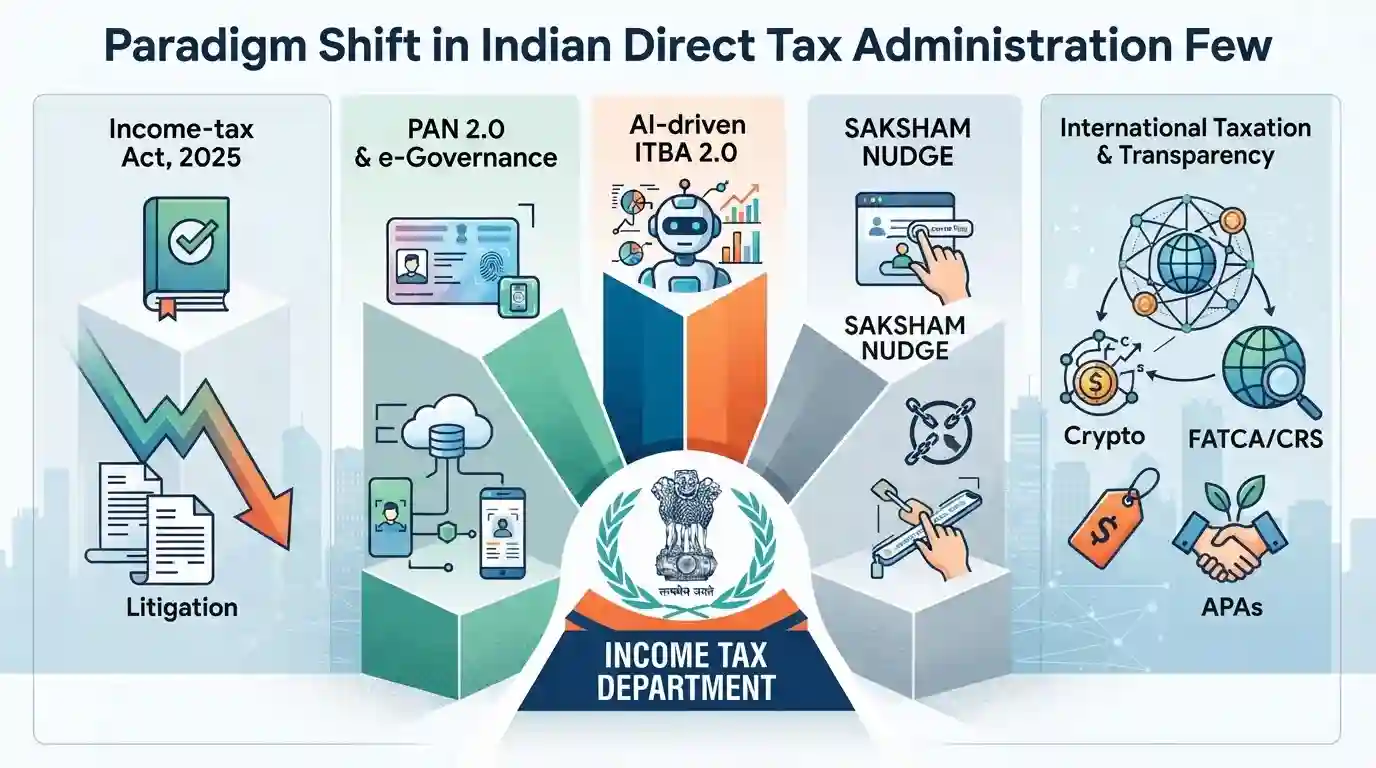
On the occasion of the 165th Income Tax Day, Finance Minister Nirmala Sitharaman highlighted a paradigm shift in direct tax administration, anchored by the '5Rs' of responsive tax governance. The landmark development is the roll-out of the Income-tax Act, 2025, designed to simplify tax laws and cut down litigation. Accompanying this legislative overhaul are major technological upgrades like PAN 2.0, the AI-driven ITBA 2.0, and the SAKSHAM NUDGE framework, shifting the focus from penal enforcement to voluntary compliance. Furthermore, international taxation capabilities are being reinforced through Crypto Asset Reporting Obligations, FATCA, CRS, and Advance Pricing Agreements (APAs) to create a robust, transparent, and taxpayer-centric ecosystem.
ముఖ్య అంశాలు
- The Finance Minister outlined the '5Rs of responsive tax governance': Recognise, Respond, Redress, Reflect, and Reform on the 165th Income Tax Day.
- A monumental reform is the impending implementation of the Income-tax Act, 2025, which replaces the 1961 Act, aiming to simplify language and substantially reduce litigation.
- Technological advancements include PAN 2.0 for taxpayer ease and ITBA 2.0 for boosting internal departmental efficiency via AI and data analytics.
- The 'SAKSHAM NUDGE framework' focuses on proactive compliance nudges rather than penal enforcement.
- On the international front, India is expanding the Automatic Exchange of Information networks, implementing Crypto Asset Reporting Obligations, and utilizing FATCA and CRS frameworks.
- To curb corporate tax disputes, the government is leaning into Advance Pricing Agreements (APAs) and promoting a collaborative approach to tax governance.
ముఖ్యమైన పదాలు
Income-tax Act, 2025

A landmark direct tax legislation replacing the 1961 Act (effective April 1, 2026). It streamlines tax administration by reducing sections to 536 and introducing a unified 'Tax Year' concept.
UPSC context
GS Paper III (Indian Economy). Tests direct tax reforms, administrative simplification, and ease of doing business.
PAN 2.0 Project
An e-governance initiative by the Income Tax Department to consolidate PAN/TAN services into a single paperless platform, introduce dynamic QR codes, and establish PAN as a universal business identifier.
UPSC context
GS Paper III (e-Governance). Tests digital public infrastructure, modernization of financial systems, and tax compliance digitization.
SAKSHAM NUDGE framework
An AI-driven compliance initiative by the Income Tax Department utilizing data analytics and behavioral insights to urge taxpayers to voluntarily rectify underreported incomes via updated returns instead of immediate penal actions.
UPSC context
GS Paper III (Economy). Tests behavioral nudging in public policy, voluntary tax compliance, and technology-led enforcement.
ITBA 2.0 (Income Tax Business Application 2.0)
The upgraded, microservices-based core IT application used internally by Income Tax officers to execute daily duties, run audits, process appeals, and facilitate faceless tax assessments efficiently.
UPSC context
GS Paper II (e-Governance). Tests administrative digitization, faceless tax assessments, and the role of IT in institutional reforms.
Advance Pricing Agreements (APAs)
A formal mechanism where taxpayers and tax authorities pre-determine the transfer pricing methodology for cross-border transactions, providing tax certainty and avoiding international transfer pricing disputes.
UPSC context
GS Paper III (Economy). Tests international taxation, transfer pricing, dispute resolution mechanisms, and global investment facilitation.
Crypto Asset Reporting Obligations
Statutory mandates (aligned with the G20's Crypto-Asset Reporting Framework) requiring virtual asset service providers to report transactional data to tax authorities, enhancing tax compliance and global financial transparency.
UPSC context
GS Paper III (Economy/Digital Assets). Tests virtual digital asset taxation, international tax coordination, and anti-money laundering measures.
ప్రిలిమ్స్ ఉచ్చు
"The Income-tax Act 2025 retains the traditional distinction between Financial Year and Assessment Year."
The 2025 Act fundamentally alters Indian taxation by merging the traditional Financial Year (FY) and Assessment Year (AY) into a single, unified 'Tax Year'.
అనుసంధానమైన స్థిర భావనలు
What is an Advance Pricing Agreement (APA)?
- Arm's Length Price: An agreement between a taxpayer and tax authority determining the transfer pricing methodology or the arm's length price for future international transactions of MNCs.
- Tenor & Rollback: It is valid for up to 5 consecutive future years, with an optional 4-year rollback provision, providing up to 9 years of absolute tax certainty.
- Primary Goal: To curb transfer pricing disputes, foster a non-adversarial tax regime, and prevent arbitrary Base Erosion and Profit Shifting (BEPS) assessments.
What are FATCA and CRS in global taxation?
- FATCA: A US law requiring foreign financial institutions to report assets held by US persons, implemented in India via a bilateral Inter-Governmental Agreement (IGA).
- CRS: Common Reporting Standard is an OECD-developed global framework for the automatic exchange of financial account information (AEOI) between participating jurisdictions.
- Objective: Both mechanisms aim to combat offshore tax evasion, round-tripping, and illicit financial flows through systemic, automated data sharing.
అంతర-అంశ నమూనాలు
Nudge Theory in Governance
The 'SAKSHAM NUDGE' framework applies Behavioral Economics to taxation, echoing earlier policy applications like the 'Give It Up' LPG campaign and 'Swachh Bharat' highlighted in past Economic Surveys.
Crypto Assets & International Regulations
Extending tax reporting obligations to Crypto Assets aligns with the G20-endorsed Crypto-Asset Reporting Framework (CARF) and FATF’s travel rule to combat international money laundering.

The structural shift from FY/AY to a single 'Tax Year' and PAN 2.0's role as a Common Business Identifier are prime targets for 2026 Prelims.
అనుసంధాన PYQలు · 3
అనుసంధాన PYQలు · 3
- 2018MainsGS3
Comment on the important changes introduced in respect of the Long-term Capital Gains Tax (LCGT) and Dividend Distribution Tax (DDT) in the Union Budget for 2018-2019.
- 2019MainsGS3
Enumerate the indirect taxes which have been subsumed in the Goods and Services Tax (GST) in India. Also, comment on the revenue implications of the GST introduced in India since July 2017.
- 2023MainsGS3
What is the status of digitalization in the Indian economy? Examine the problems faced in this regard and suggest improvements.
