Intra-Circle Roaming Activation for Disaster Communication Resilience
Source:PIB ↗
Why It Matters
For UPSC aspirants, this illustrates a practical, technology-driven approach to disaster management (GS3). It serves as a prime example of building 'disaster resilience' by utilizing regulatory tools (ICR) to maximize the utility of existing public and private infrastructure during crises, which is a highly relevant case study for answers on proactive disaster response and infrastructure resilience.
Summary
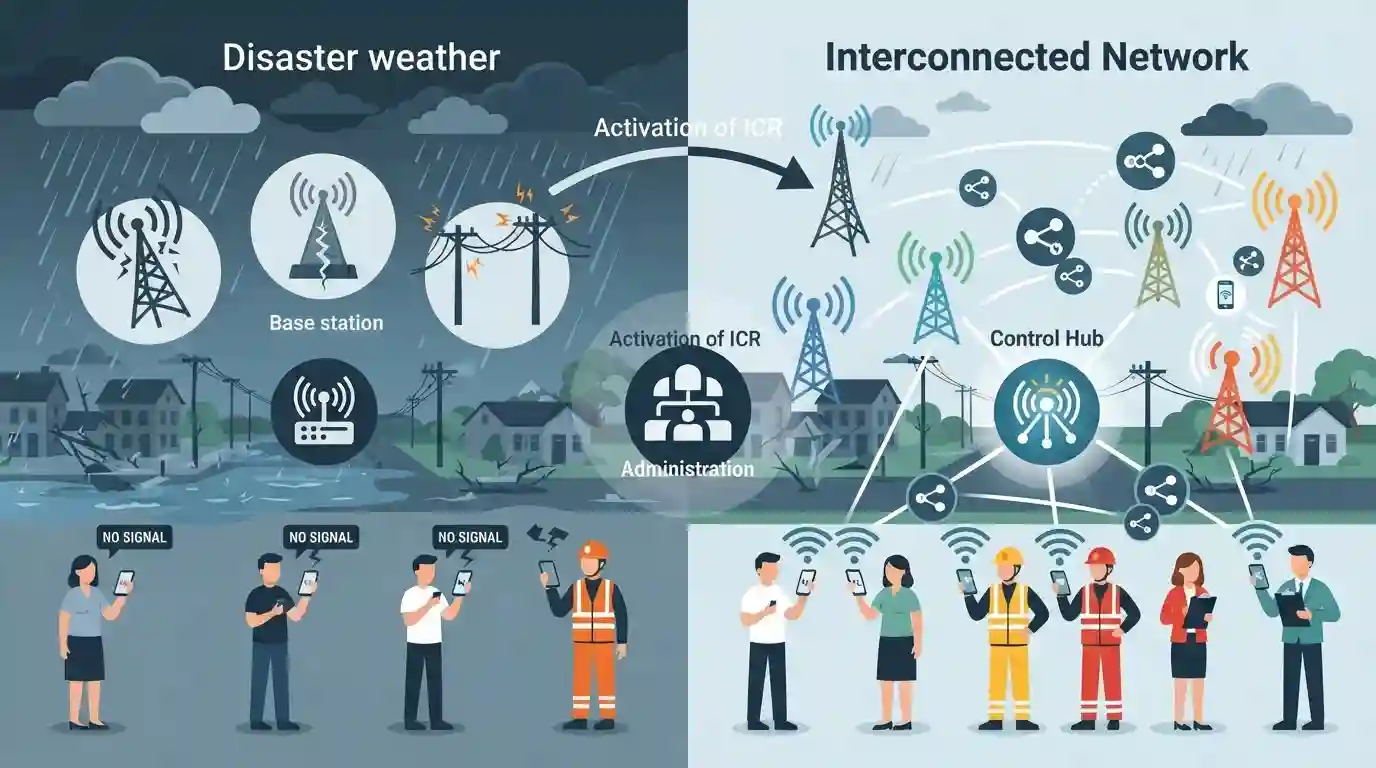
The Department of Telecommunications (DoT) activated Intra-Circle Roaming (ICR) in districts heavily affected by severe rainfall to maintain critical communication lines. ICR allows mobile users whose primary network is disrupted by infrastructure damage to seamlessly connect to any other functioning telecom operator's network in the same telecom circle without incurring roaming charges. This administrative intervention acts as a lifeline during natural disasters, ensuring uninterrupted communication for emergency response teams, local administration, and stranded individuals, thereby reinforcing the resilience of critical communication infrastructure against extreme weather events.
Key Points
- Intra-Circle Roaming (ICR) is a regulatory protocol activated by the DoT during emergencies, allowing telecom users to automatically latch onto active networks of competing providers if their own provider's infrastructure fails.
- The activation ensures that critical communication links remain functional despite physical damage to cell towers or optical fiber networks caused by severe weather and flooding.
- This seamless roaming facility is provided to affected subscribers without any additional financial burden during the crisis.
- The initiative highlights a crucial component of modern disaster management: leveraging regulatory mechanisms to ensure cross-institutional coordination between the government and private Telecom Service Providers (TSPs) for rescue and relief operations.
Important Terms
Intra-Circle Roaming (ICR)

A telecom arrangement allowing mobile subscribers to automatically connect to another operator's functioning network within the same service region when their primary provider’s infrastructure is down.
UPSC context
GS Paper III (Disaster Management/Infrastructure); tests knowledge of telecom resilience, emergency response mechanisms, and technology-driven disaster mitigation.
Disaster Management Framework
India's institutional structure governed by the Disaster Management Act, 2005, coordinating risk reduction, prevention, preparedness, and emergency response from national to district levels.
UPSC context
GS Paper III (Disaster Management); tests knowledge of institutional mechanisms, policy implementations, and legislative acts governing disaster preparedness.
Department of Telecommunications (DoT)
The executive department under India's Ministry of Communications responsible for formulating policy, licensing, and regulating the country's telecommunications sector, including activating emergency response protocols.
UPSC context
GS Paper II (Governance) and GS Paper III (Infrastructure); tests understanding of regulatory bodies and state administration in managing critical infrastructure.
Telecom Service Providers (TSPs)
Public and private business entities licensed by the government to provide cellular and data connectivity services to mobile subscribers across designated Licensed Service Areas.
UPSC context
GS Paper III (Infrastructure/Economy); tests understanding of market players, spectrum sharing, quality of service, and public-private coordination in disasters.
Prelims Trap
During disasters, Intra-Circle Roaming (ICR) is automatically active on all networks and applies only to public sector telecom service providers.
ICR is not permanently active; it requires explicit activation by the DoT, and it legally binds both private and public TSPs to share infrastructure without subscriber charges.
Static Concepts Connected
What is a 'Telecom Circle' and its disaster sharing regulatory framework in India?
- Geographical Units: India is divided into 22 Service Areas (Telecom Circles) for licensing, spectrum allocation, and administrative tariff regulations.
- Unified License Mandate: The DoT's Unified License agreement legally binds all private and public TSPs to share surviving infrastructure during notified emergencies without charging customers.
What are SACHET and the Cell Broadcast System (CBS) in India's disaster management?
- SACHET Platform: An Integrated Disaster Early Warning System portal developed by C-DOT to disseminate geo-targeted alerts from agencies like IMD, NDMA, and CWC.
- Cell Broadcast System: A technology that delivers emergency alerts directly to mobile screens with distinctive sounds, bypassing network congestion and operating effectively without active internet.
Cross-Topic Patterns
Infrastructure resilience + Early warning
Integrating ICR with the Cell Broadcast System transforms commercial telecom networks into life-saving early warning channels during climate-induced extreme weather events.
State regulatory powers + Private sector
The emergency activation of ICR showcases how sovereign regulatory frameworks can temporarily override private competition to secure public safety and public goods during disasters.

2026 Prelims may test emergency telecom protocols (ICR, Cell Broadcast) under the Disaster Management Act and Unified License terms.
Linked PYQs · 4
Linked PYQs · 4
- 2024MainsGS3
What is disaster resilience? How is it determined? Describe various elements of a resilience framework. Also mention the global targets of Sendai Framework for Disaster Risk Reduction (2015–2030).
- 2020MainsGS3
Discuss the recent measures initiated in disaster management by the Government of India departing from the earlier reactive approach.
- 2024MainsGS3
Flooding in urban areas is an emerging climate-induced disaster. Discuss the causes of this disaster. Mention the features of two such major floods in the last two decades in India. Describe the policies and frameworks in India that aim at tackling such floods.
- 2013MainsGS3
How important are vulnerability and risk assessment for pre-disaster management ? As an administrator, what are key areas that you would focus on in a Disaster Management System.
