Inland Waterways Development and Logistics Cost Efficiency
Source:PIB ↗
આ શા માટે મહત્વનું છે
Provides concrete, up-to-date data points (e.g., Rs. 1.06/TKm cost of IWT vs. road/rail) and outlines new, impactful government schemes (Jalvahak Scheme, Tonnage Tax, Coastal Shipping Act 2025) which are invaluable for writing evidence-based Mains answers on India's logistics infrastructure and sustainable transport.
સારાંશ
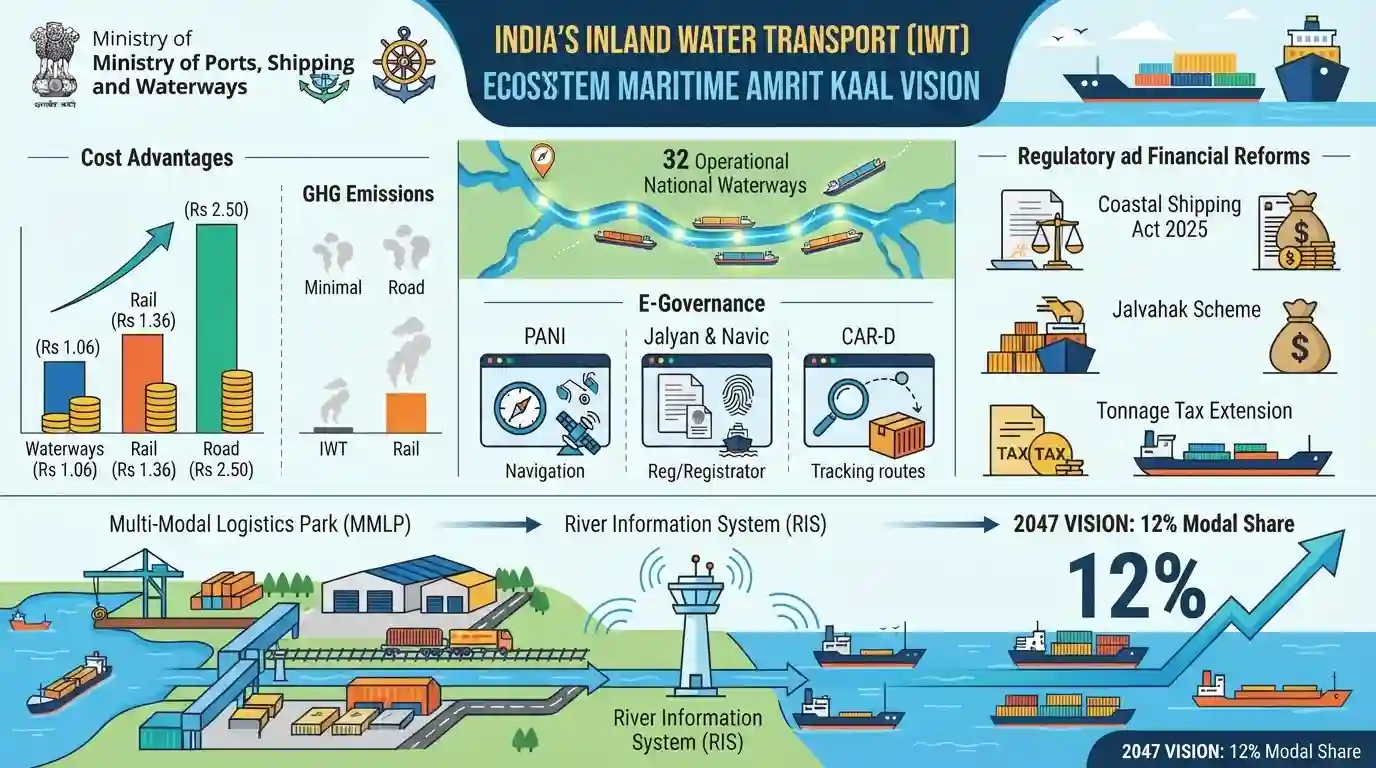
The Ministry of Ports, Shipping and Waterways is rapidly advancing India's Inland Water Transport (IWT) ecosystem to boost economic efficiency and environmental sustainability. With 32 National Waterways now operationalized, the sector offers significant cost advantages—freighting at Rs. 1.06/TKm compared to road (Rs. 2.50) and rail (Rs. 1.36)—while keeping greenhouse gas emissions negligible. To modernize the sector, the government has launched comprehensive digital platforms like PANI (navigation), Jalyan & Navic (registration), and CAR-D (cargo tracking). Regulatory and financial frameworks have been overhauled through the Coastal Shipping Act 2025, the Jalvahak Scheme (providing cargo incentives), and the extension of the Tonnage Tax to inland vessels. These reforms, alongside infrastructural expansions such as Multi-Modal Logistics Parks (MMLPs) and the River Information System (RIS), aim to double the modal share of inland and coastal shipping to 12% by 2047 as part of the Maritime Amrit Kaal Vision.
મુખ્ય મુદ્દા
- The Inland Waterways Authority of India (IWAI) has operationalized 32 National Waterways, aligning with the Maritime Amrit Kaal Vision 2047 to increase the modal share of coastal and inland water transport from 6% to 12%.
- Inland Water Transport (IWT) provides distinct economic and environmental advantages, with freight costs at Rs. 1.06 per Ton-Kilometer (TKm) compared to Rs. 1.36 for rail and Rs. 2.50 for road, alongside negligible air pollution and GHG emissions.
- Key digital reforms include the PANI portal for navigation information, Jalyan & Navic for unified vessel/crew registration, and the CAR-D portal for real-time logistics tracking.
- Major policy pushes feature the 'Jalvahak Scheme' (offering 35% financial incentives on specific routes), extension of the Tonnage Tax to inland vessels, the National Waterways Regulations 2025 for private capital, and the implementation of the Coastal Shipping Act 2025.
- Infrastructure projects involve the development of Multi-Modal Logistics Parks (MMLPs) at Varanasi and Sahibganj to enable cargo aggregation and multimodal connectivity, alongside regional facilities like the ship repair unit in Pandu.
મહત્વપૂર્ણ શબ્દો
Maritime Amrit Kaal Vision 2047

A comprehensive strategic roadmap launched by India's Ministry of Ports, Shipping and Waterways to transform the maritime sector, boost the blue economy, and achieve sustainable infrastructure goals by 2047.
UPSC context
GS Paper III (Infrastructure: Ports, Waterways); tests understanding of long-term economic planning and blue economy transformation.
Jalvahak Scheme
A policy initiative launched in December 2024 to promote cargo transit on major inland waterways by providing up to 35% operating expense reimbursement to eligible cargo owners.
UPSC context
GS Paper III (Logistics & Transport); tests policies shifting freight from roads and railways to more eco-friendly waterways.
Coastal Shipping Act 2025
A legislative act enacted in August 2025 that replaces Part XIV of the Merchant Shipping Act, 1958, simplifying licensing for domestic vessels and boosting coastal trade.
UPSC context
GS Paper III (Infrastructure & Regulations); tests legislative reforms intended to reduce logistics costs and integrate inland-coastal shipping.
Inland Vessels Act 2021
A landmark act that repealed the colonial-era 1917 legislation, establishing a unified national regulatory framework for the registration, safety, and pollution control of inland water vessels.
UPSC context
GS Paper III (Infrastructure and Environmental Protection); evaluates maritime safety, environmental compliance, and interstate logistics.
Sagarmala Programme
India's flagship port-led development initiative launched in March 2015 to modernize ports, enhance hinterland connectivity, reduce national logistics costs, and boost coastal economic zones.
UPSC context
GS Paper III (Infrastructure); tests understanding of maritime connectivity, coastal community development, and economic growth.
Indo-Bangladesh Protocol Route
A bilateral transit and trade agreement route first signed in 1972, enabling inland vessels of India and Bangladesh to transit designated waterways for seamless trade.
UPSC context
GS Paper II (International Relations); tests bilateral trade pacts, regional connectivity, and development in India's Northeast.
પ્રિલિમ્સ ટ્રેપ
The Coastal Shipping Act 2025 limits coastal trade regulations strictly to India's territorial waters.
The 2025 Act expands 'coasting trade' to include maritime services up to 200 nautical miles (EEZ), not just the 12 NM territorial waters.
સંલગ્ન સ્થિર ખ્યાલો
How are National Waterways constitutionally and legally managed in India?
- Union List: Shipping and navigation on inland waterways declared by Parliament as National Waterways falls under Entry 24.
- Concurrent List: Inland waterways not designated as 'National' fall under Entry 32, allowing state-level jurisdiction.
- IWAI Act 1985: Established the Inland Waterways Authority of India (IWAI) as the statutory body for developing and regulating NWs.
What is the strategic geography of the Indo-Bangladesh Protocol (IBP) Route?
- Geographic Link: It provides a continuous transit network connecting the Ganga (NW-1) and the Brahmaputra (NW-2) through Bangladesh's river systems.
- Strategic Bypass: It drastically cuts freight distance and time to North-East India by bypassing the congested Siliguri Corridor (Chicken's Neck).
આંતર-વિષય પેટર્ન
Gati Shakti + Climate NDCs
Shifting cargo to inland waterways (Rs 1.06/TKm) directly supports India's climate NDCs and PM Gati Shakti's mandate to slash aggregate logistics costs below 10% of GDP.
Act East + North-East Logistics
Incentivizing the Ganga (NW-1) to Brahmaputra (NW-2) route via the Indo-Bangladesh Protocol complements the Kaladan project, positioning waterways as the backbone of North-East connectivity.

Match-the-following on digital portals (PANI, Jalyan) or a statement testing the Coastal Shipping Act's 200 NM EEZ jurisdiction in 2026.
સંલગ્ન PYQ · 3
સંલગ્ન PYQ · 3
- 2016MainsGS1
Enumerate the problems and prospects of inland water transport in India.
- 2020MainsGS1
The interlinking of rivers can provide viable solutions to the multi-dimensional inter-related problems of droughts, floods and interrupted navigation. Critically examine.
- 2021MainsGS3
“Investment in infrastructure is essential for more rapid and inclusive economic growth.” Discuss in the light of India's experience.
