Gram Panchayat Decentralization and Rural Water Governance
Source:PIB ↗
Why It Matters
This article offers highly practical, ground-level case studies on how decentralized governance (PRIs) can resolve complex resource management challenges. It directly feeds into GS2 topics on grassroots democracy, the devolution of 3Fs, and administrative transparency, as well as GS3 water resource management and GS1/GS2 tribal development.
Summary
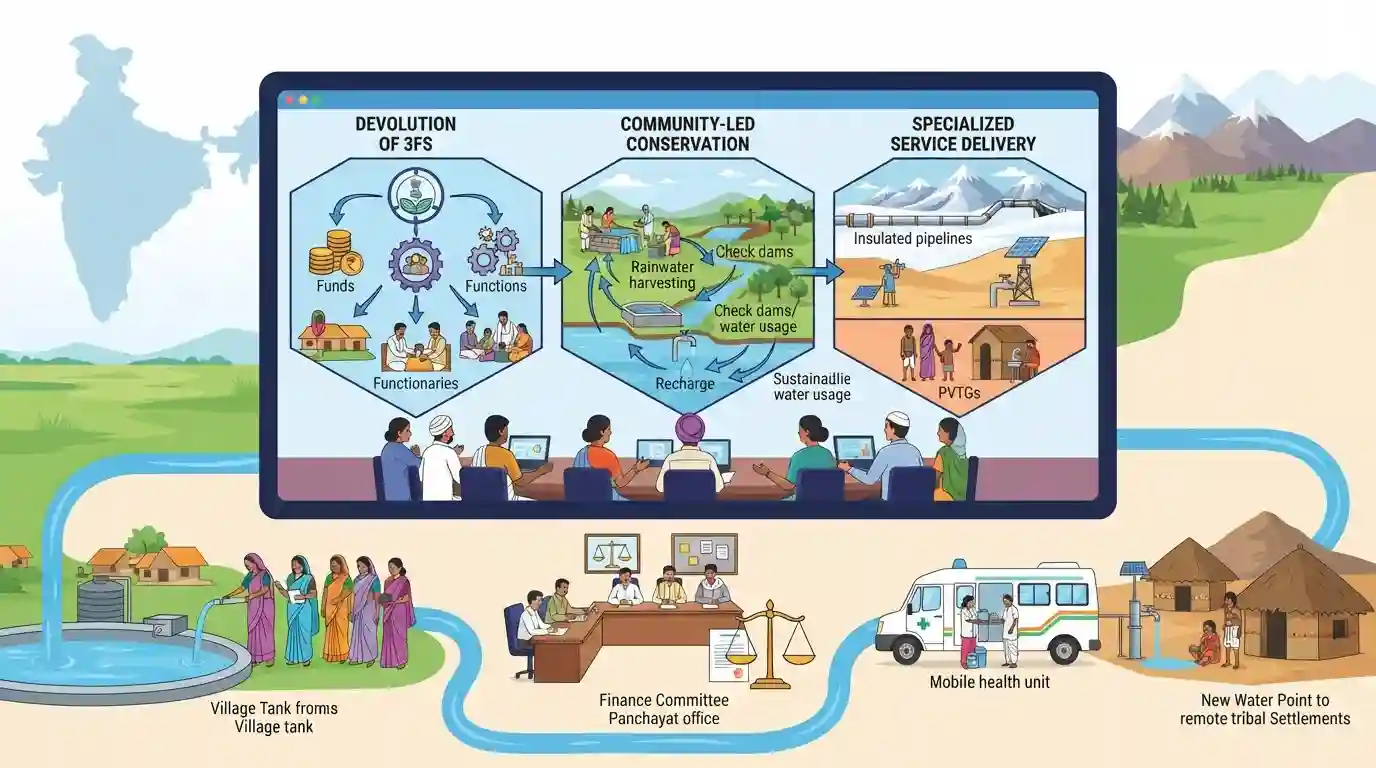
The 9th edition of 'Sujal Gram Samvad,' hosted virtually by the Department of Drinking Water and Sanitation (DDWS), showcased the transformation of rural water governance under the Jal Jeevan Mission 2.0. Highlighting the devolution of 3Fs (Funds, Functions, Functionaries) under the 73rd Constitutional Amendment Act, the dialogue with representatives from eight Gram Panchayats underscored community-led water conservation, decentralized financial models utilizing 15th and 16th Finance Commission grants, climate-resilient engineering (such as insulated pipelines in Himalayan regions), and specialized service delivery to remote tribal habitations and Particularly Vulnerable Tribal Groups (PVTGs).
Key Points
- The 9th edition of the multilingual 'Sujal Gram Samvad' focused on Gram Panchayat (GP)-driven, community-led, long-term water security under the Jal Jeevan Mission 2.0.
- Empowering Local Bodies: Emphasized the devolution of Funds, Functions, and Functionaries (3Fs) under the 73rd Constitutional Amendment Act, positioning Panchayati Raj Institutions (PRIs) as central to the sustainable management of rural water supply.
- Financial Sustainability of Assets: Encouraged local bodies to optimize 15th and 16th Finance Commission grants to cover Operations and Maintenance (O&M) expenses, paired with local community-led user charge models (ranging from ₹30 to ₹50 monthly) to build financial self-reliance.
- Digital Tools and Participatory Monitoring: Highlighted the deployment of the e-Gram Swaraj Portal, Jal Sarthi App, and Jal Seva Aankalan for tracking water supply functionality, alongside local solutions like GP-level WhatsApp groups to report and resolve pipeline leakages.
- Localized Water Conservation Practices: Showcased gravity-based spring water rejuvenation (J&K), insulated pipe technology for sub-zero Himalayan winters, SHG-led fortnightly water quality testing via Field Test Kits (FTKs), and soak pits for decentralized greywater treatment (Chhattisgarh).
- Social Inclusivity in Infrastructure: Promoted targeted infrastructure outreach to Particularly Vulnerable Tribal Groups (PVTGs) and remote tribal hamlets (e.g., Koda and Kora tribal habitations in UP; covering over 80,000 PVTG households in Coimbatore district, TN).
Important Terms
Jal Jeevan Mission 2.0

An extension of India’s flagship rural water scheme (until December 2028) focusing on community ownership, source sustainability, O&M, and digital governance to ensure reliable and safe tap water services.
UPSC context
GS Paper II: Welfare Schemes/Governance; tests implementation models of welfare schemes and sustainable public service delivery.
73rd Constitutional Amendment Act
A landmark 1992 legislation that institutionalized local self-governance in India by creating a three-tier Panchayati Raj system and mandating the devolution of Funds, Functions, and Functionaries to local bodies.
UPSC context
GS Paper II: Polity/Decentralization; tests provisions of Panchayati Raj Institutions, devolution of powers, and grassroots democratic governance.
15th Finance Commission
A constitutional body that recommended financial devolution for 2021-2026, allocating substantial tied grants (60% of rural local body funds) specifically earmarked for drinking water, sanitation, and water conservation.
UPSC context
GS Paper II & III: Fiscal Federalism; tests intergovernmental transfers, devolution formula, and resource allocation to local bodies.
e-Gram Swaraj Portal
A comprehensive digital governance platform launched by the Ministry of Panchayati Raj to simplify Gram Panchayat activities, including decentralized planning, online budgeting, work-based accounting, and real-time monitoring.
UPSC context
GS Paper II: Governance/E-governance; tests digital interventions in PRIs, financial transparency, and decentralized planning mechanisms.
Jal Seva Aankalan
A Gram Panchayat-led digital self-assessment tool launched under the Jal Jeevan Mission to evaluate rural drinking water service delivery (regularity, adequacy, quality, and sustainability) through community-led audits and Gram Sabhas.
UPSC context
GS Paper II: Governance/Welfare Schemes; tests community participation, digital monitoring systems, and citizen-led accountability in service delivery.
Department of Drinking Water and Sanitation (DDWS)
The nodal department under the Ministry of Jal Shakti responsible for executing national water and sanitation policies, notably the Jal Jeevan Mission and Swachh Bharat Mission (Grameen).
UPSC context
GS Paper II: Governance/Government Policies; tests institutional architecture, scheme implementation, and center-state cooperative federalism.
Prelims Trap
Jal Seva Aankalan is an annual external third-party performance audit of water quality conducted by the Ministry of Jal Shakti.
Aspirants often assume national assessments are done by external agencies. Under JJM 2.0, it is actually a community-led digital self-assessment tool validated directly by Gram Sabhas.
Static Concepts Connected
What is the constitutional status of drinking water under the Eleventh Schedule?
- Constitutional entry: Article 243G of the Constitution, added via the 73rd Amendment, empowers State Legislatures to devolve powers to Panchayats.
- Eleventh Schedule: The Eleventh Schedule contains 29 functional items, explicitly listing "Drinking water" as Item 11 and "Water management" as Item 3.
- Devolution gap: While constitutionally listed, actual execution depends on state-specific legislation transferring the 3Fs (Funds, Functions, Functionaries) to local bodies.
How are Finance Commission grants structured for rural local bodies?
- Tied vs Untied: FC grants are split into basic (untied) grants for location-specific needs and tied grants earmarked for national priorities.
- Water and Sanitation: Tied grants are strictly ring-fenced for sanitation (ODF maintenance) and supply of drinking water, rainwater harvesting, and recycling.
- Operational funding: While asset creation is often centrally funded, FC tied grants are increasingly leveraged for rural operations and maintenance (O&M) cost recovery.
Cross-Topic Patterns
Fiscal federalism and local O&M
Linking Finance Commission tied grants to Panchayats for water infrastructure operations addresses the classic "build-neglect-rebuild" cycle in rural public asset management.
PVTG welfare and basic amenities
Targeted drinking water supply to PVTGs under JJM 2.0 complements the PM-JANMAN scheme, highlighting a shift towards saturation-based tribal development.

JJM 2.0's shift to a service-delivery model (Sujalam Bharat, Jal Seva Aankalan) will likely feature in 2026 questions on PRI devolution.
Linked PYQs · 3
Linked PYQs · 3
- 2022MainsGS2
To what extent, in your opinion, has the decentralisation of power in India changed the governance landscape at the grassroots?
- 2020MainsGS3
Suggest measures to improve water storage and irrigation system to make its judicious use under depleting scenario.
- 2019PrelimsGS1
Consider the following statements about Particularly Vulnerable Tribal Groups (PVTGs) in India : 1. PVTGs reside in 18 States and one Union Territory. 2. A stagnant or declining population is one of the criteria for determining PVTG status. 3. There are 95 PVTGS officially notified in the country so far. 4. Irular and Konda Reddi tribes are included in the list of PVTGs. Which of the statements given above are correct?
