Scientific Mine Closure and Circular Economy Transition
Source:PIB ↗
কেন এটি গুরুত্বপূর্ণ
Mining causes significant environmental degradation, making sustainable mining and ecological restoration critical topics for UPSC (directly tested in Mains 2025). The transition to a circular economy through overburden utilization and the socio-economic challenges of closing mines (just transition) bridge the gap between GS3 Environment, GS3 Economy, and GS1 Geography.
সারসংক্ষেপ
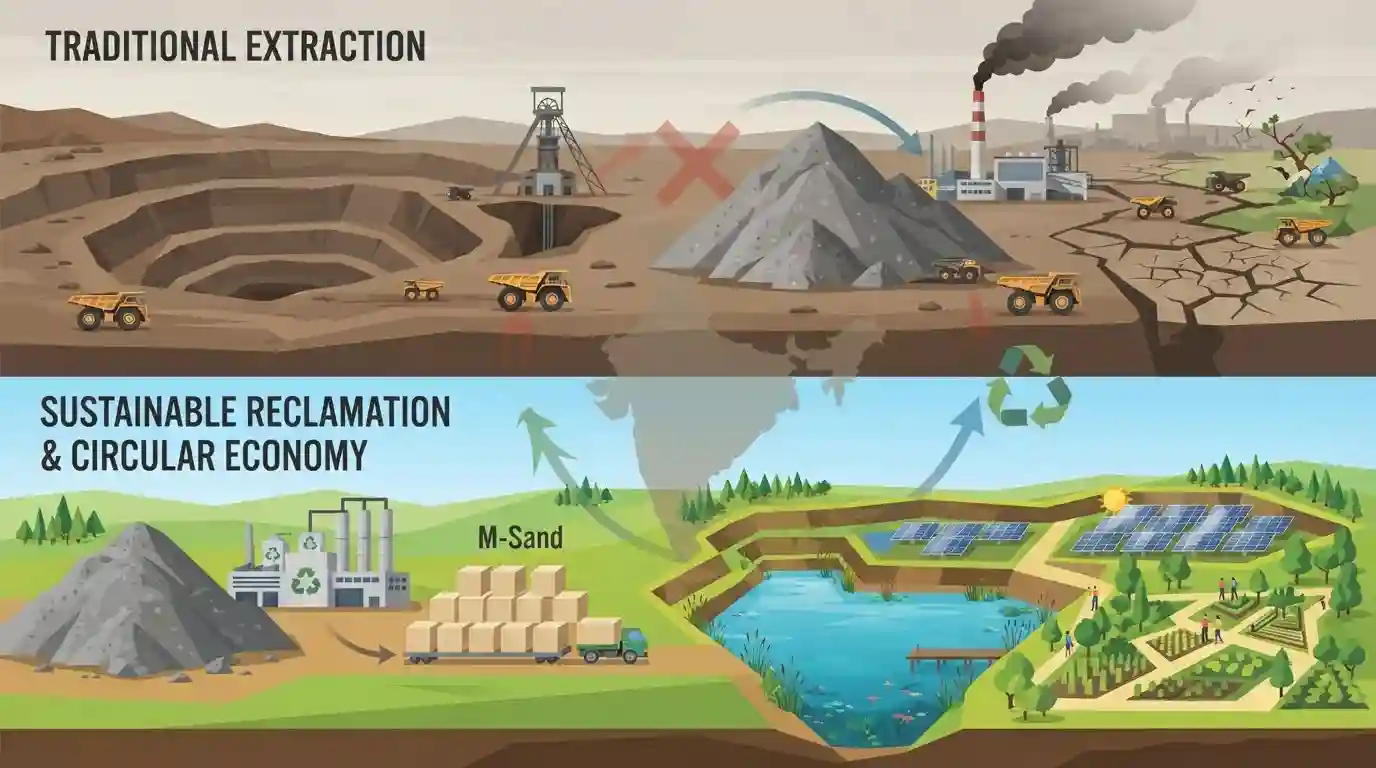
Union Minister Dr. Jitendra Singh has highlighted mine closure as a landmark initiative in India's transition toward a circular economy. The process of scientifically reclaiming and repurposing exhausted mining sites represents a shift from traditional extraction to sustainable resource management. By utilizing mine overburden to produce manufactured sand (M-sand) and transforming abandoned mines into eco-parks, water reservoirs, and solar energy installations, the government aims to generate wealth from waste while mitigating environmental hazards. This approach is integral to fulfilling India's 'Panchamrit' climate commitments, achieving Net Zero by 2070, and ensuring a just socio-economic transition for mining-dependent communities.
মূল বিষয়
- Scientific mine closure is recognized as a vital component of India's transition to a circular economy, shifting the focus from mere resource extraction to 'waste-to-wealth' creation.
- Exhausted and abandoned mines are being repurposed into eco-parks, water reservoirs, and solar energy hubs, ensuring environmental restoration and continued economic utility.
- A key circular economy initiative is the conversion of mining overburden (waste rock) into manufactured sand (M-sand), which directly reduces the ecological damage caused by river sand mining.
- Properly managed mine closures support a 'just transition' for local communities by generating alternative livelihoods and preventing socio-economic collapse after mining ceases.
- These initiatives are crucial for mitigating the environmental hazards of mining and align closely with India's Net Zero by 2070 targets and SDG 12 (Responsible Consumption).
গুরুত্বপূর্ণ শব্দ
Progressive Mine Closure Plan (PMCP)

A conceptual and operational framework to continuously reclaim, restore, and rehabilitate mined-out land concurrently with ongoing mining activities, thereby limiting ecological and land degradation from the project's inception.
UPSC context
GS Paper III (EIA & Conservation); tests knowledge of sustainable resource extraction, environmental impact mitigation, and statutory compliance for mining leaseholders.
Final Mine Closure Plan (FMCP)
A statutory document detailed and submitted years before intended mine closure, outlining final reclamation, hazard mitigation, safety measures, and site repurposing to ensure safe and sustainable post-mining land use.
UPSC context
GS Paper III (EIA & Conservation); tests understanding of decommissioning protocols, post-extraction land rehabilitation, and socio-economic transitions for mining-dependent communities.
Panchamrit
India's five-point climate action strategy announced at COP26, committing to net-zero emissions by 2070, reducing carbon emissions by one billion tonnes, and transitioning 50% of energy requirements to renewables by 2030.
UPSC context
GS Paper III (Climate Change & Energy); tests knowledge of India's international climate pledges, green transition targets, and national decarbonization strategies.
Sustainable Development Goals (SDGs)
A set of 17 global goals adopted by the UN in 2015 to end poverty, protect the planet, and ensure prosperity, heavily integrated into India's planning for sustainable mining and circular economy.
UPSC context
GS Papers II & III (Development, Conservation); tests understanding of global sustainability frameworks and India's localization of environmental targets.
Coal India Limited (CIL)
A Maharatna public sector undertaking under the Ministry of Coal, serving as the world's largest coal-producing company and a key entity implementing land reclamation and greening initiatives.
UPSC context
GS Paper III (Energy, PSUs); tests understanding of India's primary energy security provider, transitioning public energy monopolies, and corporate environmental responsibility.
Ministry of Coal
The central government ministry responsible for the exploration, production, distribution, and pricing of coal and lignite in India, while also regulating progressive and final mine closure policies.
UPSC context
GS Paper III (Infrastructure: Energy); tests knowledge of government institutions managing primary fossil fuels, transition to green energy, and environmental regulation compliance.
প্রিলিমস ফাঁদ
The Central Government has the exclusive legislative power to frame rules for regulating the mining of minor minerals.
Under Section 15 of the MMDR Act, 1957, State Governments (not the Centre) are fully empowered to frame rules for regulating and leasing minor minerals like sand.
সংযুক্ত স্থির ধারণা
What is the regulatory distinction between Major and Minor Minerals under the MMDR Act, 1957?
- Classification Authority: Section 3(e) defines minor minerals (e.g., gravel, clay, building stone, sand), while the Central Government retains the power to declare any mineral as 'minor'.
- Rule-Making Power: Unlike major minerals, the power to frame rules, grant concessions, and collect royalties for minor minerals is delegated entirely to State Governments under Section 15.
- Illegal Mining Control: Section 23C empowers State Governments to make rules to prevent illegal mining, transportation, and storage of both major and minor minerals.
What constitutes a 'Just Transition' in the context of climate action?
- Core Philosophy: Ensuring that the transition to a low-carbon economy does not disproportionately harm fossil-fuel-dependent workers, communities, and local economies.
- Socio-Economic Safety: Providing green skills, alternative livelihoods, and community development investments (e.g., using mine-closure corpuses for local infrastructure).
- Environmental Justice: Restoring degraded land and ecological health of extraction sites to prevent long-term public health hazards post-industrial shutdown.
আন্তঃবিষয় প্যাটার্ন
Minor minerals and Federal friction
Administrative control over sand mining frequently triggers center-state and interstate disputes, showcasing how minor mineral regulation tests federal relations in environmental management.
Just Transition and climate justice
Coal phase-down directly impacts millions of informal workers; linking mine-rehabilitation corpuses to local economic diversification is critical to achieving climate justice.

Socio-ecological impacts of coal phase-down and the regulatory framework of M-sand versus river sand will likely be tested in GS3 2026.
সংযুক্ত PYQ · 4
সংযুক্ত PYQ · 4
- 2025MainsGS3
Mineral resources are fundamental to the country's economy and these are exploited by mining. Why is mining considered an environmental hazard? Explain the remedial measures required to reduce the environmental hazard due to mining.
- 2018MainsGS3
What are the impediments in disposing the huge quantities of discarded solid wastes which are continuously being generated? How do we remove safely the toxic wastes that have been accumulating in our habitable environment?
- 2019MainsGS3
Define the concept of carrying capacity of an ecosystem as relevant to an environment. Explain how understanding this concept is vital while planning for sustainable development of a region.
- 2023PrelimsGS1
Consider the following activities: 1. Spreading finely ground basalt rock on farmlands extensively 2. Increasing the alkalinity of oceans by adding lime 3. Capturing carbon dioxide released by various industries and pumping it into abandoned subterranean mines in the form of carbonated waters How many of the above activities are often considered and discussed for carbon capture and sequestration?
