Scheduled Caste Scholarship Schemes and Direct Benefit Transfer
Source:PIB ↗
આ શા માટે મહત્વનું છે
This update provides concrete empirical evidence and administrative reforms (such as DBT adoption and NITI Aayog evaluation) that can be used to write high-quality answers on the implementation challenges and successes of social justice/educational welfare policies for vulnerable communities in GS Paper 2.
સારાંશ
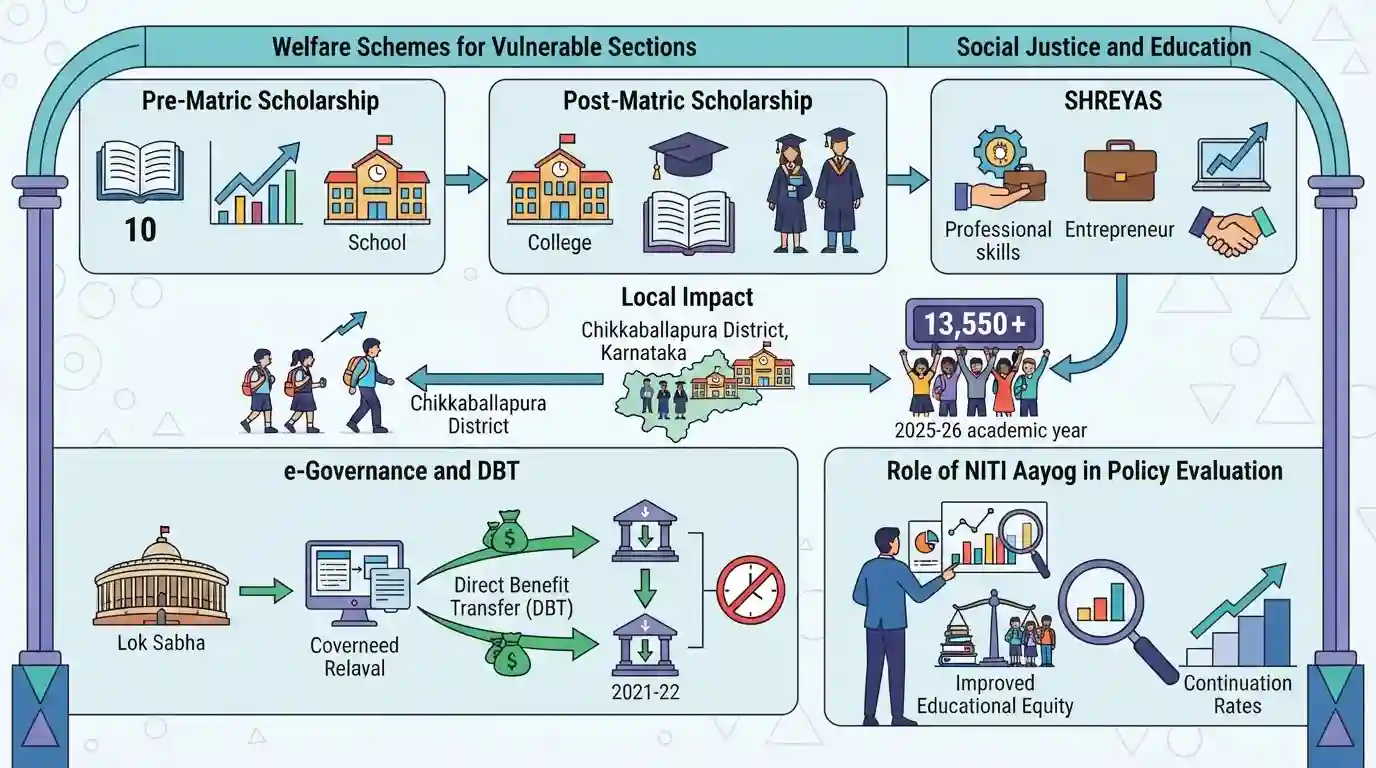
In a written reply in the Lok Sabha, the Minister of State for Social Justice and Empowerment highlighted the progress of three major central scholarship schemes (Post-Matric, Pre-Matric, and SHREYAS) designed for Scheduled Caste (SC) students. He showcased local impact using Karnataka's Chikkaballapura district, where over 13,550 students benefited during the 2025–26 academic year. The implementation of Direct Benefit Transfer (DBT) since 2021–22 has eliminated delays and enhanced transparency, as endorsed by a NITI Aayog evaluation noting improved educational equity and continuation rates.
મુખ્ય મુદ્દા
- The Ministry of Social Justice and Empowerment implements three major central scholarship schemes for Scheduled Caste (SC) students: the Post-Matric Scholarship (PMS-SC), the Pre-Matric Scholarship, and the SHREYAS-SC scheme.
- In the Chikkaballapura district of Karnataka alone, 13,550 SC students benefited from these schemes during the 2025–26 academic year (8,460 under PMS-SC and 5,090 under Pre-Matric).
- The adoption of the Direct Benefit Transfer (DBT) mechanism (introduced in 2021–22 for Post-Matric and 2022–23 for Pre-Matric) directly to Aadhaar-seeded accounts has enhanced transparency, reduced disbursement delays, and eliminated duplications.
- To boost awareness and implementation efficiency, the department conducts extensive campaigns, newspaper ads, social media outreach, and regular monitoring via National Chintan Shivirs and regional review meetings with states.
- An evaluation of these schemes by NITI Aayog observed that they have successfully promoted educational equity, reduced financial barriers, and encouraged disadvantaged students to continue higher education.
મહત્વપૂર્ણ શબ્દો
SHREYAS (Scholarships for Higher Education for Young Achievers Scheme)

An umbrella Central Sector scheme by the Ministry of Social Justice & Empowerment providing financial assistance to SC and OBC students for higher education, fellowships, overseas studies, and competitive exam coaching.
UPSC context
GS-2 (Welfare Schemes). Frequently tested in Prelims for its target demographic and sub-components.
Post-Matric Scholarship for Scheduled Castes (PMS-SC)
A Centrally Sponsored Scheme providing financial assistance to Scheduled Caste students at post-matriculation or post-secondary stages. It aims to increase the Gross Enrolment Ratio (GER) among the poorest SC households.
UPSC context
GS-2 (Social Justice/Education). Crucial for questions on educational equity and inclusive growth interventions.
Pre-Matric Scholarship for Scheduled Castes
A centrally supported scholarship scheme aimed at reducing financial barriers for SC students at the pre-matriculation level, thereby minimizing school dropout rates and encouraging transition to higher education.
UPSC context
GS-2 (Education). Important for illustrating grassroots interventions targeting foundational educational access for marginalized groups.
Direct Benefit Transfer (DBT)
A major governance reform mechanism that transfers government subsidies and welfare funds directly into the Aadhaar-linked bank accounts of beneficiaries, eliminating intermediaries and minimizing leakages.
UPSC context
GS-2 (e-Governance) & GS-3 (Economy/Subsidies). A key component of the JAM trinity for efficient welfare delivery.
NITI Aayog
The premier policy think tank of the Government of India, responsible for fostering cooperative federalism, directing strategic policy initiatives, and conducting robust evaluations of government welfare schemes.
UPSC context
GS-2 (Constitutional/Non-Constitutional Bodies). Its evaluation reports are essential references for Mains answers on scheme effectiveness.
પ્રિલિમ્સ ટ્રેપ
The Central Government unconditionally releases its 60% share under the Post-Matric SC scholarship scheme directly to students via DBT.
Under the revised Post-Matric Scholarship guidelines, the Central Government does NOT release its funds first or unconditionally. The 60% Central share via DBT is strictly contingent upon the State Government first releasing its 40% share and uploading that data.
સંલગ્ન સ્થિર ખ્યાલો
What was the 'Committed Liability' system in Centrally Sponsored Schemes?
- Definition: It was the expenditure liability a State had to bear after a Five-Year Plan ended to maintain the schemes initiated during that plan period.
- Fiscal burden: For PMS-SC, States had to bear 100% of the expenditure exceeding a historically frozen benchmark, causing severe state budget deficits and delayed scholarships.
- Reform impact: In 2020, the Centre abolished this for PMS-SC, moving to a fixed 60:40 (90:10 for North East) sharing ratio to ensure predictable funding.
What is the core distinction between Central Sector and Centrally Sponsored Schemes?
- Central Sector Schemes: These are funded 100% by the Central Government and implemented directly by the Union machinery (e.g., components of SHREYAS).
- Centrally Sponsored Schemes: These are co-funded by the Centre and States (e.g., 60:40 sharing) but implemented by State administrations (e.g., Pre- and Post-Matric SC Scholarships).
આંતર-વિષય પેટર્ન
DBT + Fiscal Federalism
The shift from 'committed liability' to fixed ratios shows how Union-State financial relations are restructured to ensure policy delivery and prevent states from accumulating unpaid welfare dues.
Affirmative Action + Sanitation Welfare
Completely waiving income caps for children of those in hazardous/unclean occupations aligns Pre-Matric educational aid directly with Article 17 and manual scavenging eradication mandates.

PMS-SC's conditional DBT (Central share contingent on States releasing 40% first) is highly likely to be tested in a 2026 multi-statement question.
સંલગ્ન PYQ · 3
સંલગ્ન PYQ · 3
- 2019MainsGS2
Performance of welfare schemes that are implemented for vulnerable sections is not so effective due to absence of their awareness and active involvement at all stages of policy process. Discuss.
- 2023MainsGS2
“Development and welfare schemes for the vulnerable, by its nature, are discriminatory in approach.” Do you agree? Give reasons for your answer.
- 2024MainsGS2
e-governance is not just about the routine application of digital technology in service delivery process. It is as much about multifarious interactions for ensuring transparency and accountability. In this context evaluate the role of the 'Interactive Service Model' of e-governance.
