Weather Data Networks and Crop Insurance Claim Reforms
Source:PIB ↗
কেন এটি গুরুত্বপূর্ণ
Highlights the critical intersection of technology (remote sensing, data networks) and agricultural policy (PMFBY) in India. Relevant for GS-3 questions on e-technology in the aid of farmers, crop insurance mechanisms, and disaster risk reduction.
সারসংক্ষেপ
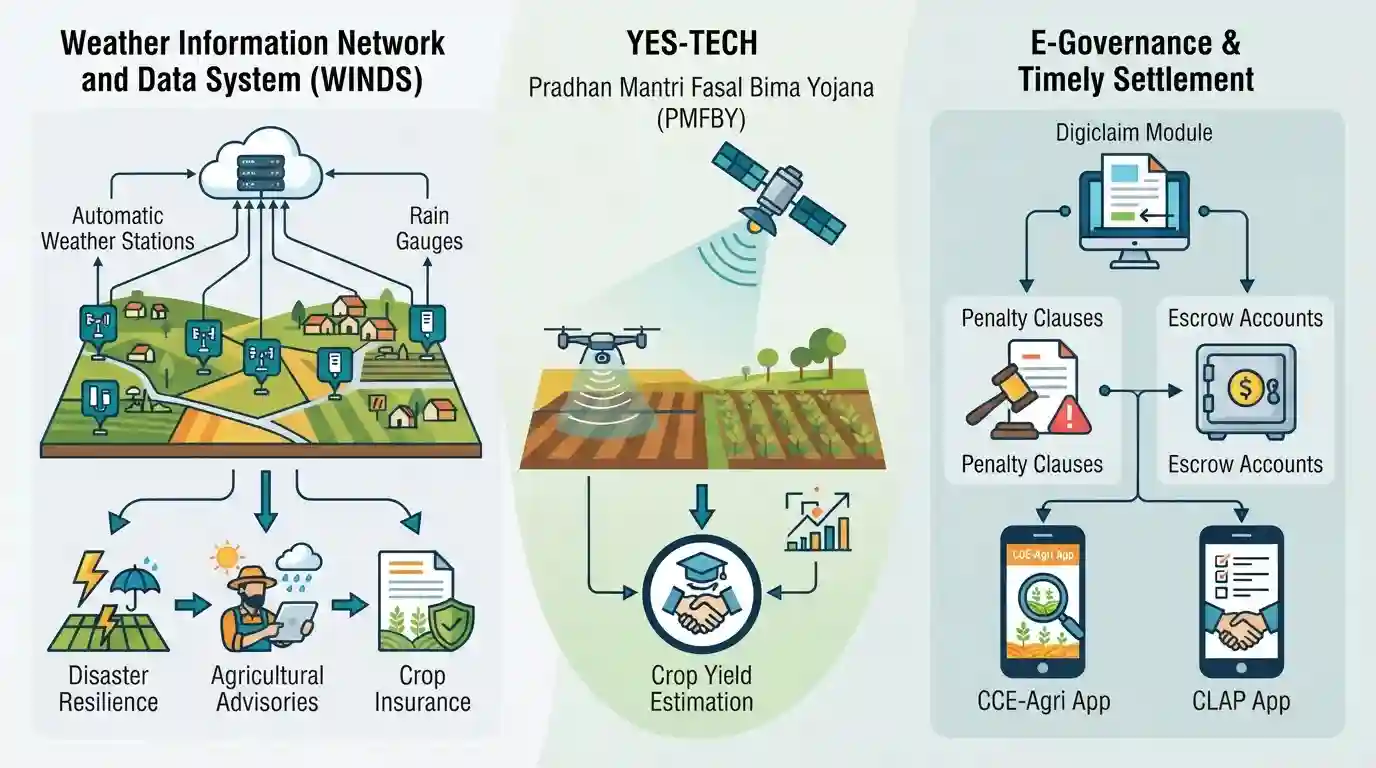
The Government has rolled out the Weather Information Network and Data System (WINDS) to establish a national network of Automatic Weather Stations and Rain Gauges. This initiative provides hyper-local weather data crucial for crop insurance, agricultural advisories, and disaster resilience. Concurrently, under the Pradhan Mantri Fasal Bima Yojana (PMFBY), the Ministry of Agriculture is deploying YES-TECH for remote-sensing-based crop yield estimation. To ensure timely settlement of crop insurance claims, structural reforms such as the Digiclaim module, strict penalty clauses for insurance companies and State Governments, mandatory escrow accounts, and dedicated mobile apps (CCE-Agri, CLAP) have been implemented.
মূল বিষয়
- WINDS initiative establishes a national network of Automatic Weather Stations (AWS) and Rain Gauges (ARGs) to generate hyper-local weather data for agricultural advisory and disaster risk resilience.
- Under PMFBY, the YES-TECH system is transitioning yield estimation from traditional methods to objective, remote-sensing-based techniques, starting with paddy, wheat, and soybean.
- The Digiclaim Module integrates the National Crop Insurance Portal (NCIP) with the Public Financial Management System (PFMS) for automated and direct claim settlements to farmers.
- Strict penalties have been introduced under PMFBY: a 12% penalty on insurance companies for payment delays (from Kharif 2024), and a 12% penalty on State Governments for delaying premium subsidy shares (from Kharif 2025).
- Digital tools like the CCE-Agri App for reporting Crop Cutting Experiments and the Crop Loss Assessment App (CLAP) for localized calamities ensure transparency and real-time data flow.
গুরুত্বপূর্ণ শব্দ
PMFBY

India's flagship crop insurance scheme launched in 2016. It offers comprehensive financial protection to farmers against non-preventable natural risks, from pre-sowing to post-harvest, at low, standardized premium rates of 1.5% to 5%.
UPSC context
GS Paper III: Technology in agriculture and crop insurance mechanisms. Underpins food security and farm-income stabilization.
WINDS
Launched in 2023, the Weather Information Network and Data System is a national initiative to establish over 200,000 automatic weather stations and rain gauges, generating hyper-local weather data for agricultural planning and disaster management.
UPSC context
GS Paper III: Agricultural technology and disaster resilience. Crucial for assessing tech-driven climate adaptation and precision farming.
YES-TECH
Yield Estimation System based on Technology is a remote-sensing-driven initiative under PMFBY. It utilizes satellite imagery and AI to ensure highly accurate, gram-panchayat-level crop yield estimation, eliminating manual assessment delays.
UPSC context
GS Paper III: e-Technology in the aid of farmers. Focuses on tech-driven structural reforms in governance.
National Crop Insurance Portal (NCIP)
A centralized digital platform that serves as the IT backbone for PMFBY. It integrates data from farmers, banks, state governments, and insurers to streamline applications, verify land records, and expedite claims.
UPSC context
GS Paper II & III: E-governance and direct benefit transfers. Tests digitalization of agricultural services.
Digiclaim
An automated claim settlement module integrated into the National Crop Insurance Portal. It links with the Public Financial Management System (PFMS) to disburse crop insurance claims directly and transparently into farmers' bank accounts.
UPSC context
GS Paper II & III: E-governance, digital direct benefit transfers, and welfare schemes. Tests operational reforms in agriculture.
PFMS
The Public Financial Management System is a web-based financial management platform developed by the Controller General of Accounts. It tracks fund flow across government schemes and facilitates direct benefit transfers to beneficiaries.
UPSC context
GS Paper II: Public finance, accountability, and e-governance. Core to understanding efficient fiscal management and welfare delivery.
প্রিলিমস ফাঁদ
Under the WINDS initiative, Automatic Weather Stations are deployed at the Gram Panchayat level and Automatic Rain Gauges at the Block level.
The government deliberately deploys AWS at the larger Block/Tehsil level but places the denser Automatic Rain Gauges (ARG) at the hyper-local Gram Panchayat level. Examiners love swapping these spatial scales.
সংযুক্ত স্থির ধারণা
What are the key structural features and premium rates of PMFBY?
- Premium Rates: Farmers pay a flat premium rate of 2.0% for Kharif, 1.5% for Rabi, and 5.0% for commercial/horticultural crops.
- Subsidy Sharing: The remaining subsidy is split 50:50 between the Center and States, and 90:10 for North Eastern States.
- Voluntary Enrollment: Since the 2020 revamp, participation is entirely voluntary for all farmers, including loanee farmers.
How does remote sensing technology assist in agricultural crop yield estimation?
- Radar (SAR) Utility: Synthetic Aperture Radar (SAR) is critical during monsoon seasons because microwave bands can penetrate persistent cloud cover.
- Optical Vegetation Indices: Normalized Difference Vegetation Index (NDVI) measures chlorophyll absorption to assess crop health, biomass, and greenness.
আন্তঃবিষয় প্যাটার্ন
Agri-Tech + Fiscal Federalism
The 12% interest penalty on State Governments for premium delays highlights how central agricultural insurance depends directly on state fiscal liquidity and escrow discipline.
Remote Sensing + Disaster Mitigation
Using YES-TECH for Kharif crops like paddy and soybean relies on Synthetic Aperture Radar (SAR) to bypass monsoon cloud cover, mapping space technology to ground-level risk.

PMFBY tech-reforms like YES-TECH and WINDS deployment levels are high-probability targets for multi-statement prelims questions by 2026.
সংযুক্ত PYQ · 5
সংযুক্ত PYQ · 5
- 2016MainsGS3
Given the vulnerability of Indian agriculture to vagaries of nature, discuss the need for crop insurance and bring out the salient features of the Pradhan Mantri Fasal Bima Yojana (PMFBY).
- 2023MainsGS3
How does e-Technology help farmers in production and marketing of agricultural produce? Explain it.
- 2016PrelimsGS1
With reference to 'Pradhan Mantri Fasal Bima Yojana', consider the following statements: 1. Under this scheme, farmers will have to pay a uniform premium of two percent for any crop they cultivate in any season of the year. 2. This scheme covers post-harvest losses arising out of cyclones and unseasonal rains. Which of the statements given above is/are correct?
- 2019PrelimsGS1
For the measurement/estimation of which of the following are satellite images/remote sensing data used? 1. Chlorophyll content in the vegetation of a specific location 2. Greenhouse gas emissions from rice paddies of a specific location 3. Land surface temperatures of a specific location Select the correct answer using the code given below.
- 2015PrelimsGS1
In which of the following activities are Indian Remote Sensing (IRS) satellites used? 1. Assessment of crop productivity 2. Locating groundwater resources 3. Mineral exploration 4. Telecommunications 5. Traffic studies Select the correct answer using the code given below.
