Artificial Intelligence Adoption in Indian Agricultural Policy
Source:PIB ↗
কেন এটি গুরুত্বপূর্ণ
This press release provides concrete examples (NPSS, BharatVistaar), user metrics, and current budgetary allocations regarding AI adoption in Indian agriculture. This is directly applicable to GS3 syllabus sub-topics on e-technology for farmers and technology-driven crop and risk management.
সারসংক্ষেপ
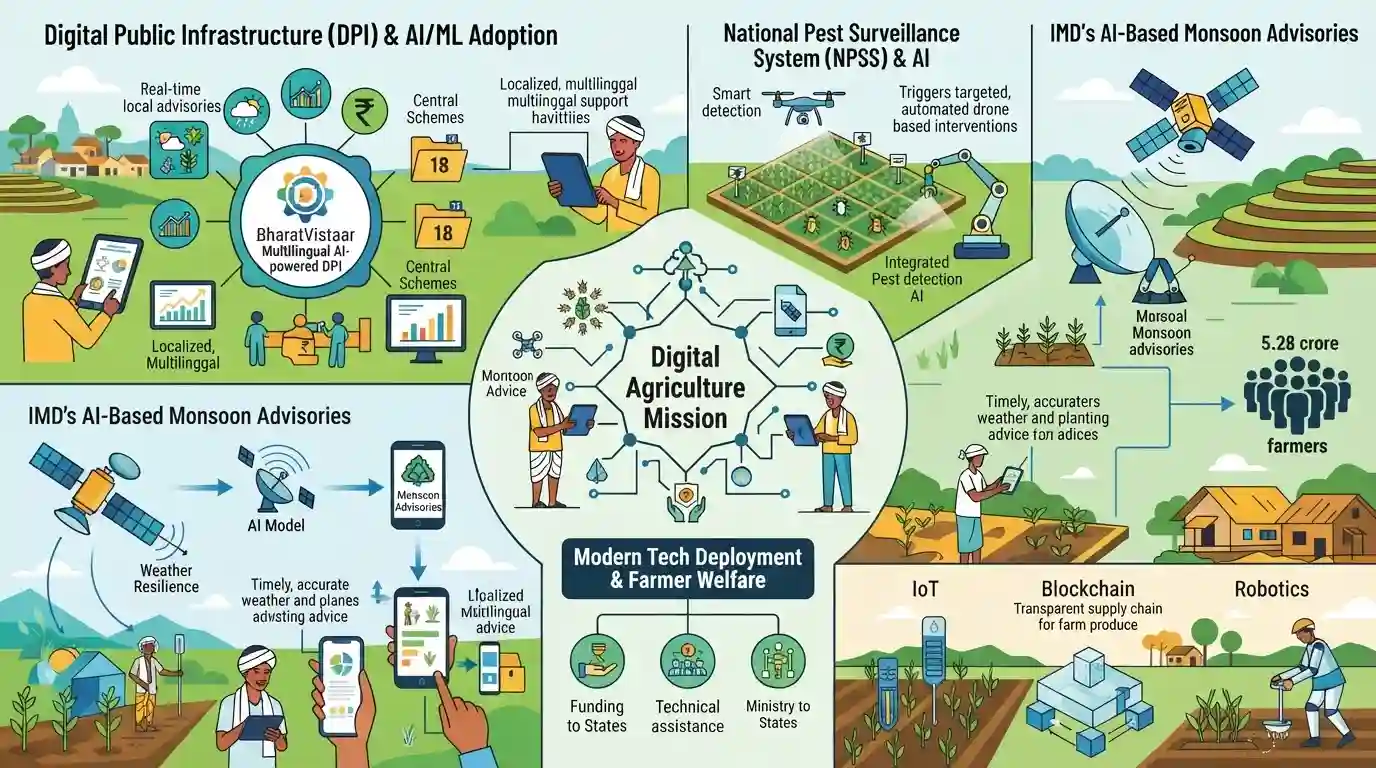
The Union Ministry of Agriculture and Farmers Welfare, in a Rajya Sabha response by Minister of State Shri Ramnath Thakur, detailed the promotion and adoption of Artificial Intelligence (AI) and Machine Learning (ML) in Indian agriculture. Under the Digital Agriculture Mission, the Government is extending funding and technical assistance to States and UTs to deploy modern tech including AI, ML, IoT, Blockchain, and Robotics. Key implementations include the National Pest Surveillance System (NPSS) for smart pest detection, IMD's AI-based monsoon advisories benefiting 5.28 crore farmers, and 'BharatVistaar'—a multilingual AI-powered Digital Public Infrastructure (DPI) providing real-time local advisories, mandi prices, and access to 18 Central schemes to over 3 lakh farmers.
মূল বিষয়
- National Pest Surveillance System (NPSS): An AI/ML-driven platform supporting 73 crops and 436 pests. It enables farmers and over 10,000 extension workers to upload images of pests to receive timely mitigation advice and reduce crop losses.
- AI-based Monsoon and Weather Advisory: Operated by the IMD, this initiative leverages AI/ML to provide location-specific, timely weather forecasts, aiding over 5.28 crore farmers in operational decision-making.
- BharatVistaar: A multilingual, AI-powered Digital Public Infrastructure (DPI) for agriculture that has addressed over 72 lakh queries. It offers real-time agronomic advisories, soil health recommendations, mandi prices, and information on 18 central schemes across web, mobile, chatbot, and telephone interfaces.
- Support for States & Capacity Building: Under the Digital Agriculture Mission, the central government funds and supports States/UTs to adopt emerging technologies (AI, IoT, Blockchain, Robotics) and provides technical assistance tailored for small and marginal farmers.
- Funding Trends: Budgetary allocations for digital and AI-based agricultural initiatives rose significantly, peaking at ₹763.88 Crores (2024-25) and ₹758.56 Crores (2025-26), with ₹502.40 Crores allocated for 2026-27.
গুরুত্বপূর্ণ শব্দ
Digital Agriculture Mission

An umbrella scheme approved in September 2024 to modernize Indian agriculture by establishing Digital Public Infrastructure (AgriStack, Krishi-DSS) and utilizing AI, ML, and digital surveys.
UPSC context
GS Paper III: Technology in aid of farmers; tests understanding of digital governance and modernization in agriculture.
National Pest Surveillance System (NPSS)
An AI and ML-powered digital platform launched in August 2024 to provide farmers with real-time, expert-backed pest diagnosis and scientific control advisories using crop images.
UPSC context
GS Paper III: Crop protection, e-technology; tests knowledge of precision agriculture and technology-led pest management.
BharatVistaar
A multilingual, voice-first AI-powered Digital Public Infrastructure (DPI) launched in early 2026 to provide farmers personalized real-time agricultural advisories, weather updates, and central scheme access.
UPSC context
GS Paper III: E-technology, DPI; tests familiarity with AI applications and multilingual public service systems.
Digital Public Infrastructure (DPI)
A secure, shared, open, and interoperable digital network or framework (like India Stack or AgriStack) that enables the population-scale delivery of public and private services.
UPSC context
GS Paper III: Science and Technology, E-technology; tests understanding of digital transformation and financial/social inclusion.
প্রিলিমস ফাঁদ
BharatVistaar is a centralized, proprietary database managed exclusively by the Union government to store farmer information.
BharatVistaar is built on open-source, federated Beckn protocols (OpenAgriNet) to ensure decentralized interoperability, rather than operating as a closed, centralized government database.
সংযুক্ত স্থির ধারণা
What are the three core pillars of the Digital Agriculture Mission (DAM)?
- AgriStack: Farmer-centric DPI including Aadhaar-linked 'Farmer IDs', geo-referenced village maps, and crop sown registries.
- Krishi-DSS: Geospatial platform integrating satellite, weather, and groundwater data for real-time crop mapping and drought monitoring.
- Soil Fertility Mapping: Comprehensive digital maps detailing soil chemistry and nutrient status to optimize crop selection and fertilizer use.
What is the Beckn Protocol and how does it support decentralized DPIs?
- Open Specification: An open-source transaction protocol enabling machine-to-machine communication without a centralized aggregator.
- Interoperability: Allows disparate platforms (like ONDC, Namma Yatri, and OpenAgriNet) to interoperate seamlessly using a common digital language.
- Decentralized Architecture: Ensures state registries, startups, and banks can connect and trade while retaining control over their independent data stores.
আন্তঃবিষয় প্যাটার্ন
DPI expansion from fintech to agritech
India's successful financial DPI model (UPI, ONDC) is being replicated in agriculture via OpenAgriNet, enabling decentralized, interoperable market and credit access for farmers.
Precision farming as climate adaptation
AI-driven systems like Krishi-DSS and IMD advisories operationalize macro climate data into precise farm-level inputs, representing a shift toward technology-enabled climate adaptation.

Expected 2026 question comparing AgriStack's registry-based framework with Krishi-DSS's remote-sensing capabilities under the DAM.
সংযুক্ত PYQ · 2
সংযুক্ত PYQ · 2
- 2023MainsGS3
How does e-Technology help farmers in production and marketing of agricultural produce? Explain it.
- 2015MainsGS3
How can the 'Digital India' programme help farmers to improve farm productivity and income ? What steps has the Government taken in this regard?
