National Mission for Natural Farming Implementation and Scope
Source:PIB ↗
Why It Matters
Natural farming marks a fundamental policy shift in Indian agriculture, moving away from input-intensive chemical practices towards ecological restoration and cost-effective farming. Understanding its implementation architecture (such as BRCs, Krishi Sakhis, and target scopes) is crucial for both Prelims (agronomic practices and schemes) and Mains GS3 (sustainable agriculture, food security, and climate adaptation).
Summary
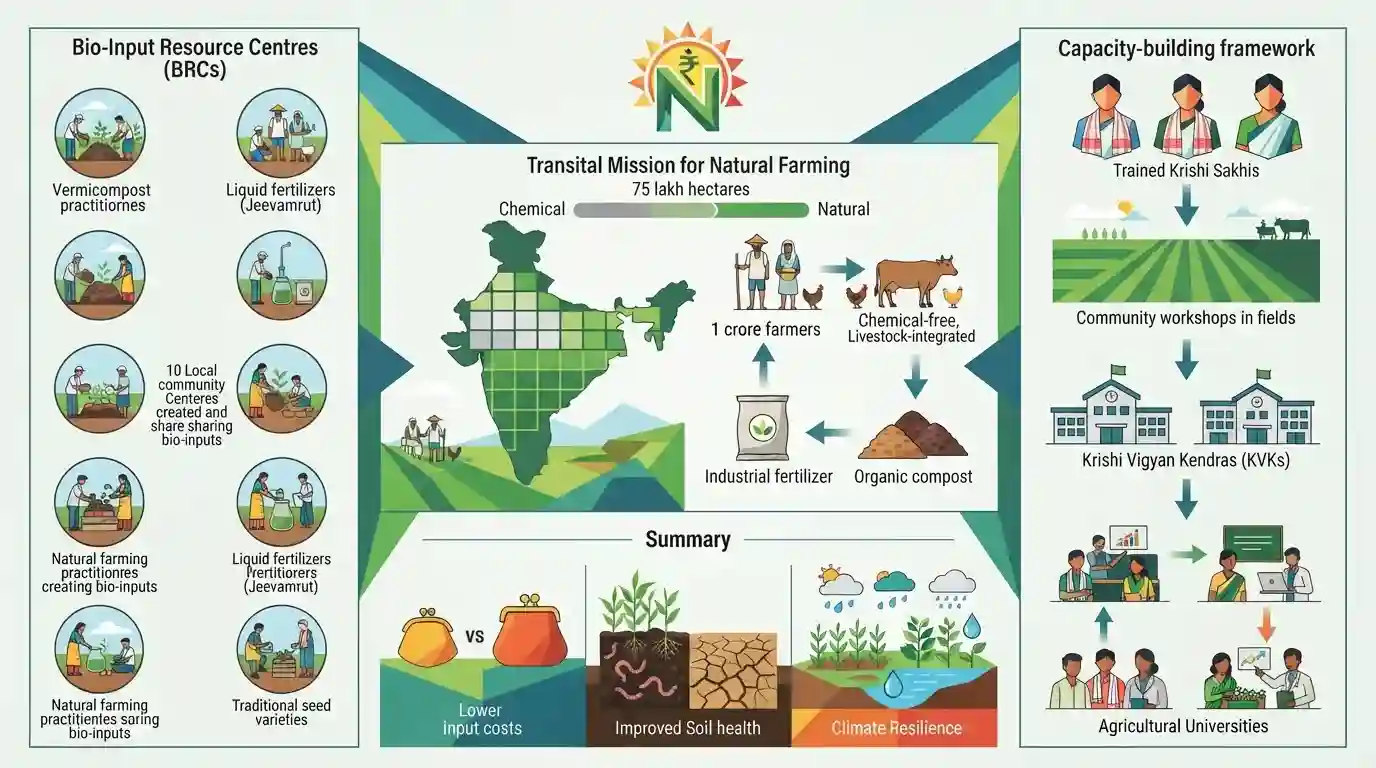
The National Mission for Natural Farming (NMNF), approved as a standalone Centrally Sponsored Scheme with an outlay of Rs. 2,481.19 crore, aims to transition 1 crore farmers and 75 lakh hectares of land to chemical-free, livestock-integrated farming methods. Rooted in traditional Indian knowledge, the mission addresses the adverse ecological impacts of heavy chemical fertilizer usage. Key highlights of its implementation framework include establishing 10,000 Bio-Input Resource Centres (BRCs), deploying 30,000 Krishi Sakhis for community-level training, and coordinating with Krishi Vigyan Kendras (KVKs) and Agricultural Universities to scale up capacity building. This intervention is designed to lower input costs, improve soil health, and foster climate-resilient agriculture across India.
Key Points
- The Union Cabinet approved the National Mission on Natural Farming (NMNF) as a standalone Centrally Sponsored Scheme (CSS) with a financial outlay of Rs. 2,481.19 crore up to the year 2025-26.
- The mission targets scaling up chemical-free, traditional farming to cover 1 crore (10 million) farmers and 75 lakh (7.5 million) hectares of land across India.
- A critical component is the setting up of 10,000 Bio-Input Resource Centres (BRCs) to ensure localized production and easy access to biological formulations like Jeevamrit and Beejamrit.
- Extension support will be bolstered by deploying 30,000 Krishi Sakhis / Community Resource Persons (CRPs) trained under DAY-NRLM to provide peer-to-peer mentoring at the grassroot level.
- The scheme focuses on livestock-integrated farming models to minimize input costs, improve soil health, retain groundwater, and restore local ecosystems, contributing to long-term climate resilience.
Important Terms
National Mission for Natural Farming

A standalone Centrally Sponsored Scheme under the Ministry of Agriculture and Farmers Welfare aiming to transition one crore farmers to chemical-free, livestock-integrated, climate-resilient natural farming.
UPSC context
GS Paper III (Agriculture); tests understanding of sustainable farming, soil health initiatives, and government-led agrarian transformations.
Centrally Sponsored Scheme
A central government development scheme implemented by state governments, where funding is shared between the Centre and States based on a predetermined ratio.
UPSC context
GS Paper II (Federal Structure); tests knowledge of cooperative federalism and fiscal relations in developmental planning.
Participatory Guarantee System-India
A decentralized, peer-reviewed, trust-based organic and natural farming certification system implemented by the Agriculture Ministry as a low-cost quality assurance alternative for small domestic farmers.
UPSC context
GS Paper III (Agriculture); tests knowledge of domestic organic quality standards, peer-verification, and farmer-led certification.
National Programme for Organic Production
An organic certification program managed by APEDA under the Ministry of Commerce, requiring third-party accredited audits, primarily used for the export of Indian organic products.
UPSC context
GS Paper III (Agriculture/Exports); tests knowledge of third-party standards, international trade compliance, and organic export regulation.
DAY-NRLM
A flagship rural poverty alleviation programme empowering poor households, particularly women, through Self-Help Groups (SHGs) by promoting self-employment, skill development, and farm-based enterprises.
UPSC context
GS Paper II (Social Justice/SHGs); tests women-led rural development and grassroots agricultural extension models.
Krishi Vigyan Kendras
District-level agricultural science extension centers established by ICAR to bridge the gap between scientific research and practical application on farmers' fields through training and technology trials.
UPSC context
GS Paper III (Agriculture); tests understanding of institutional mechanisms transferring technology from laboratory to farm level.
Prelims Trap
Natural farming under NMNF permits the use of commercially purchased organic manures and vermicompost, aligning it directly with national organic farming certifications like NPOP.
Natural farming strictly prohibits external, off-farm organic inputs, relying solely on on-farm resources and indigenous livestock-based formulations (Jeevamrit/Beejamrit). Organic farming permits external organic inputs.
Static Concepts Connected
How do Natural Farming and Organic Farming differ under Indian agricultural frameworks?
- On-farm vs. Off-farm: Natural farming strictly uses on-farm, livestock-based inputs, while organic farming permits external, purchased organic manures and bio-fertilizers.
- Soil Interventions: Natural farming discourages deep tilling to maintain soil microclimate, whereas organic farming allows conventional tilling and intensive soil management.
- Regulatory Frameworks: Organic farming targets export markets via NPOP certification, while natural farming focuses on local self-sufficiency and Participatory Guarantee System (PGS-India) certification.
What is the role of Krishi Sakhis in India's agricultural extension system?
- Para-extension workers: They act as peer-to-peer agricultural educators, bridging the critical gap between research labs and actual farm implementation at the village level.
- Inter-ministerial convergence: The program leverages the rural livelihood framework of the Ministry of Rural Development to deliver technical farming training for the Ministry of Agriculture.
Cross-Topic Patterns
Gender-led extension and rural livelihoods
Leveraging SHG networks via Krishi Sakhis bridges the extension gap, empowering women as peer educators while driving decentralized green-economy jobs.
Livestock economy and climate adaptation
Integrating indigenous cattle into farming cycles creates a circular loop that improves water retention, linking dryland husbandry policies to climate-resilient crops.

UPSC 2026 may test the operational differences between Organic and Natural farming techniques alongside NMNF's funding architecture.
Linked PYQs · 3
Linked PYQs · 3
- 2018MainsGS3
Sikkim is the first 'Organic State' in India. What are the ecological and economical benefits of Organic State?
- 2020PrelimsGS1
In the context of India, which of the following is/are considered to be practice(s) of eco-friendly agriculture ? 1. Crop diversification 2. Legume intensification 3. Tensiometer use 4. Vertical farming Select the correct answer using the code given below:
- 2020PrelimsGS1
What is/are the advantage/advantages of zero tillage in agriculture ? 1. Sowing of wheat is possible without burning the residue of previous crop. 2. Without the need for nursery of rice saplings, direct planting of paddy seeds in the wet soil is possible. 3. Carbon sequestration in the soil is possible. Select the correct answer using the code given below:
